
Russian Lieutenant Filmed Ukraine War on Phone, Survived to Tell
Russian lieutenant Yuri Shalayev filmed his Ukraine campaign on a mobile phone. The footage circulates online, sparking debate over its authenticity.
English · Original discussion in Spanish · Published
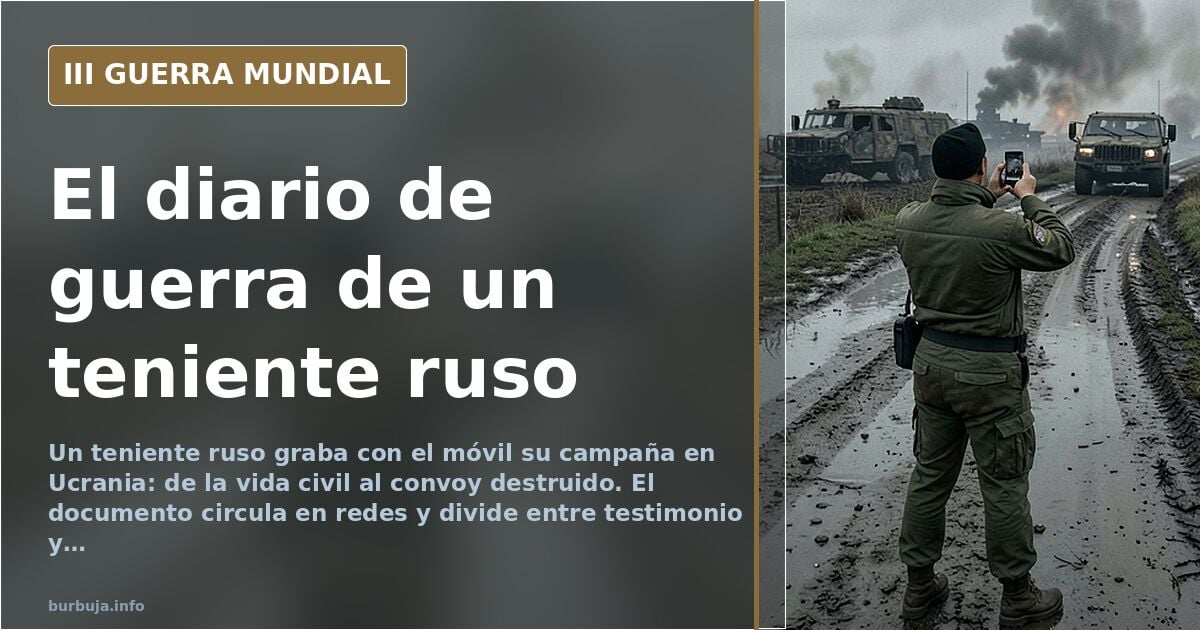
The Russian Lieutenant Who Filmed His Own War on a Mobile
What happens when a motorized infantry officer decides to document his campaign with a smartphone instead of an official war report? The result resembles a survival reality show more than a military operation. The story of Lieutenant Yuri Shalayev, platoon commander in the 42nd Guards Motor Rifle Division, has circulated on Russian social media as a series of videos starting from his civilian life—family scenes, friends, and alcohol issues—and ending with his convoy destroyed and him captured, according to circulating versions.
The material, spread as a Twitter thread, shows a pogre any screenwriter would envy: first normality, then transporting the wounded, trinc by survival on a farm without knowing the date, and finally combat. His armored vehicle's jammed cannon and an invisible enemy complete the picture. Shalayev does not lose his nerve. He keeps filming.
From Civilian Life to the Front Without Knowing the Date
The first part of this amateur documentary shows Shalayev before the war: family, friends, and a complicated relationship with drinking. It is the portrait of an ordinary man, not a propaganda hero. A few days later, things get ugly. His unit transports wounded soldiers—unclear if from another unit—and he continues reporting his location, although he has already lost track of the day.
The unit ends up on a farm, barely surviving, unsure exactly where they are. Shalayev rejoices at having been able to take a bath. This detail humanizes the narrative while highlighting logistical precariousness: an officer who doesn't know where he is or what date it is, but who retains his mobile phone and internet connection.
The Final Battle: Jammed Cannon and Invisible Enemy
The climax arrives when Shalayev's unit engages in combat. His convoy faces Ukrainian forces and suffers heavy casualties. Destroyed Russian vehicles everywhere. His armored vehicle's cannon is jammed, and the enemy is invisible. Despite this, Shalayev remains calm and continues recording. The image recalls pavor movies where the protagonist decides to document everything rather than run away.
The version circulating on Russian networks claims Shalayev was captured alive with his phone, and that Ukrainians edited and published the material. There is no independent confirmation of this. What remains is the document itself: a first-person testimony of the war from the Russian side, with its hardships, chaos, and strange normality.
The Debate: Documentary or Staged Footage?
The discussion generated by the material divides those who see it as valuable testimony and those suspecting manipulation. Some argue Ukrainians took images from the prisoner's phone and edited the documentary. Others point out video details they deem inconsistent: Ukrainian soldiers advancing relaxed through a meadow, weapons resting, one tying his boots. For these critics, anyone who served in an army would maintain safe distance and keep their weapon ready. They conclude it is staged.
Against this suspicion, some recall that videos are edited before publication without implying falsification. The debate over editing intertwines with discussions on veracity. Underlying this is an uncomfortable issue: war is hell, and documents showing it rarely please any side.
Mobile Phones, Logistics, and War Economy
The detail about the mobile phone is not minor. An officer recording and uploading videos needs battery, coverage, and time. The lingering question is how he manages to carry his phone and keep it operational at the front. Some analyses suggest Russians, unable to use secure phones, spoke and gave orders via cellphones, facilitating command localization. This is a hypothesis, not confirmed fact.
The conversation shifts to economics. Some claim the conflict accelerates an energy and raw materials crisis hitting Europe, with rising interest rates, persistent inflation, and recession risk. Dependence on cereals and energy, debt costs, and industrial impact are cited. Conversely, others note Spain imported less than one percent of total petroleum derivatives from Russia and exported less than four percent of its total exports to Russia. Their conclusion: if the war affects so much, those who started it can stop it.
The War Not Seen in Official Reports
Shalayev's document is not propaganda. It is the account of an officer bathing on a farm, losing count of days, and filming while his convoy burns. A soldier's life is always hell, summarizes one comment. It adds: read Junger if you couldn't talk to your ancestors about the civil war. The comparison is apt: the compensations of a soldier who knows he might die—looting, kicking down doors, burning houses—are part of the same package.
In the end, Shalayev's story leaves an uncomfortable question: how many documentaries like this have been recorded but never reached the internet? The answer, like the invisible enemy of his armored vehicle, is not in sight.
Also available in: Deutsch
Summary of a discussion on Burbuja.info - Foro de economía, actualidad y política., translated from Spanish and reviewed before publication. Read the full discussion (69 replies).
More summaries
-
Strike on Novokuybyshevsk refinery puts 8.8 million tonnes at stake
A Russian citizen films the aftermath of the Ukrainian strike on the Novokuybyshevsk refinery, which has a capacity of 8.8 million tonnes of crude per year.
-
Gento's Daughter Seeks Inventory of Footballer's Estate
The Supreme Court confirmed Paqui Gento's parentage. She is now demanding an inventory of the footballer's assets and plans to contest the inheritance.
-
Russian police officer coerces men into army contracts
In Penza, Russia, officer Olesya Adamova allegedly threatened men with arrest unless they signed military contracts, promising rear-guard service.
-
Madrid Divided Over Russian Threat Ahead of NATO Summit
Forum users debate armed Civil Guard presence at Barajas, speculating on a Russian attack versus false flag theories.
-
US Defense Industry Faces Supply Cracks, Washington Post Reports
The Washington Post notes US ammo production of 14,000 155mm shells monthly, a quantity Ukraine exhausts in two days.
-
Girkin warns Russia lacks troops to seize Donbas
Igor Girkin argues Russia lacks the manpower to take the Donbas, calling its air superiority 'quite relative.' The artillery battle remains in flux.