
Spain's Pam links fatphobia to classism, sparking backlash
Pam argues that anti-fat sentiment stems from perceiving overweight people as poor. This controversial stance on obesity and income divides public opinion.
English · Original discussion in Spanish · Published
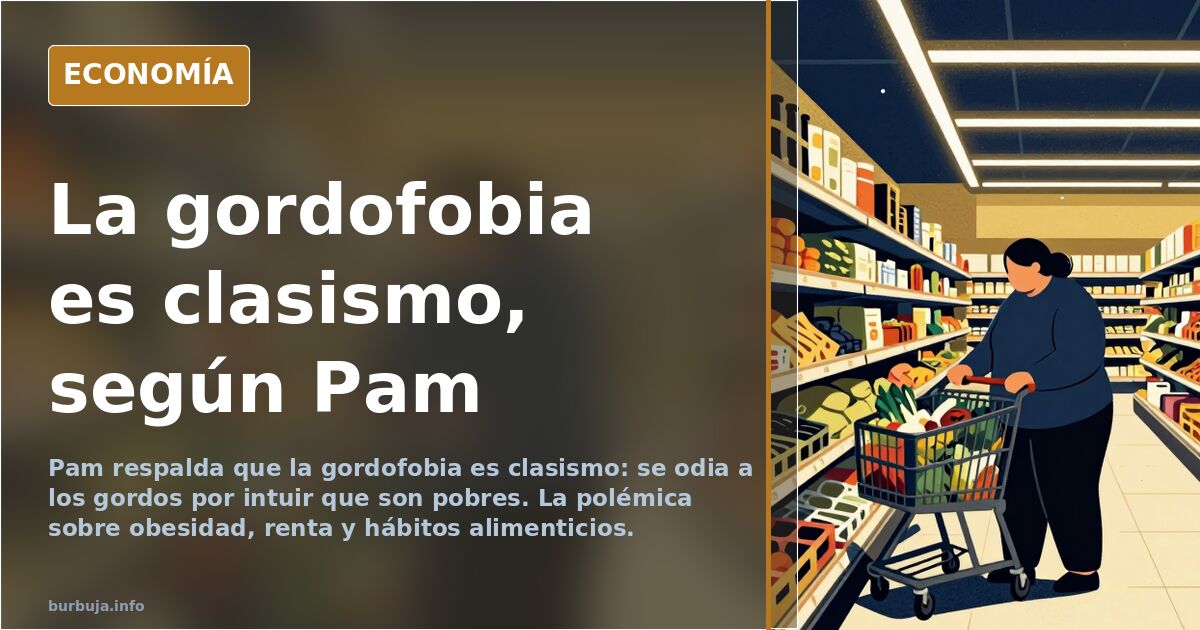
Pam claims hatred of fat people stems from assuming they are poor
Irene Montero’s deputy publicly backed the thesis that aversion to overweight individuals is not about their physique, but a perception of scarce resources. The statement, spread via social media and reported by outlets like Okdiario and La Razón, triggered a storm of reactions. The central argument posits that this rejection is not fatphobia, but classism.
The controversy unfolds in a context where inflation and food prices have strained household budgets. The debate quickly shifted to uncomfortable ground: the link between obesity, income, and consumption habits. Here, opinions diverged sharply.
Origin of the controversy: Solís’ thesis and Pam’s support
It started with a paragraph by Solís that Pam quoted verbatim: “Fat people aren’t hated for being fat, but for being perceived as poor. It’s not fatphobia; it’s called classism.” Irene Montero’s deputy expressed her “absolute support” for this idea, according to cited media. The thesis suggests fatphobia doesn’t exist as physical rejection, but as part of a perceived link between weight and low resources.
Reaction was immediate. Hundreds criticized her for directly linking fatness with poverty, reminding her she earns over 100,000 euros as a senior official. The contradiction—claiming fat people are hated for appearing poor while earning an executive salary—became the core of the criticism.
Historical argument: from opulence symbol to poverty stigma
For centuries, excess weight signified wealth. Having meat daily was a privilege of few. Soviet propaganda in the 20s, 30s, and 40s caricatured capitalists as fat men with slicked hair, smoking cigars and eating roast pork. The fat man was the bourgeois; the thin one, the people.
That logic has inverted. Today, in the West, upper classes are thin, eat well, and exercise. Obesity concentrates in lower-income strata. This shift isn’t anecdotal: it reflects how access to healthy food, cooking time, and nutritional education have become luxury goods.
Is obesity a money problem or a habit problem?
Here consensus breaks. One view holds that eating healthy is expensive: quality meat, fresh fish, fruit, and vegetables cost more than many families can afford. Time is also a factor: healthy cooking requires dedication, which those working twelve hours lack.
Opponents argue one can eat clean and adequately on a small budget. What’s unacceptable, they claim, is eating poorly and excessively. Ultra-processed foods are cheap, yes, but so are rice, legumes, and eggs. The difference lies in education and willpower, not just wallet size.
Available data show a correlation between lower economic/cultural levels and higher obesity rates. But correlation isn’t causation. There are rich fat people and poor thin ones. Yet, the discussion rarely admits nuance.
Political rebuttal: where is rich-phobia?
The most repeated counter-argument against Pam’s thesis is asymmetry. If fatphobia is classism, why isn’t “rich-phobia” denounced? Meaning, if fat people are hated for seeming poor, it admits hating poor people. And if so, why legislate against contempt for the wealthy?
Critics suggest the State Secretariat for Equality invents theses to justify narratives. That their approaches rely on perceptions, not real data. Turning personal complexes into political debate degrades public conversation.
Economic context: inflation and shopping basket
The debate matters when food prices rise sharply. If healthy eating is costly, and inflation hits fresh products hardest, the gap widens between those who can afford balanced diets and those who cannot. In this framework, obesity ceases to be individual choice, becoming a socioeconomic marker.
But the debate gets tangled. If the solution is cheaper healthy food, how? If it’s education, who provides it and with what resources? No one has the complete answer.
What remains unresolved
With these elements, the controversy likely fades without resolution. Pam and Solís’ thesis will continue to be defended by some and ridiculed by others. What won’t change is the uncomfortable fact: obesity and poverty are statistically correlated in Spain. Whether that relationship is cause, effect, or coincidence is another matter. Meanwhile, vegetable prices keep rising.
Irene Montero’s deputy publicly backed the thesis that aversion to overweight individuals is not about their physique, but a perception of scarce resources. The statement, spread via social media and reported by outlets like Okdiario and La Razón, triggered a storm of reactions. The central argument posits that this rejection is not fatphobia, but classism.
The controversy unfolds in a context where inflation and food prices have strained household budgets. The debate quickly shifted to uncomfortable ground: the link between obesity, income, and consumption habits. Here, opinions diverged sharply.
Origin of the controversy: Solís’ thesis and Pam’s support
It started with a paragraph by Solís that Pam quoted verbatim: “Fat people aren’t hated for being fat, but for being perceived as poor. It’s not fatphobia; it’s called classism.” Irene Montero’s deputy expressed her “absolute support” for this idea, according to cited media. The thesis suggests fatphobia doesn’t exist as physical rejection, but as part of a perceived link between weight and low resources.
Reaction was immediate. Hundreds criticized her for directly linking fatness with poverty, reminding her she earns over 100,000 euros as a senior official. The contradiction—claiming fat people are hated for appearing poor while earning an executive salary—became the core of the criticism.
Historical argument: from opulence symbol to poverty stigma
For centuries, excess weight signified wealth. Having meat daily was a privilege of few. Soviet propaganda in the 20s, 30s, and 40s caricatured capitalists as fat men with slicked hair, smoking cigars and eating roast pork. The fat man was the bourgeois; the thin one, the people.
That logic has inverted. Today, in the West, upper classes are thin, eat well, and exercise. Obesity concentrates in lower-income strata. This shift isn’t anecdotal: it reflects how access to healthy food, cooking time, and nutritional education have become luxury goods.
Is obesity a money problem or a habit problem?
Here consensus breaks. One view holds that eating healthy is expensive: quality meat, fresh fish, fruit, and vegetables cost more than many families can afford. Time is also a factor: healthy cooking requires dedication, which those working twelve hours lack.
Opponents argue one can eat clean and adequately on a small budget. What’s unacceptable, they claim, is eating poorly and excessively. Ultra-processed foods are cheap, yes, but so are rice, legumes, and eggs. The difference lies in education and willpower, not just wallet size.
Available data show a correlation between lower economic/cultural levels and higher obesity rates. But correlation isn’t causation. There are rich fat people and poor thin ones. Yet, the discussion rarely admits nuance.
Political rebuttal: where is rich-phobia?
The most repeated counter-argument against Pam’s thesis is asymmetry. If fatphobia is classism, why isn’t “rich-phobia” denounced? Meaning, if fat people are hated for seeming poor, it admits hating poor people. And if so, why legislate against contempt for the wealthy?
Critics suggest the State Secretariat for Equality invents theses to justify narratives. That their approaches rely on perceptions, not real data. Turning personal complexes into political debate degrades public conversation.
Economic context: inflation and shopping basket
The debate matters when food prices rise sharply. If healthy eating is costly, and inflation hits fresh products hardest, the gap widens between those who can afford balanced diets and those who cannot. In this framework, obesity ceases to be individual choice, becoming a socioeconomic marker.
But the debate gets tangled. If the solution is cheaper healthy food, how? If it’s education, who provides it and with what resources? No one has the complete answer.
What remains unresolved
With these elements, the controversy likely fades without resolution. Pam and Solís’ thesis will continue to be defended by some and ridiculed by others. What won’t change is the uncomfortable fact: obesity and poverty are statistically correlated in Spain. Whether that relationship is cause, effect, or coincidence is another matter. Meanwhile, vegetable prices keep rising.
Also available in: Deutsch
Summary of a discussion on Burbuja.info - Foro de economía, actualidad y política., translated from Spanish and reviewed before publication. Read the full discussion (122 replies).
More summaries
-
Spain's Official Gazette Announces End of Equality Secretary Angela Rodriguez 'Pam'
The BOE confirms the dismissal of Angela Rodriguez 'Pam' as Spain's State Secretary for Equality, a role that became a major media platform.
-
Equality Ministry’s Me Toca app costs €211,750 to track household chores
Spain’s Equality Ministry launched Me Toca, a €211,750 app tracking domestic labor to promote shared responsibilities and generate family rankings.
-
Montero's Departure from Equality: 'Sánchez Expels Us from Government'
Irene Montero leaves the Equality Ministry, citing President Sánchez's allies and defending her tenure's work.
-
AI-driven decompilation threatens proprietary software giants
Amateur groups use AI to decompile Adobe suites, cloning commercial apps in days and shaking the software industry.
-
Parents vs. Patrons: The Battle Over Etiquette in Spanish Bars
The issue isn't the child, but the parent who undermines authority: a clash over coexistence on terraces and in restaurants.
-
Ireland is outside Schengen: Key fact reshaping asylum debate
Ireland's non-Schengen status requires passport checks for entry. This legal reality challenges arguments about how asylum seekers arrive in the country.