
Montero's Departure from Equality: 'Sánchez Expels Us from Government'
Irene Montero leaves the Equality Ministry, citing President Sánchez's allies and defending her tenure's work.
English · Original discussion in Spanish · Published
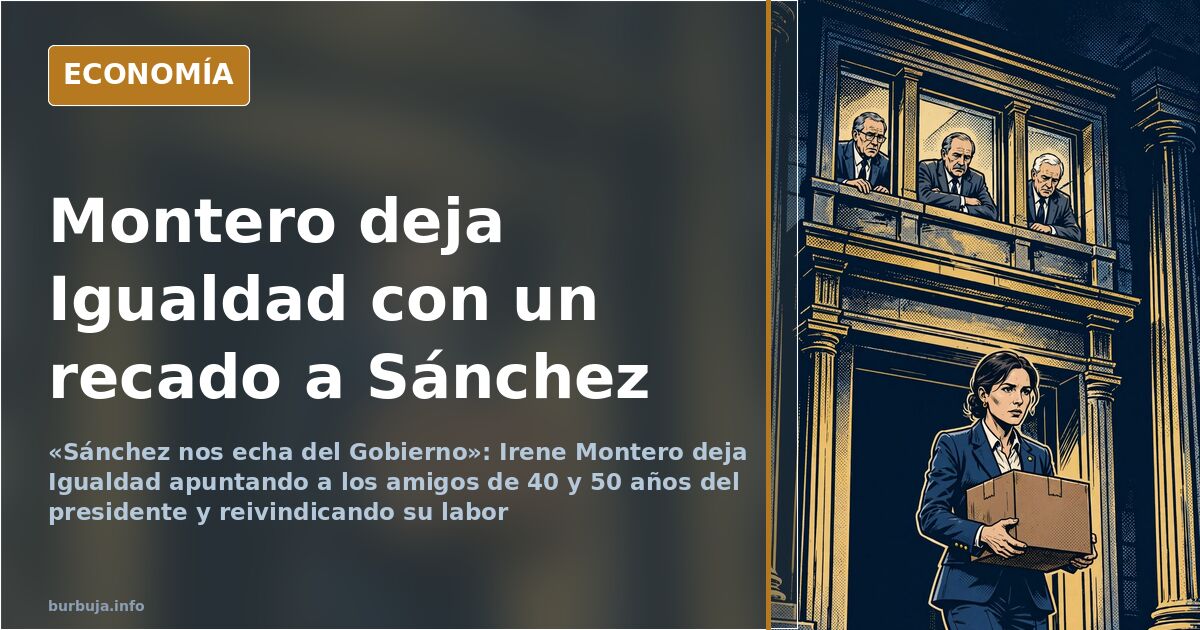
Montero exits Equality, targeting Sánchez's inner circle
The handover of the Equality Ministry turned into a public reckoning. Irene Montero handed the portfolio to Ana Redondo with a statement summarizing her exit: "Today, Pedro Sánchez removes us from the Government for implementing the policies we promised, services for citizens." This was not a ceremonial farewell but a pointed reproach, delivered before outgoing Social Rights Minister Ione Belarra and a successor advised to surround herself with the "best team" and show "courage to upset the president's friends in their 40s and 50s."
Beneath the gesture lies a recognizable context: the coalition's wear and tear, the subsequent correction of the Yes Means Yes Law, and Podemos's reduced influence in the Council of Ministers. On this, the farewell message was silent.
The message to the president's 'friends in their 40s and 50s'
The most resonant phrase of the press conference was this. Montero did not name names, and that is half its effectiveness: the formula allows each person to fill the void with whoever they prefer. Chronicles reporting her words interpreted it as an implicit reference to the president's veteran circle, the group that always appears in internal betting when ministries are distributed. Naming the unnamed is a cheap way to tighten the rope without exposing oneself.
Two readings coexist with the phrase. One interprets it as a settlement of accounts in the final stretch of the legislature. The other, more cynical, sees it as a positioning operation: someone leaving this way is not saying goodbye, they are positioning themselves. Rotational, naturally.
'Do not tell us something is feminist just because there are women'
Montero reasserted feminism as a movement that has transformed Spain and "asks new questions." She left a nuance that discomforts even within her own sphere: "Do not tell us something is feminist just because there are women." The phrase admits a double reading. On one hand, it defends substance over labels. On the other, it distances itself from those who have occupied the space of institutional feminism without passing through its ideological framework.
It is important to separate two things that the farewell mixes purposefully. One is the balance of the legislature at Equality. The other is the narrative the former minister constructs upon leaving: she presents herself as the one leaving for doing what she promised, not as the one leaving for having done it poorly.
The Yes Means Yes Law, the point dominating the balance
No assessment of her time at the ministry avoids the reform that bore her name and which later had to be corrected. It is the wound the opposition exploited for months and the most repeated argument to justify her exit. Some do not hesitate to call it the greatest legislative error of recent democracy; the statement is opinion, debated, and part of the body of cross-reproaches, not any legal conclusion.
Strikingly, Montero did not mention it when saying goodbye. Not an error, not a nuance, not a self-criticism. She left claiming the whole and pointing upward, toward those who sign the dismissals.
What future awaits her outside the ministry?
There is no official confirmation of anything. Her continuation as a deputy is taken for granted in analyses, and from there, all are speculations. The most repeated scenarios are three: an organic position within Podemos, television talk shows, and a return to the private sector. None are confirmed, and the interested party has not detailed her plans.
The detail has its economic humor. A departing minister does not queue for unemployment benefits; the posts they leave are recycled into seats, advisory roles, foundations, or studios. If anything Spanish politics teaches, it is that here, the worker with the fewest rights is, curiously, the one who needs them least.
Internal purging or inevitable adjustment: the two readings of her exit
One current holds that Sánchez used the former minister while she was useful and sacrificed her when she became an obstacle, reconstructing the flank with a less worn titular. The other defends the opposite: that her exit was inevitable, that the coalition demanded it, and that the farewell reproach is noise for internal consumption. Both share an uncomfortable assumption: the decision was not hers.
And a third reading, less emotional: that the exit changes nothing. That institutional feminism will continue in the Official State Gazette with another signature and that the legacy, good or bad, is already written.
Here, the analysis stalls. No one knows if that farewell is the end of a career or the start of something else, nor if Montero leaves damaged or positioned as a reference for the PSOE's left. The only certainty is the one she placed at the podium: he expels her, the very one she helped elevate.]
The handover of the Equality Ministry turned into a public reckoning. Irene Montero handed the portfolio to Ana Redondo with a statement summarizing her exit: "Today, Pedro Sánchez removes us from the Government for implementing the policies we promised, services for citizens." This was not a ceremonial farewell but a pointed reproach, delivered before outgoing Social Rights Minister Ione Belarra and a successor advised to surround herself with the "best team" and show "courage to upset the president's friends in their 40s and 50s."
Beneath the gesture lies a recognizable context: the coalition's wear and tear, the subsequent correction of the Yes Means Yes Law, and Podemos's reduced influence in the Council of Ministers. On this, the farewell message was silent.
The message to the president's 'friends in their 40s and 50s'
The most resonant phrase of the press conference was this. Montero did not name names, and that is half its effectiveness: the formula allows each person to fill the void with whoever they prefer. Chronicles reporting her words interpreted it as an implicit reference to the president's veteran circle, the group that always appears in internal betting when ministries are distributed. Naming the unnamed is a cheap way to tighten the rope without exposing oneself.
Two readings coexist with the phrase. One interprets it as a settlement of accounts in the final stretch of the legislature. The other, more cynical, sees it as a positioning operation: someone leaving this way is not saying goodbye, they are positioning themselves. Rotational, naturally.
'Do not tell us something is feminist just because there are women'
Montero reasserted feminism as a movement that has transformed Spain and "asks new questions." She left a nuance that discomforts even within her own sphere: "Do not tell us something is feminist just because there are women." The phrase admits a double reading. On one hand, it defends substance over labels. On the other, it distances itself from those who have occupied the space of institutional feminism without passing through its ideological framework.
It is important to separate two things that the farewell mixes purposefully. One is the balance of the legislature at Equality. The other is the narrative the former minister constructs upon leaving: she presents herself as the one leaving for doing what she promised, not as the one leaving for having done it poorly.
The Yes Means Yes Law, the point dominating the balance
No assessment of her time at the ministry avoids the reform that bore her name and which later had to be corrected. It is the wound the opposition exploited for months and the most repeated argument to justify her exit. Some do not hesitate to call it the greatest legislative error of recent democracy; the statement is opinion, debated, and part of the body of cross-reproaches, not any legal conclusion.
Strikingly, Montero did not mention it when saying goodbye. Not an error, not a nuance, not a self-criticism. She left claiming the whole and pointing upward, toward those who sign the dismissals.
What future awaits her outside the ministry?
There is no official confirmation of anything. Her continuation as a deputy is taken for granted in analyses, and from there, all are speculations. The most repeated scenarios are three: an organic position within Podemos, television talk shows, and a return to the private sector. None are confirmed, and the interested party has not detailed her plans.
The detail has its economic humor. A departing minister does not queue for unemployment benefits; the posts they leave are recycled into seats, advisory roles, foundations, or studios. If anything Spanish politics teaches, it is that here, the worker with the fewest rights is, curiously, the one who needs them least.
Internal purging or inevitable adjustment: the two readings of her exit
One current holds that Sánchez used the former minister while she was useful and sacrificed her when she became an obstacle, reconstructing the flank with a less worn titular. The other defends the opposite: that her exit was inevitable, that the coalition demanded it, and that the farewell reproach is noise for internal consumption. Both share an uncomfortable assumption: the decision was not hers.
And a third reading, less emotional: that the exit changes nothing. That institutional feminism will continue in the Official State Gazette with another signature and that the legacy, good or bad, is already written.
Here, the analysis stalls. No one knows if that farewell is the end of a career or the start of something else, nor if Montero leaves damaged or positioned as a reference for the PSOE's left. The only certainty is the one she placed at the podium: he expels her, the very one she helped elevate.]
Summary of a discussion on Burbuja.info - Foro de economía, actualidad y política., translated from Spanish and reviewed before publication. Read the full discussion (210 replies).
More summaries
-
Cerezo Slams Montero and Belarra with Epithets: Podemos Walks Out
Patricia Cerezo hurled insults at Montero and Belarra; Pablo Fernández (Podemos) abandoned the set, and the collaborator retracted her comments after the commercial break.
-
Equality Ministry’s Me Toca app costs €211,750 to track household chores
Spain’s Equality Ministry launched Me Toca, a €211,750 app tracking domestic labor to promote shared responsibilities and generate family rankings.
-
Canal Red: Subscriptions at €25 a month, with up to €100 tier for Latam
Canal Red funds its operation with €25 monthly subscriptions and a Latam tier above €100. A model supporting an entire staff.
-
Spain's farmers and haulers join indefinite national strike
Autonomous haulers, SMEs, farmers and fishermen coordinate an indefinite strike starting Saturday the 10th against EU rules.
-
40 years paid, 13 received: Spain's pension debate reignites
The claim that Spaniards pay into pensions for 40 years but collect only 13 reopens the debate on contributory and non-contributory benefits.
-
Indonesia tragedy sparks debate on traveling with kids
A fatal boat accident in Indonesia reignites discussion on the risks of taking young children to destinations with fragile infrastructure.