
Equality Ministry’s Me Toca app costs €211,750 to track household chores
Spain’s Equality Ministry launched Me Toca, a €211,750 app tracking domestic labor to promote shared responsibilities and generate family rankings.
English · Original discussion in Spanish · Published
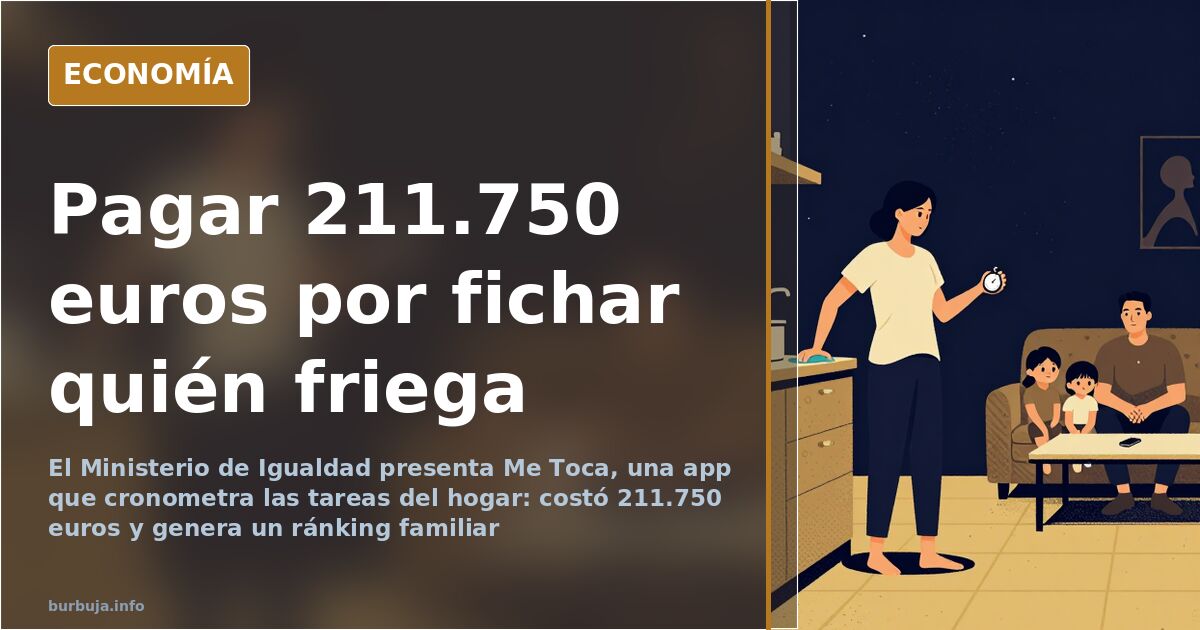
Me Toca: €211,750 to track who washes the dishes
How much does it cost to know who washes the dishes at home? If the Ministry for Equality sets the timer, the answer has six figures: €211,750. This is the contract value signed with tech consultancy Wairbut S.A. to develop the portal and mobile app Me Toca, the tool with which Minister Irene Montero and State Secretary for Equality and Gender Violence, Ángela Rodríguez Pam, aim to measure the division of domestic labor within each household. Both plan to unveil it in the coming days, according to information published by OKDIARIO.
What is Me Toca and what does the contract say
The Ministry promotes it with a slogan: “Tired of always being the one to do the household chores? Download the Me Toca app, create your work team and… let’s share!” The procedure has three steps: download the application, create a team by inviting other household members, and register routine tasks. From there, the app generates graphs showing who spends the most time, what type of tasks each person handles, and the declared level of effort.
The contract was signed with Wairbut S.A. for €211,750 under a concept that sounds like a file: “IT services necessary for the development of a Ministry for Equality portal and a mobile application for recording domestic and care tasks in cohabitation units.” According to app portals, the Ministry for Equality is listed directly as the developer. There is no visible external supplier for the user.
Twenty tasks, three levels of effort, and a family ranking
The app requires choosing between twenty categories: companionship and teaching, clothing repair, attending meetings, emotional care, changing house clothes, buying food, pet care and walking, supervision, adult care, home equipment, washing dishes, household management, doing laundry, gardening, ironing, planning activities and meals, setting and clearing the table, tidying and organizing, home repairs, and administrative tasks.
Whenever one is completed, the add button is pressed, the level of effort (1, 2, or 3) and duration are selected, in multiples of five minutes with a maximum of eight hours. Then everything is summed up and a ranking is generated showing who collaborates more and who less. Registration requires a name or alias, age, and gender: female, male, or non-binary. The aesthetics, according to screenshots, recall Tetris.
Why is there domestic work that doesn’t fit in the app?
Because the list is neither exhaustive nor objective. Among the activities that do not appear are taking out the trash, taking the car for inspection, plumbing, painting, paperwork, and tax returns. Some add that part of this work consumes time but also organization, and that effort depends on who measures it: there are tasks one person considers essential while another does not see them as necessary.
One case summarizes the problem. One person reported working away for ten days and returning to find five perfectly aligned bags of trash waiting at home to be taken to the bin. The task was assigned, yes. Executed, no.
How much does it cost to develop an app like this?
Here begins the second front. The €211,750 is compared with a development that, critics argue, should not exceed a final-cycle project: a task list with four graphs and a small database. The technology used—Flutter—is pointed to as proof that the real cost would have been much lower. The comparison with Radar Elbichito, the pandemic contact tracing app, appears in the debate.
Another stream pulls out the calculator and distributes the money: if the technical development cost a fraction, the rest would have gone to intermediaries. It is an unverified calculation, but it circulates with the same fluency as the official figure. And behind it, the recurring argument of opportunity cost: this expenditure will not go to pensions, hospitals, or roads.
From a summit in Geneva to leaked screenshots
Rodríguez Pam already hinted in May that Equality was working on this project. She did so at a summit in Geneva, giving few details and with two underlying ideas: that household chores fall mostly on women and that the app should replicate what apps for splitting travel expenses among friends already do. From that intention to the screenshots with prices and task lists is a leap that summarizes the evolution of the matter well.
Shared responsibility or intrusion into private life?
Registration is not mandatory: the app must be downloaded by personal decision and the family team is formed by invitations. The problem is not coercion, but direction. One part of the analysis sees in the tool a reasonable way to make visible the domestic labor that no one accounts for; another reads in it a step toward the guardianship of private life and warns that what is optional today may end up being required.
The underlying approach is also discussed. The most repeated idea: meeting a household’s basic needs is not a job, because no one pays to keep anyone alive. Measuring it in minutes turns cohabitation into an spreadsheet with winners and losers. Some even joke that the invention will multiply separations.
The app promises domestic harmony for €211,750 and a family ranking in between. Washing the dishes yourself still comes for free.
How much does it cost to know who washes the dishes at home? If the Ministry for Equality sets the timer, the answer has six figures: €211,750. This is the contract value signed with tech consultancy Wairbut S.A. to develop the portal and mobile app Me Toca, the tool with which Minister Irene Montero and State Secretary for Equality and Gender Violence, Ángela Rodríguez Pam, aim to measure the division of domestic labor within each household. Both plan to unveil it in the coming days, according to information published by OKDIARIO.
What is Me Toca and what does the contract say
The Ministry promotes it with a slogan: “Tired of always being the one to do the household chores? Download the Me Toca app, create your work team and… let’s share!” The procedure has three steps: download the application, create a team by inviting other household members, and register routine tasks. From there, the app generates graphs showing who spends the most time, what type of tasks each person handles, and the declared level of effort.
The contract was signed with Wairbut S.A. for €211,750 under a concept that sounds like a file: “IT services necessary for the development of a Ministry for Equality portal and a mobile application for recording domestic and care tasks in cohabitation units.” According to app portals, the Ministry for Equality is listed directly as the developer. There is no visible external supplier for the user.
Twenty tasks, three levels of effort, and a family ranking
The app requires choosing between twenty categories: companionship and teaching, clothing repair, attending meetings, emotional care, changing house clothes, buying food, pet care and walking, supervision, adult care, home equipment, washing dishes, household management, doing laundry, gardening, ironing, planning activities and meals, setting and clearing the table, tidying and organizing, home repairs, and administrative tasks.
Whenever one is completed, the add button is pressed, the level of effort (1, 2, or 3) and duration are selected, in multiples of five minutes with a maximum of eight hours. Then everything is summed up and a ranking is generated showing who collaborates more and who less. Registration requires a name or alias, age, and gender: female, male, or non-binary. The aesthetics, according to screenshots, recall Tetris.
Why is there domestic work that doesn’t fit in the app?
Because the list is neither exhaustive nor objective. Among the activities that do not appear are taking out the trash, taking the car for inspection, plumbing, painting, paperwork, and tax returns. Some add that part of this work consumes time but also organization, and that effort depends on who measures it: there are tasks one person considers essential while another does not see them as necessary.
One case summarizes the problem. One person reported working away for ten days and returning to find five perfectly aligned bags of trash waiting at home to be taken to the bin. The task was assigned, yes. Executed, no.
How much does it cost to develop an app like this?
Here begins the second front. The €211,750 is compared with a development that, critics argue, should not exceed a final-cycle project: a task list with four graphs and a small database. The technology used—Flutter—is pointed to as proof that the real cost would have been much lower. The comparison with Radar Elbichito, the pandemic contact tracing app, appears in the debate.
Another stream pulls out the calculator and distributes the money: if the technical development cost a fraction, the rest would have gone to intermediaries. It is an unverified calculation, but it circulates with the same fluency as the official figure. And behind it, the recurring argument of opportunity cost: this expenditure will not go to pensions, hospitals, or roads.
From a summit in Geneva to leaked screenshots
Rodríguez Pam already hinted in May that Equality was working on this project. She did so at a summit in Geneva, giving few details and with two underlying ideas: that household chores fall mostly on women and that the app should replicate what apps for splitting travel expenses among friends already do. From that intention to the screenshots with prices and task lists is a leap that summarizes the evolution of the matter well.
Shared responsibility or intrusion into private life?
Registration is not mandatory: the app must be downloaded by personal decision and the family team is formed by invitations. The problem is not coercion, but direction. One part of the analysis sees in the tool a reasonable way to make visible the domestic labor that no one accounts for; another reads in it a step toward the guardianship of private life and warns that what is optional today may end up being required.
The underlying approach is also discussed. The most repeated idea: meeting a household’s basic needs is not a job, because no one pays to keep anyone alive. Measuring it in minutes turns cohabitation into an spreadsheet with winners and losers. Some even joke that the invention will multiply separations.
The app promises domestic harmony for €211,750 and a family ranking in between. Washing the dishes yourself still comes for free.
Summary of a discussion on Burbuja.info - Foro de economía, actualidad y política., translated from Spanish and reviewed before publication. Read the full discussion (283 replies).
More summaries
-
Irene Montero’s Tarot Habits Spark Debate on Spain’s Equality Ministry
Equality Minister Irene Montero’s reported reliance on horoscopes and tarot raises questions about esoteric influences on public policy and institutional credibility.
-
Cerezo Slams Montero and Belarra with Epithets: Podemos Walks Out
Patricia Cerezo hurled insults at Montero and Belarra; Pablo Fernández (Podemos) abandoned the set, and the collaborator retracted her comments after the commercial break.
-
Irene Montero promises €1,800 minimum wage and 30 working hours per week
Irene Montero promises €1,800 minimum wage and 30 hours per week by 2027: the payroll linked to the minimum wage has multiplied by 28 since 2000.
-
Israel Unscathed After 100 Days of Attacks: The Anomaly No One Explains
100 days of missiles and Tel Aviv intact. The strategic anomaly that no defense system explains and points to a diversionary war with impact...
-
Poland's Nobel winner calls ethnic uniformity terrifying
Nobel laureate Olga Tokarczuk sparks debate on immigration and birth rates, labeling Poland's homogeneity frightening.
-
Ayuso compares Ceuta crisis to 2.5 million migrants in Madrid
Ayuso suggests imagining 2.5 million illegal entrants in Madrid to grasp the Ceuta crisis, highlighting silent demographic shifts.