
Ireland is outside Schengen: Key fact reshaping asylum debate
Ireland's non-Schengen status requires passport checks for entry. This legal reality challenges arguments about how asylum seekers arrive in the country.
English · Original discussion in Spanish · Published
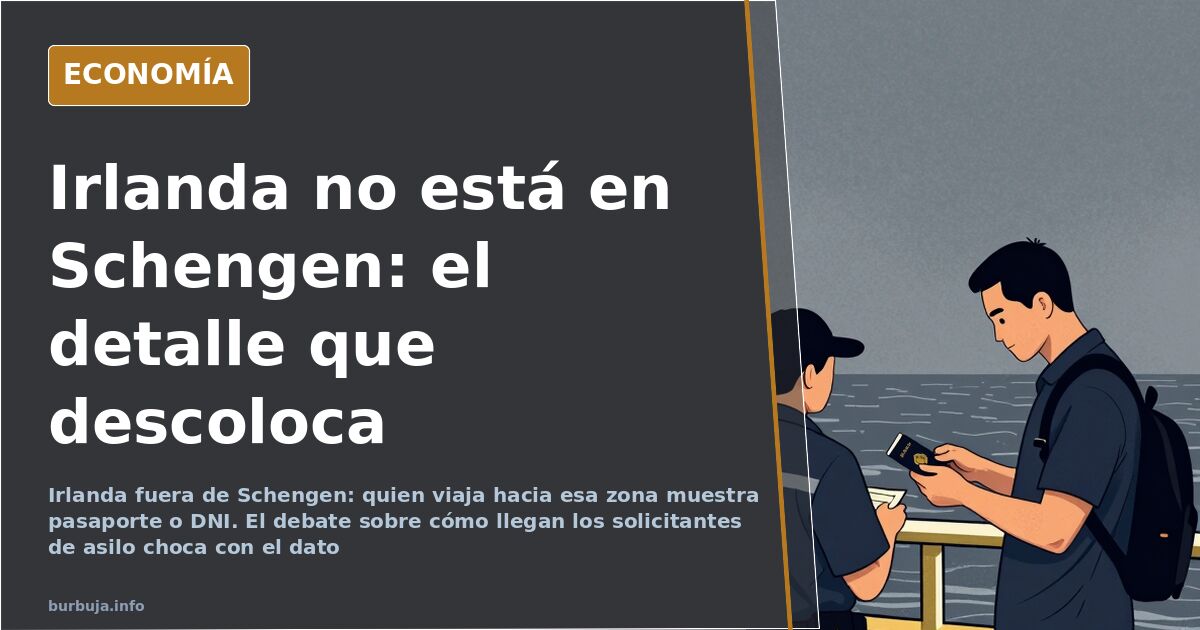
Ireland is outside Schengen: The key fact reshaping this debate
In Ireland, some neighbors protesting the resettlement of asylum seekers have raised three uncomfortable questions: where are the women and children, can one remain a refugee after crossing thirteen borders, and how is it possible to enter the country without a passport? The third question has an administrative answer. The other two allow for different interpretations but no conclusive proof. And the detail that upends the entire discussion is legal and geographic: Ireland is not part of the Schengen area, which completely changes the way people enter and leave the island.
Why ask if you can enter Ireland without a passport?
Official Irish information explains it directly: anyone traveling from Ireland to the Schengen zone undergoes immigration control and must show a passport or national identity document. If the island maintains its own border regime, access is not simply an open door. A nuance often overlooked is added: Irish citizens do not have a standard national ID card, so, as noted in the debate, their valid identification is the passport. Hence, the question about entering without it clashes with the very rules of the country posing it.
Some point to a second layer of the issue, less legal and more fundamental: the suspicion that the itinerary and lack of documentation prove the motive is not persecution. Against this weighs a simple argument: those truly fleeing rarely carry their paperwork in order. The debate hinges there, not on verifiable facts.
Where are the women and children among those arriving?
This is the question without an administrative answer. The profile of arrivals is predominantly male and of working age, according to several contributions collected, a pattern that part of the analysis interprets as a sign that the motive is economic rather than humanitarian. The image of a refugee carrying a family does not fit, they say, with what is seen arriving.
The opposing view holds that this imbalance is expected in any migration flow: first go those who can afford it and withstand it, and family reunification comes later. "The strongest come, the weakest stay behind," summarizes one contribution, drawing the opposite conclusion: if the most vulnerable do not stay there, then no one is in danger there. The same observation serves both theses.
In the forum, this composition is used to doubt the status of those arriving, without the count resolving the disagreement.
Crossing thirteen borders and still calling oneself a refugee
The second question also does not admit data to settle it. It is debated whether crossing a dozen countries, several of them safe, contradicts the status of someone seeking protection; whether the itinerary proves there was no persecution, or if it only proves that the person fleeing seeks a destination offering something concrete. The number of borders crossed is cited as evidence and also as an anecdote, and depending on who uses it, its meaning changes: some speak of thirteen and others raise it to fourteen to highlight the contrast with the freedom of movement of European travelers, who do need documentation.
At its core, the dispute is about criteria: whether being persecuted at origin is enough to deserve protection, or whether the journey matters as much as the motive. Neither side of the debate has yet found a number that resolves the issue.
The political response: vote, protest, or neither
A third axis runs through the conversation and has nothing to do with passports. Some argue that protest is a minority activity, that it does not keep the majority of voters awake, and that when it affects them closely, they complain without voting for those promising to curb the flow. Abstention thus appears as the true culprit for what is criticized later.
On the other hand, it is argued that voting is a waste of time, that electoral promises on migration control are never fulfilled, and that the street is the only path. The exchange of accusations — between not voting and believing in the ballot box — ends up leaving the original issue in the background, which is precisely the opposite of what the instigator of the controversy intended.
Other fronts: Kragujevac, Cuba, and residency accounts
The discussion does not stop at Ireland. A protest in Kragujevac, Serbia, is cited, with neighbors touring immigrant homes to make clear what they consider their norms. Also described, as direct experience, is the case of those seeking asylum in the United States who return to Cuba for vacation after some time, with people organizing themselves to not lose residency by alternating six months and a day in the US and six months minus a day in Cuba. These are portraits of a common tension in several countries, not of a local episode.
With these elements, the question about the passport will continue to have a better answer than the other two. The profile of those arriving and the itinerary they trinc are not resolved with one piece of data, and perhaps not even with ten. Those expecting a figure that closes the matter should not hold their breath: in these debates, the missing data usually arrives last, and almost never brought by those who asked for it.
In Ireland, some neighbors protesting the resettlement of asylum seekers have raised three uncomfortable questions: where are the women and children, can one remain a refugee after crossing thirteen borders, and how is it possible to enter the country without a passport? The third question has an administrative answer. The other two allow for different interpretations but no conclusive proof. And the detail that upends the entire discussion is legal and geographic: Ireland is not part of the Schengen area, which completely changes the way people enter and leave the island.
Why ask if you can enter Ireland without a passport?
Official Irish information explains it directly: anyone traveling from Ireland to the Schengen zone undergoes immigration control and must show a passport or national identity document. If the island maintains its own border regime, access is not simply an open door. A nuance often overlooked is added: Irish citizens do not have a standard national ID card, so, as noted in the debate, their valid identification is the passport. Hence, the question about entering without it clashes with the very rules of the country posing it.
Some point to a second layer of the issue, less legal and more fundamental: the suspicion that the itinerary and lack of documentation prove the motive is not persecution. Against this weighs a simple argument: those truly fleeing rarely carry their paperwork in order. The debate hinges there, not on verifiable facts.
Where are the women and children among those arriving?
This is the question without an administrative answer. The profile of arrivals is predominantly male and of working age, according to several contributions collected, a pattern that part of the analysis interprets as a sign that the motive is economic rather than humanitarian. The image of a refugee carrying a family does not fit, they say, with what is seen arriving.
The opposing view holds that this imbalance is expected in any migration flow: first go those who can afford it and withstand it, and family reunification comes later. "The strongest come, the weakest stay behind," summarizes one contribution, drawing the opposite conclusion: if the most vulnerable do not stay there, then no one is in danger there. The same observation serves both theses.
In the forum, this composition is used to doubt the status of those arriving, without the count resolving the disagreement.
Crossing thirteen borders and still calling oneself a refugee
The second question also does not admit data to settle it. It is debated whether crossing a dozen countries, several of them safe, contradicts the status of someone seeking protection; whether the itinerary proves there was no persecution, or if it only proves that the person fleeing seeks a destination offering something concrete. The number of borders crossed is cited as evidence and also as an anecdote, and depending on who uses it, its meaning changes: some speak of thirteen and others raise it to fourteen to highlight the contrast with the freedom of movement of European travelers, who do need documentation.
At its core, the dispute is about criteria: whether being persecuted at origin is enough to deserve protection, or whether the journey matters as much as the motive. Neither side of the debate has yet found a number that resolves the issue.
The political response: vote, protest, or neither
A third axis runs through the conversation and has nothing to do with passports. Some argue that protest is a minority activity, that it does not keep the majority of voters awake, and that when it affects them closely, they complain without voting for those promising to curb the flow. Abstention thus appears as the true culprit for what is criticized later.
On the other hand, it is argued that voting is a waste of time, that electoral promises on migration control are never fulfilled, and that the street is the only path. The exchange of accusations — between not voting and believing in the ballot box — ends up leaving the original issue in the background, which is precisely the opposite of what the instigator of the controversy intended.
Other fronts: Kragujevac, Cuba, and residency accounts
The discussion does not stop at Ireland. A protest in Kragujevac, Serbia, is cited, with neighbors touring immigrant homes to make clear what they consider their norms. Also described, as direct experience, is the case of those seeking asylum in the United States who return to Cuba for vacation after some time, with people organizing themselves to not lose residency by alternating six months and a day in the US and six months minus a day in Cuba. These are portraits of a common tension in several countries, not of a local episode.
With these elements, the question about the passport will continue to have a better answer than the other two. The profile of those arriving and the itinerary they trinc are not resolved with one piece of data, and perhaps not even with ten. Those expecting a figure that closes the matter should not hold their breath: in these debates, the missing data usually arrives last, and almost never brought by those who asked for it.
Also available in: Deutsch
Summary of a discussion on Burbuja.info - Foro de economía, actualidad y política., translated from Spanish and reviewed before publication. Read the full discussion (107 replies).
More summaries
-
Gibraltar Joins Schengen: Goodbye to Border Fence, Same VAT
Spain and UK agree to include Gibraltar in Schengen, equalize VAT and tariffs, and demolish the border fence. Who benefits from the pact remains open.
-
Ignacio Lázaro: 'Maricarmen paid €154 rent while we paid €750'
Ignacio Lázaro, grandson of the original owner, reveals the other side of the Maricarmen case: 'We subsidized her for years and now, with our taxes.'
-
Serious Injury in Warner Park's Batman Ride Incident
A 49-year-old man was seriously injured on the Batman Gotham City Escape coaster at Parque Warner Madrid. Conflicting accounts and no official explanation yet.
-
Ganges Swimming Risks: Ignoring Fecal Water Costs
Swimming in the Ganges ends in vomiting: 70% of the water is waste. The cost of a dip without precautions.
-
Titanic Submersible Implosion: Four Safe Dives Preceded Disaster
At $250,000 per seat, the submersible featured a porthole rated for only 1,300 meters and carbon fiber construction before imploding at 4,000 meters.
-
Why heavy rain isn't filling Spain's reservoirs
Despite torrential rains, Spanish reservoir levels remain low amid debates over deforestation, evaporation, and hidden water transfers.