
Spain's most common wage drops €4,000, near minimum
The most frequent salary in Spain has fallen nearly €4,000 to €14,586 annually, approaching the SMI (minimum wage) as the pay scale compresses.
English · Original discussion in Spanish · Published
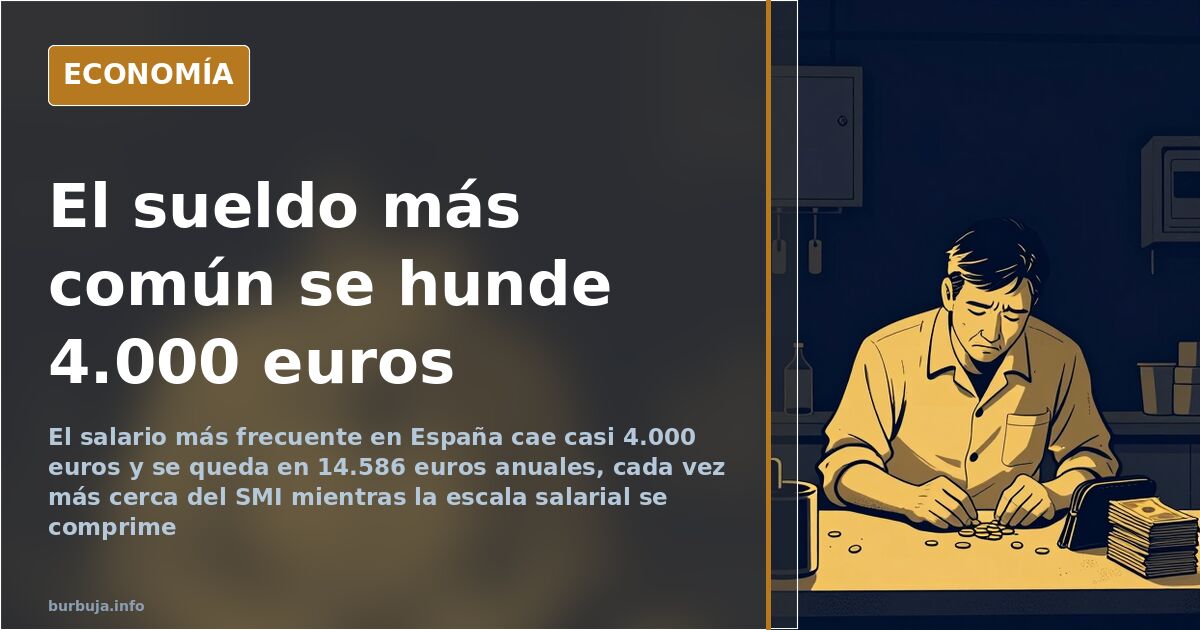
Most common salary in Spain falls by nearly €4,000
A single figure best summarizes the situation in the Spanish labor market: the most frequent wage has dropped almost €4,000, settling at €14,586 per year. This is not the average salary, which is skewed upward by a few high earners. It is the wage received by the majority. And that wage, which defines the real lives of millions of workers, has been falling until it dangerously approaches the SMI (Salario Mínimo Interprofesional). The result is a scissors effect openly discussed today: as the minimum wage rises, it absorbs those who previously earned slightly more, compressing the pay scale until nearly everyone earns the same.
The minimum wage eating into higher salaries
The thesis running through economic analysis is uncomfortable: each increase in the minimum wage does not lift the entire scale but drags it down. The SMI paid to entry-level workers has approached what experienced staff earn, and companies have seen this minimum as "decent" enough to hire near that amount. Consequently, the gap between the lowest tier and qualified, experienced workers in their payslips is shrinking.
The most repeated example is the technician earning barely more than the SMI for a responsible role. A control body engineer working excessive hours for a salary close to the minimum. A senior validation technician offered just over €27,000 gross annually. The difference between the cleaner and the report signer has become absurdly narrow.
Education no longer pays off
The opportunity cost of studying has skyrocketed. Four or five years of university, working intensely without pay or even paying fees, only to end up with poor jobs and constant stress, when one could finish secondary school (ESO), become an orderly, and work daily with less pressure for a similar salary. Many are no longer asking if it is worth it, but why bother.
Some argue university only makes sense as a step toward civil service exams (oposición A1), spending minimal effort on the degree and reserving energy for the master's/exam prep. Others note that those entering the job market after the 2008 crisis, despite years of university, faced unemployment while those without high school diplomas worked and accessed housing. In many cases, the opportunity cost is brutal.
Why is the gap between SMI and average wage shrinking?
Because total payroll grows little except for those at the SMI level. Reasons vary by company, but the aggregate effect is identical: raising the minimum does not drag the rest of the scale up. When social benefits approach the SMI, another phenomenon appears: people question whether working is worthwhile. In countries where benefits are not far from the minimum wage, this doubt is already real.
The scenario emerging is impoverishment through shared misery. It is not that everyone earns less, but that the distance between minimum wage earners and those earning slightly more vanishes. With it goes the motivation to train, promote, or take responsibility.
Spain loses its wage ladder
The recurring diagnosis is a labor market approaching de facto socialism: according to some participants, no one truly works and everyone earns poverty wages, while wealth concentrates at the top. Very rich and very poor, with a blurring middle class. Governments of this nature achieve this scenario, it is argued, because they serve power's interests.
The practical consequence is that cleaners stay in Spain, engineers emigrate, productivity plummets, and then observatories are requested to understand what peine. Raising the SMI would be good news if it lifted all other wages. Without that, competitiveness clouds gather. And the unsettling data point is this: the most frequent wage, earned by the majority, is now €14,586 per year.
Also available in: Deutsch
Summary of a discussion on Burbuja.info - Foro de economía, actualidad y política., translated from Spanish and reviewed before publication. Read the full discussion (119 replies).
More summaries
-
Debt and Diesel: The Hypothesis of Early Elections
Public debt, the end of Next Generation funds, and the ghost of fuel rationing: why early elections are being discussed in Spain.
-
Spain's 2025 Minimum Wage: Nearly €1,400 Monthly with 37.5-Hour Week
Spain's minimum wage rises to €1,375–€1,389 in 12 payments and reduces the workweek to 37.5 hours starting January 2025.
-
Spain's Public Sector and Pensioners Prop Up Sánchez
Pension hikes and public sector growth sustain PSOE support in Spain, despite private sector discontent.
-
Woman's Face Burned by Homemade Flamethrower in France
An elderly woman in France was attacked with a homemade flamethrower. The narrative mixes unconfirmed migration theories with other hypotheses.
-
The 'charo certificate': using men and leaving them behind
The 'charo certificate' popularizes the theory of using men and leaving them behind: who wins and who ends up used in the dating market
-
Renting in Spain yields 3%: why rental listings keep shrinking
An analysis argues that average rental yields in Spain are 3%, below inflation. With 400,000 fewer flats on the market since 2018, the business of being…