
Spain's Public Sector and Pensioners Prop Up Sánchez
Pension hikes and public sector growth sustain PSOE support in Spain, despite private sector discontent.
English · Original discussion in Spanish · Published
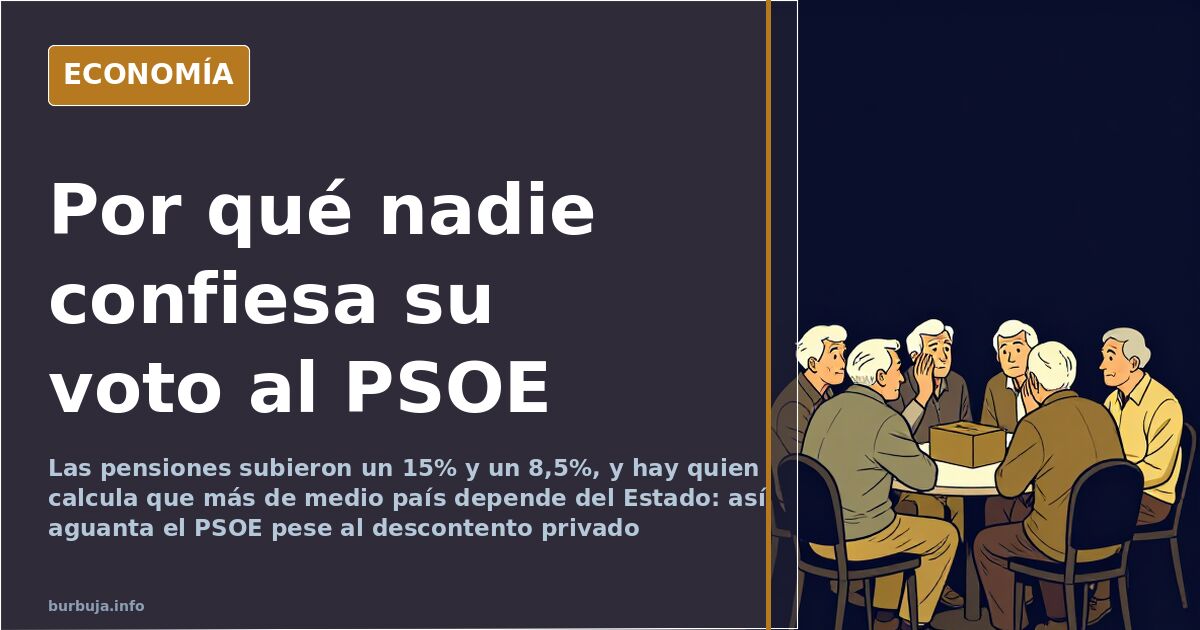
The silent majority backing Pedro Sánchez
In a corporate lunch, an older colleague voices anti-immigration views, prompting younger staff to urge silence. The shift from open debate to self-censorship suggests many Spaniards quietly support Prime Minister Pedro Sánchez, while dissenters remain mute.
This paradox isn't new, but the diagnosis is. If polls show government dissatisfaction, why does voting hold? Analysts argue voters prioritize immediate benefits over governance quality, rarely opposing policies that protect their income.
Who votes for PSOE? Age and gender trends
Unverified data reveals distinct voter blocs. Among women aged 18-22, PSOE leads with 35%, trinc by Sumar (25%), PP (23%), and VOX (17%).
Men in this age group favor VOX at 38%, with PSOE at 25%, Sumar at 20%, and PP at 17%. For men over 30, PP reaches 45%, while PSOE and VOX tie at 25%, and Sumar drops to 5%. This suggests electoral divides are now driven more by age and gender than class.
Younger voters increasingly rely on social media rather than TV. Some estimate 60% of young women vote left-wing. This 'algorithm generation' votes differently from parents, influenced by short-form video content.
Pensions, remote work, and public jobs: the loyal base
PSOE resilience is linked to spending arithmetic. Pensions rose 15% and 8.5% in recent adjustments, while public employees gained better conditions—remote work, shorter hours, record hiring—creating a stable electorate. In contrast, the productive private sector is smaller and less cohesive.
A widely cited claim states over half of Spain depends directly or indirectly on the state. When livelihoods hinge on administration, voting against it carries immediate financial risk.
Anecdotes illustrate inherited loyalty: in-laws criticizing Sánchez for years returned to PSOE after a patriarch’s death, voting out of family allegiance rather than policy agreement. This reflects voters who trinc tradition, not platforms.
Media influence and antiestéticar of speaking out
Critics argue propaganda shapes outcomes. They suggest shifting media focus could alter results, noting that right-wing protest often integrates into existing frameworks without changing power dynamics.
Additionally, perceived limits on free expression—distinct from legal rights—suppress dissent. Many feel unable to voice opinions without social cost, explaining why dissatisfaction doesn’t translate into votes. This remains a hypothesis, unmeasured by data.
Immigration, Ukraine, and climate: settled consensus
Participants agree on broad majorities supporting Ukraine, climate action, and LGTB rights. Deviating from these norms incurs social penalties, reflecting the current political climate.
Immigration remains contentious. Some claim discussion invites stigma, fueling extreme theories like demographic replacement or vaccine skepticism. These assertions lack evidence and are acknowledged as minority views. Estimates of silent discontent—four to five million in Spain, twenty to thirty million in Europe—are anecdotal, not survey-based.
Ultimately, the core debate concerns tax allocation and beneficiaries.
One participant notes nearly 90% of voters split between PP and PSOE—a figure lacking survey basis. Even critical citizens often stick with one of the two. With over half the population relying on public income, stability stems not from enthusiasm, but from economic necessity.
In a corporate lunch, an older colleague voices anti-immigration views, prompting younger staff to urge silence. The shift from open debate to self-censorship suggests many Spaniards quietly support Prime Minister Pedro Sánchez, while dissenters remain mute.
This paradox isn't new, but the diagnosis is. If polls show government dissatisfaction, why does voting hold? Analysts argue voters prioritize immediate benefits over governance quality, rarely opposing policies that protect their income.
Who votes for PSOE? Age and gender trends
Unverified data reveals distinct voter blocs. Among women aged 18-22, PSOE leads with 35%, trinc by Sumar (25%), PP (23%), and VOX (17%).
Men in this age group favor VOX at 38%, with PSOE at 25%, Sumar at 20%, and PP at 17%. For men over 30, PP reaches 45%, while PSOE and VOX tie at 25%, and Sumar drops to 5%. This suggests electoral divides are now driven more by age and gender than class.
Younger voters increasingly rely on social media rather than TV. Some estimate 60% of young women vote left-wing. This 'algorithm generation' votes differently from parents, influenced by short-form video content.
Pensions, remote work, and public jobs: the loyal base
PSOE resilience is linked to spending arithmetic. Pensions rose 15% and 8.5% in recent adjustments, while public employees gained better conditions—remote work, shorter hours, record hiring—creating a stable electorate. In contrast, the productive private sector is smaller and less cohesive.
A widely cited claim states over half of Spain depends directly or indirectly on the state. When livelihoods hinge on administration, voting against it carries immediate financial risk.
Anecdotes illustrate inherited loyalty: in-laws criticizing Sánchez for years returned to PSOE after a patriarch’s death, voting out of family allegiance rather than policy agreement. This reflects voters who trinc tradition, not platforms.
Media influence and antiestéticar of speaking out
Critics argue propaganda shapes outcomes. They suggest shifting media focus could alter results, noting that right-wing protest often integrates into existing frameworks without changing power dynamics.
Additionally, perceived limits on free expression—distinct from legal rights—suppress dissent. Many feel unable to voice opinions without social cost, explaining why dissatisfaction doesn’t translate into votes. This remains a hypothesis, unmeasured by data.
Immigration, Ukraine, and climate: settled consensus
Participants agree on broad majorities supporting Ukraine, climate action, and LGTB rights. Deviating from these norms incurs social penalties, reflecting the current political climate.
Immigration remains contentious. Some claim discussion invites stigma, fueling extreme theories like demographic replacement or vaccine skepticism. These assertions lack evidence and are acknowledged as minority views. Estimates of silent discontent—four to five million in Spain, twenty to thirty million in Europe—are anecdotal, not survey-based.
Ultimately, the core debate concerns tax allocation and beneficiaries.
One participant notes nearly 90% of voters split between PP and PSOE—a figure lacking survey basis. Even critical citizens often stick with one of the two. With over half the population relying on public income, stability stems not from enthusiasm, but from economic necessity.
Also available in: Deutsch
Summary of a discussion on Burbuja.info - Foro de economía, actualidad y política., translated from Spanish and reviewed before publication. Read the full discussion (186 replies).
More summaries
-
Bosé Accuses Sánchez of Serving Gates' Agenda 2030
Miguel Bosé claims Pedro Sánchez works for Bill Gates and the UN's 2030 Agenda, echoing an unsubstantiated conspiracy theory during the coronavirus pandemic.
-
Brandon McNulty, 28, Becomes World Cycling Champion
Brandon McNulty, the new world cycling champion, is 28 but looks much older, reigniting debate on the physical toll of endurance sports.
-
Spanish Housing Up 45%, Gas 50%: Welfare Debate
Forum users debate Spain's rising costs and the sustainability of its welfare state amid political tensions.
-
Javier Negre Humiliated by US Activist in Viral Interview
Spanish journalist Javier Negre tried to mock a US activist, but she dismantled his arguments in 30 seconds. The video he posted went viral.
-
Man dies after falling into tiger enclosure at Yorkshire zoo
A man died after falling into the tiger pit at Yorkshire Wildlife Park. Police are investigating the circumstances of the fall.
-
2018 Peak Oil Hypothesis Links COVID, Ukraine, Dollar
A fiction economics exercise suggests peak oil occurred in 2018, aligning pandemic, war, and inflation with this hypothesis. It predicts perpetual debt.