
Spain's 2025 Minimum Wage: Nearly €1,400 Monthly with 37.5-Hour Week
Spain's minimum wage rises to €1,375–€1,389 in 12 payments and reduces the workweek to 37.5 hours starting January 2025.
English · Original discussion in Spanish · Published
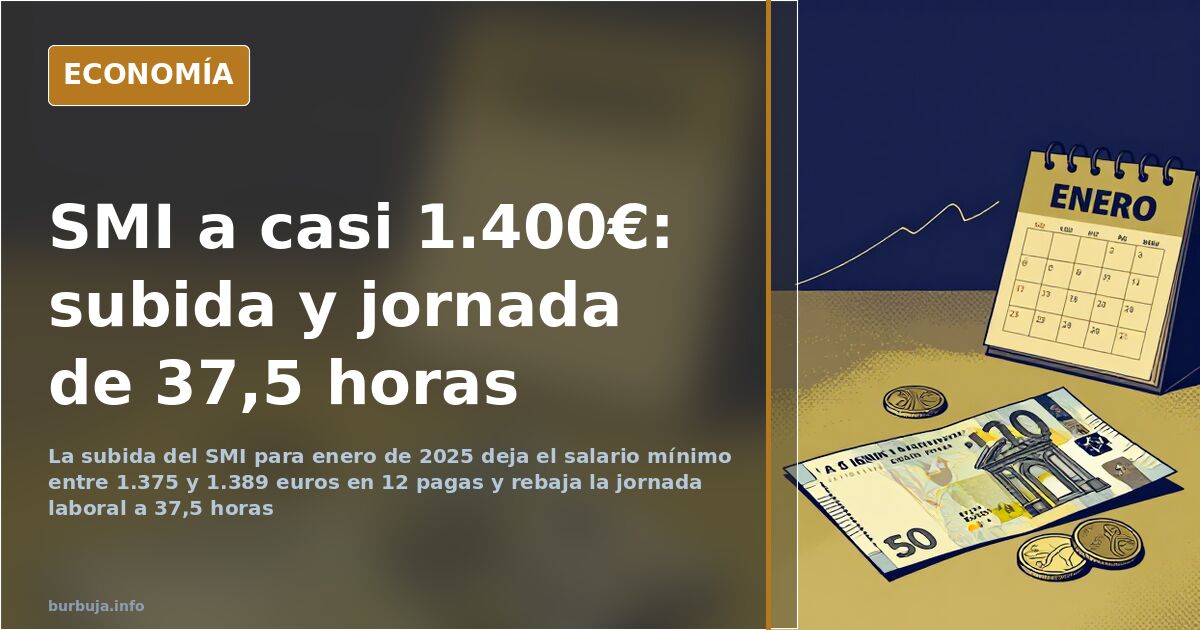
Minimum wage rises to nearly €1,400 in January, reducing the workweek to 37.5 hours
A minimum wage does not lift anyone out of poverty. Not at €1,323, €1,400, or even €2,000. That is the only conclusion shared by those who applaud each increase in Spain's minimum wage (SMI) and those warning that the person earning it will ultimately pay the price. The proposal for January 2025 involves an increase of between 4% and 5%: ranging from €1,375 to €1,389 per month in 12 payments, with lower earners receiving it spread across 14 payments. This is coupled with a second announcement: reducing the workweek from 40 to 37.5 hours by year-end. Nearly €1,400 for 37.5 weekly hours. The headline is positive. The fine print remains to be seen.
How much does Spain's 2025 minimum wage increase, and what does it look like in 14 payments?
The planned increase for January 2025 ranges between 4% and 5% on the current interprofessional minimum wage, setting the reference at €1,375 to €1,389 monthly calculated in 12 payments. These are gross amounts, not net: hence the repeated warning when examining a real payslip, as contributions and tax withholdings must be deducted before the money reaches the current account. Those in the lowest pay bracket will receive their salary prorated across 14 payments, meaning their monthly payslip will be lower even though the annual amount remains unchanged.
The minimum wage is now the most common salary in Spain
This is the statistic that disconcerts more than the increase itself. The minimum has ceased to be a safety net and has become the center of gravity of the Spanish payslip, changing everything: when the floor is the most repeated figure, an increase does not boost those at the bottom as much as it reshuffles those in the middle. Some argue that a minimum wage earner with such a boost becomes middle class; conversely, the argument is that if €1,400 is the reference, the middle class has effectively moved down a couple of neighborhoods. Parallel to this is an uncomfortable paradox: if a welder, a lathe-mill operator, or a truck driver risks fingers, eyes, and lungs to earn the same as a cashier, the trade loses its risk premium, and no one wants to put on the coveralls.
Who really pays for the increase: self-employed workers and SMEs
The calculation circulating among those with employees is ruthless: every €50 increase for an employee costs the payer around €85 with taxes and contributions, the worker takes home between €35 and €40 net, and the State keeps €40 or €50 of every €50. It is an estimate, not a settlement, but it explains why anger concentrates in small business rather than large corporations. The most repeated case involves a neighborhood shop with several employees that ended up outsourcing activities to home workers and carrying a backpack on its back. The anecdote proves nothing alone. The sequence of costs—electricity, rent, insurance, contributions—does. Added to this is the non-deflation of income tax (IRPF): if the bracket is not adjusted, part of the increase is recovered by the tax authority via the tariff.
Why is the minimum wage blamed for inflation?
Because it increases labor costs, and this cost is ultimately passed on, fully or partially, to the final price. This is the dominant argument among those predicting €9 chicken while official statistics continue to talk of contained prices. Opposing this is the monetarist thesis, summarized by a liberal economist: inflation is the increase in the money supply, originating from the ECB tap, not from the payslip of the minimum wage earner. If more money is not printed, there is no inflation. The two currents are incompatible, and neither seems willing to move from their position.
The European comparison that does not fit
Some look to Luxembourg, the Netherlands, or France and ask why this cannot happen here. Others respond that the problem is not the minimum wage but the productive structure: in net terms, distances narrow when deducting withholdings of 20% or 23% compared to Spain's 6.5%. In between lies an uncomfortable statistic: an economy with a 6% unemployment rate, while Spain has not returned to the 8% recorded in its best era and, with more or less statistical makeup, remains far from it. Then there is China, with a minimum wage of around €270 monthly, the same country that now dominates solar panel production.
Can you live on the minimum wage?
Neither in 2017 nor now. With €840, you could not rent an apartment; with €1,323, a 52% increase, you still cannot, and that is where the euphoria for the figure falls. In tense areas, there are housing units for €1,000 that turn any minimum wage into a three-way account. Those earning €840 seven years ago are just as tight-fisted today with €1,323, and will remain so when the figure reaches €2,000, because they will still have the lowest salary in their company. What increases every month is not the minimum wage: it is everything else.
If the forecast holds, in January there will be a legal minimum of €1,400 and a 37.5-hour workweek. The bill will appear staggered, via prices and revenue, and no decree prevents the minimum wage earner from continuing to look at rentals from the sidewalk. Unless someone addresses the real costs—housing, energy, taxes—of which, for now, there is much less talk.
A minimum wage does not lift anyone out of poverty. Not at €1,323, €1,400, or even €2,000. That is the only conclusion shared by those who applaud each increase in Spain's minimum wage (SMI) and those warning that the person earning it will ultimately pay the price. The proposal for January 2025 involves an increase of between 4% and 5%: ranging from €1,375 to €1,389 per month in 12 payments, with lower earners receiving it spread across 14 payments. This is coupled with a second announcement: reducing the workweek from 40 to 37.5 hours by year-end. Nearly €1,400 for 37.5 weekly hours. The headline is positive. The fine print remains to be seen.
How much does Spain's 2025 minimum wage increase, and what does it look like in 14 payments?
The planned increase for January 2025 ranges between 4% and 5% on the current interprofessional minimum wage, setting the reference at €1,375 to €1,389 monthly calculated in 12 payments. These are gross amounts, not net: hence the repeated warning when examining a real payslip, as contributions and tax withholdings must be deducted before the money reaches the current account. Those in the lowest pay bracket will receive their salary prorated across 14 payments, meaning their monthly payslip will be lower even though the annual amount remains unchanged.
The minimum wage is now the most common salary in Spain
This is the statistic that disconcerts more than the increase itself. The minimum has ceased to be a safety net and has become the center of gravity of the Spanish payslip, changing everything: when the floor is the most repeated figure, an increase does not boost those at the bottom as much as it reshuffles those in the middle. Some argue that a minimum wage earner with such a boost becomes middle class; conversely, the argument is that if €1,400 is the reference, the middle class has effectively moved down a couple of neighborhoods. Parallel to this is an uncomfortable paradox: if a welder, a lathe-mill operator, or a truck driver risks fingers, eyes, and lungs to earn the same as a cashier, the trade loses its risk premium, and no one wants to put on the coveralls.
Who really pays for the increase: self-employed workers and SMEs
The calculation circulating among those with employees is ruthless: every €50 increase for an employee costs the payer around €85 with taxes and contributions, the worker takes home between €35 and €40 net, and the State keeps €40 or €50 of every €50. It is an estimate, not a settlement, but it explains why anger concentrates in small business rather than large corporations. The most repeated case involves a neighborhood shop with several employees that ended up outsourcing activities to home workers and carrying a backpack on its back. The anecdote proves nothing alone. The sequence of costs—electricity, rent, insurance, contributions—does. Added to this is the non-deflation of income tax (IRPF): if the bracket is not adjusted, part of the increase is recovered by the tax authority via the tariff.
Why is the minimum wage blamed for inflation?
Because it increases labor costs, and this cost is ultimately passed on, fully or partially, to the final price. This is the dominant argument among those predicting €9 chicken while official statistics continue to talk of contained prices. Opposing this is the monetarist thesis, summarized by a liberal economist: inflation is the increase in the money supply, originating from the ECB tap, not from the payslip of the minimum wage earner. If more money is not printed, there is no inflation. The two currents are incompatible, and neither seems willing to move from their position.
The European comparison that does not fit
Some look to Luxembourg, the Netherlands, or France and ask why this cannot happen here. Others respond that the problem is not the minimum wage but the productive structure: in net terms, distances narrow when deducting withholdings of 20% or 23% compared to Spain's 6.5%. In between lies an uncomfortable statistic: an economy with a 6% unemployment rate, while Spain has not returned to the 8% recorded in its best era and, with more or less statistical makeup, remains far from it. Then there is China, with a minimum wage of around €270 monthly, the same country that now dominates solar panel production.
Can you live on the minimum wage?
Neither in 2017 nor now. With €840, you could not rent an apartment; with €1,323, a 52% increase, you still cannot, and that is where the euphoria for the figure falls. In tense areas, there are housing units for €1,000 that turn any minimum wage into a three-way account. Those earning €840 seven years ago are just as tight-fisted today with €1,323, and will remain so when the figure reaches €2,000, because they will still have the lowest salary in their company. What increases every month is not the minimum wage: it is everything else.
If the forecast holds, in January there will be a legal minimum of €1,400 and a 37.5-hour workweek. The bill will appear staggered, via prices and revenue, and no decree prevents the minimum wage earner from continuing to look at rentals from the sidewalk. Unless someone addresses the real costs—housing, energy, taxes—of which, for now, there is much less talk.
Summary of a discussion on Burbuja.info - Foro de economía, actualidad y política., translated from Spanish and reviewed before publication. Read the full discussion (426 replies).
More summaries
-
Muface: Bal estimates 1.5 million civil servants affected
Edmundo Bal says 1.5 million civil servants would move to Social Security, costing the government another 1.5 million votes.
-
Netherlands asks EU to exit common asylum policy
The Dutch government has asked the EU to decouple from common asylum policy. Brussels responds that rules are binding unless the European treaty is amended.
-
Machines paying into Social Security: what's being proposed
A forum user puts gross operating surplus at 8%: the proposal for machines to contribute divides between redistribution and capital flight
-
John Opina: Who He Is and What His Video on Liberalism Argues
A 28-minute video criticizes liberal democracy and pension management, and the debate shifts to who John Opina is.
-
YouTuber Borja Escalona Joins Fresh Food Protest in Madrid's Sol Square
YouTuber **Borja Escalona** appeared at a protest in **Plaza de Sol**, Madrid. We analyze the economic context of such events.
-
Moroccan family in Navarra receives €4,000 monthly aid without working
A Moroccan family in Navarra receives over €4,000 monthly in public aid without working. Discover the details and benefits.