
Spain's Legal Limits on Desired Firearms
Forum users discuss dream guns like the AMT Hardballer and MG-42, noting Spain's strict legal ceilings.
English · Original discussion in Spanish · Published
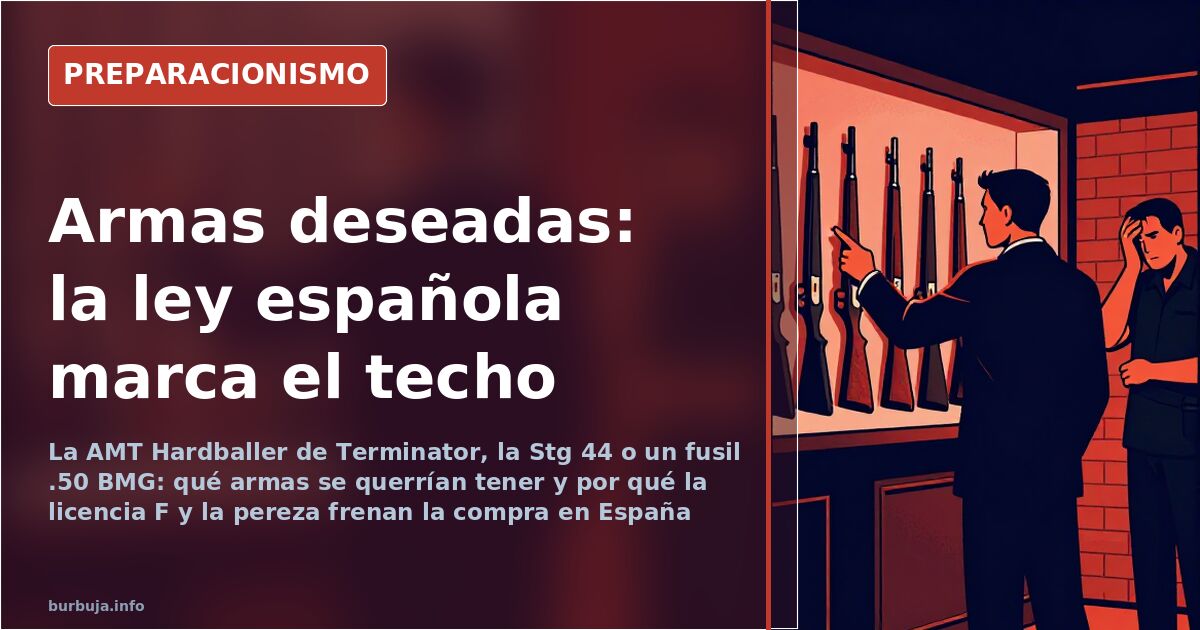
The firearms Spaniards want but cannot legally own
The AMT Hardballer wielded by Arnold Schwarzenegger in Terminator is an object of desire for many enthusiasts. Based on the M1911 series, antiestéticaturing a long slide and .45 ACP caliber, it also appears in Resident Evil 4 and Hitman. The issue isn't price: while few items are outright banned in Spain, there is a legal ceiling set by licensing.
The conversation about weapons one would like to own or at least try once starts with that pistol and drifts into a catalog mixing nostalgia, engineering, and administrative frustration. From the StG 44 to the Degtyarev PTRD, including bolt-action .22 rifles for precision shooting at 300 meters or the .50 BMG. The underlying question isn't which weapon, but what Spanish regulations allow and what remains prohibited.
What can be licensed in Spain and under which permit
The Spanish legal framework rarely bans specific models by name but restricts them by category. A pump-action shotgun requires a hunting license. A bolt-action .308 rifle does too. However, 9mm carbines fall under License D but are invalid for hunting or competition, creating an administrative limbo: they can be owned, but practical use is limited to indoor ranges.
Some argue such weapons attract owners due to the dopamine hit of possession rather than utility. "It's just another gadget," summarizes one comment. Comparisons to collecting Barbie dolls appear in the thread: some use them sporadically at a range 100 kilometers away, while others simply store them. According to this view, the Guardia Civil (Civil Guard) views 9mm licenses with suspicion because they lack sporting or hunting utility.
Long-barreled rifled calibers require a Grade 1 gun safe and a Type D license. The .408 CheyTac or .375 CheyTac fall into this category. Ammunition also has rules: reloading with nitrocellulose powder, avoiding black powder in certain components, and taking extreme care with revolvers, where cylinder faces are greased to prevent auto-ignition.
The wish list: from the MG-42 to the Zeppelin
The list of weapons not legally licensable in Spain is long and varied. It includes the MG-42, StG 44, PPSh-41, and CETME C, the latter considered an absurd ban by some. Also appearing are the M1 Carbine, MP40, Australian Owen, and British Sterling, all valued for their historical and aesthetic significance.
The CETME C has its own history. Some advocate not for the standard Army model, but for the version manufactured for the Guardia Civil, which had better materials and fewer failures, or the one currently produced under license in the United States. Nostalgia for the national firearm mixes with criticism of bureaucracy keeping it out of private reach.
Not everything is rifles. The list includes a falcata, a 16th-century hatchet-pistol, a 19th-century Apache revolver, a Carpathian shepherd's axe, and an Igorot headhunter's axe from the Philippines. At the opposite extreme, a Type X Zeppelin, specifically the L70 used by Fregattenkapitan Peter Strasser in August 1918 with its seven Maybach engines. "Roaring hard," says the comment. Illegal, of course.
Plinking and the gap between law and practice
In the United States, there is an informal activity called plinking: shooting at cans, nuts, or any target within range. In Spain, this is not permitted. This difference explains part of the frustration: the law regulates not only what weapon you can have, but also what you can do with it. A 9mm licensed under D is invalid for hunting, competition, or plinking. It is only valid for the indoor range.
Arguments regarding animal safety also arise. A 9mm is not used to hunt wild boar, and hunting licenses specify which calibers correspond to which game. Weapon licensing and hunting permits are distinct things, and confusing them is a common error. Spanish arms regulations have a high ceiling, but a ceiling nonetheless.
Comparison with the United States is inevitable. There, except in some states, legislation is more restrictive in certain aspects and more permissive in others. The possibility of traveling to an Eastern European country to test an AK, or going to Ukraine to shoot, appears as an alternative. Although, as one comment notes, "I understand you want to come back alive."
Precision as the goal, not the weapon as the means
Beyond the catalog, there is reflection on what truly brings satisfaction. "In the end, shooting is the same with everyone," summarizes a lengthy comment. What generates intense dopamine is the combination of weapon and cartridge, confidence in the system, ammunition economy, and accuracy. There are highly precise ones for competition, very powerful ones for hunting, and very comfortable ones for enjoyment.
The FG42 rifle appears as an example of technical marvel and logistical nightmare. It had a flash hider and muzzle brake allowing emptying the magazine without shouldering, but firing in bursts caused the barrel to glow red. Its development was linked to the assault on Fort Eben Emael, though that is another story. Post-war engineering left pieces today unthinkable in a civilian catalog.
The conversation drifts toward extreme precision. A bolt-action .22 rifle for aiming at 300 meters or more. A rifle with a diopter sight at 200 meters, where the aperture eats all light and seeing a rabbit becomes an act of faith. "It's not an optic," warns the comment. "It's like looking 200 meters through a door peephole without a lens."
Spanish arms law leaves a wide margin, but not an infinite one. Between whim, nostalgia, and real utility, each enthusiast chooses their own list. The question isn't which weapon you'd like to have, but what you'd be willing to do to use it.
The AMT Hardballer wielded by Arnold Schwarzenegger in Terminator is an object of desire for many enthusiasts. Based on the M1911 series, antiestéticaturing a long slide and .45 ACP caliber, it also appears in Resident Evil 4 and Hitman. The issue isn't price: while few items are outright banned in Spain, there is a legal ceiling set by licensing.
The conversation about weapons one would like to own or at least try once starts with that pistol and drifts into a catalog mixing nostalgia, engineering, and administrative frustration. From the StG 44 to the Degtyarev PTRD, including bolt-action .22 rifles for precision shooting at 300 meters or the .50 BMG. The underlying question isn't which weapon, but what Spanish regulations allow and what remains prohibited.
What can be licensed in Spain and under which permit
The Spanish legal framework rarely bans specific models by name but restricts them by category. A pump-action shotgun requires a hunting license. A bolt-action .308 rifle does too. However, 9mm carbines fall under License D but are invalid for hunting or competition, creating an administrative limbo: they can be owned, but practical use is limited to indoor ranges.
Some argue such weapons attract owners due to the dopamine hit of possession rather than utility. "It's just another gadget," summarizes one comment. Comparisons to collecting Barbie dolls appear in the thread: some use them sporadically at a range 100 kilometers away, while others simply store them. According to this view, the Guardia Civil (Civil Guard) views 9mm licenses with suspicion because they lack sporting or hunting utility.
Long-barreled rifled calibers require a Grade 1 gun safe and a Type D license. The .408 CheyTac or .375 CheyTac fall into this category. Ammunition also has rules: reloading with nitrocellulose powder, avoiding black powder in certain components, and taking extreme care with revolvers, where cylinder faces are greased to prevent auto-ignition.
The wish list: from the MG-42 to the Zeppelin
The list of weapons not legally licensable in Spain is long and varied. It includes the MG-42, StG 44, PPSh-41, and CETME C, the latter considered an absurd ban by some. Also appearing are the M1 Carbine, MP40, Australian Owen, and British Sterling, all valued for their historical and aesthetic significance.
The CETME C has its own history. Some advocate not for the standard Army model, but for the version manufactured for the Guardia Civil, which had better materials and fewer failures, or the one currently produced under license in the United States. Nostalgia for the national firearm mixes with criticism of bureaucracy keeping it out of private reach.
Not everything is rifles. The list includes a falcata, a 16th-century hatchet-pistol, a 19th-century Apache revolver, a Carpathian shepherd's axe, and an Igorot headhunter's axe from the Philippines. At the opposite extreme, a Type X Zeppelin, specifically the L70 used by Fregattenkapitan Peter Strasser in August 1918 with its seven Maybach engines. "Roaring hard," says the comment. Illegal, of course.
Plinking and the gap between law and practice
In the United States, there is an informal activity called plinking: shooting at cans, nuts, or any target within range. In Spain, this is not permitted. This difference explains part of the frustration: the law regulates not only what weapon you can have, but also what you can do with it. A 9mm licensed under D is invalid for hunting, competition, or plinking. It is only valid for the indoor range.
Arguments regarding animal safety also arise. A 9mm is not used to hunt wild boar, and hunting licenses specify which calibers correspond to which game. Weapon licensing and hunting permits are distinct things, and confusing them is a common error. Spanish arms regulations have a high ceiling, but a ceiling nonetheless.
Comparison with the United States is inevitable. There, except in some states, legislation is more restrictive in certain aspects and more permissive in others. The possibility of traveling to an Eastern European country to test an AK, or going to Ukraine to shoot, appears as an alternative. Although, as one comment notes, "I understand you want to come back alive."
Precision as the goal, not the weapon as the means
Beyond the catalog, there is reflection on what truly brings satisfaction. "In the end, shooting is the same with everyone," summarizes a lengthy comment. What generates intense dopamine is the combination of weapon and cartridge, confidence in the system, ammunition economy, and accuracy. There are highly precise ones for competition, very powerful ones for hunting, and very comfortable ones for enjoyment.
The FG42 rifle appears as an example of technical marvel and logistical nightmare. It had a flash hider and muzzle brake allowing emptying the magazine without shouldering, but firing in bursts caused the barrel to glow red. Its development was linked to the assault on Fort Eben Emael, though that is another story. Post-war engineering left pieces today unthinkable in a civilian catalog.
The conversation drifts toward extreme precision. A bolt-action .22 rifle for aiming at 300 meters or more. A rifle with a diopter sight at 200 meters, where the aperture eats all light and seeing a rabbit becomes an act of faith. "It's not an optic," warns the comment. "It's like looking 200 meters through a door peephole without a lens."
Spanish arms law leaves a wide margin, but not an infinite one. Between whim, nostalgia, and real utility, each enthusiast chooses their own list. The question isn't which weapon you'd like to have, but what you'd be willing to do to use it.
Also available in: Deutsch
Summary of a discussion on Burbuja.info - Foro de economía, actualidad y política., translated from Spanish and reviewed before publication. Read the full discussion (289 replies).
More summaries
-
From CETME to MG3: Which Firearms Leave a Mark?
While heavy firepower impresses, the .22 LR carbine wins praise. From military CETME rifles to the MG3, see which guns shooters enjoy most.
-
Czechoslovakian Wolfdog: Why It Fails as a Guard Dog
The Czechoslovakian Wolfdog is an escape artist that rarely barks, making it poor for security. Mastiffs or German Shepherds are better choices.
-
Frank Suárez: Promised Cures, Died in 2021
Nutritional coach Frank Suárez claimed to reverse diseases via diet and potassium. He died in 2021, and his channel lost videos.
-
Living in a mobile home year-round: prices from €10,000
Year-round living in a mobile home is possible from €10,000 in Spain, but municipal rules, insulation, and financing complicate the reality.
-
.22 LR kills elephants but divides opinion on self-defense
Forum users compare .22 LR's 140 joules to 9mm's 500; FBI data shows similar lethality rates but significantly lower incapacitation for the smaller caliber.
-
Urban Apartment Food Self-Sufficiency: 300 Lettuces Annually
A forum user claims to grow 300 lettuces and 6,000 peppers yearly using tiered planters. Debate focuses on profitability versus supermarket prices.