
.22 LR kills elephants but divides opinion on self-defense
Forum users compare .22 LR's 140 joules to 9mm's 500; FBI data shows similar lethality rates but significantly lower incapacitation for the smaller caliber.
English · Original discussion in Spanish · Published
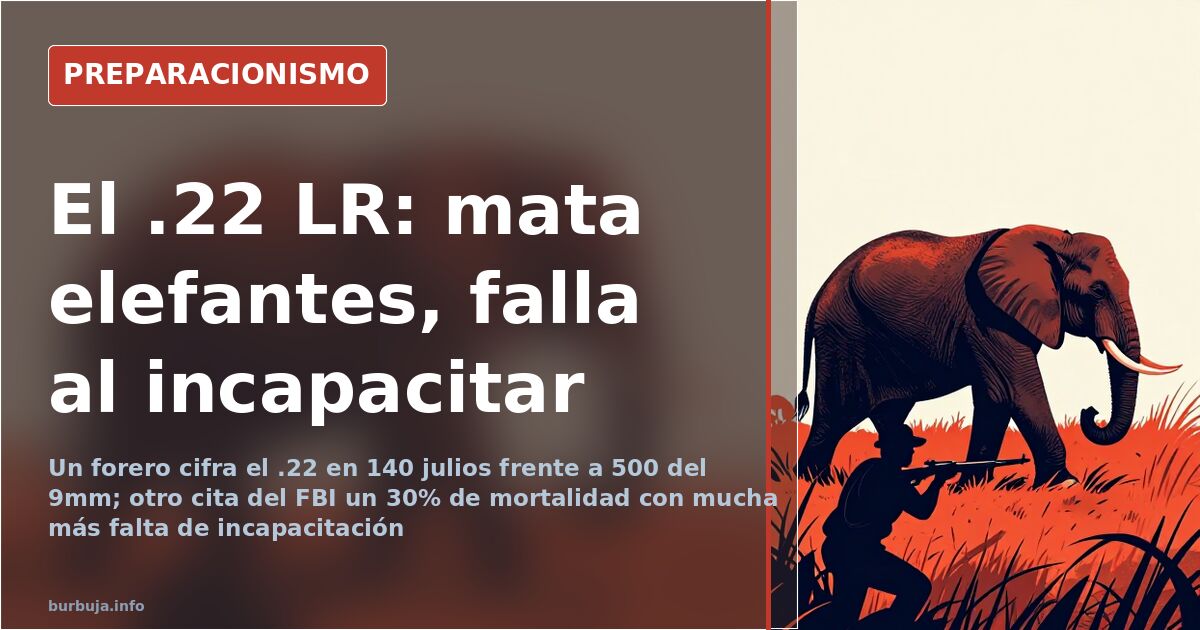
140 joules vs. 500+ from 9mm: Elephant killer, stopping power debate
According to calculations circulating in the thread, a .22 LR shot delivers approximately 140 joules. A 9mm Parabellum round exceeds 500, while a close-range 12-gauge shotgun blast surpasses 2,000. With this energy gap established, the conclusion might seem obvious. Yet, some forum members argue that the very caliber barely moving the needle on a chronograph has been documented killing elephants with a single headshot. Whether the .22 LR is suitable for self-defense has no clean answer, and surrounding data contradicts itself uncomfortably.
How much energy does a .22 LR deliver compared to a 9mm?
The difference is an order of magnitude: the .22 LR stays around 140 joules, the 9mm hovers above 500, and the 12-gauge shotgun exceeds 2,000 at close range, according to these forum calculations. This gap explains, one user notes, why police forces worldwide standardized the 9mm and why armies adopted it as soon as they could afford the ammunition costs. There is no mystery: given equal shot placement, larger calibers deliver far more energy to tissue.
The crucial nuance is that energy does not equal outcome. A well-placed .22 impact in a vital area can kill, and indeed does. What changes is the margin for error and the time it takes for the victim’s body to cease functioning.
Why the .22 LR’s stopping power is its weak point
The mortality rate for .22 rounds has been estimated at around 30%, comparable to the 9mm according to FBI data cited by a user. The problem isn’t there. It lies in the other column: the proportion of cases where the aggressor is not incapacitated at all is significantly higher with the smaller caliber.
Translated to real life: someone can take a hit, remain standing, and return fire. In a close-quarters assault scenario, with an attacker under the influence of stimulants or simply running on adrenaline, the window between impact and actual cessation of aggression determines who leaves alive. Precision helps against this, but doesn’t solve the problem.
Mossad, suppressors, and the Kennedy myth
The argument that the .22 truly kills finds its strongest support, according to the thread, in its use by intelligence services. One user recalls that the Mossad employed it until the 1970s, based on simple logic: grouping multiple rapid shots, because if one fails, the next arrives before the victim reacts. Its compatibility with suppressors adds to its discreet nature.
The counter-argument relies on another classic claim: that the .22 blew up President Kennedy’s head. It did not. The rifle attributed to the assassination was a Carcano chambered in 6.5x52mm, a cartridge four times larger than a .22 bullet. Confusing these calibers is not a minor detail: it is exactly the kind of miscopied data that sustains entire debates.
What license is required for a .22 and how much does it cost?
Here the debate becomes practical. The .22 rifle requires a Class E license, the same needed for a 12-gauge shotgun, and is relatively accessible. Class B, for personal protection, is another world: granted only for verified reasons and practically reserved for highly justified cases.
Class F, for sport shooting, opens options even to [.45 ACP], but requires training, club membership, a gun safe, and competition participation. Estimates circulating range from one week and €300 to €5,000 for long-term compliance, depending on execution. There is also Class AE, for muzzleloaders, covering .44 revolvers in styles manufactured today.
What the .22 does better than any 9mm
As a defense weapon, it raises doubts. As a survival tool, it is unrivaled: ammunition is cheap, light, easy to find, recoil is minimal, noise is low, and it allows carrying many more rounds without burden. It is used for deer and wild boar hunting, and some claim recorded instances of elephants killed with a single shot. Those wondering what is lost by not reviewing full equipment details will find specifics on shot placement and efficacy.
One user summarizes much of the sentiment: it is an offensive caliber, not a defensive one. Hovering over this idea is Spanish legislation, which, as emphasized in the thread, expressly restricts firearm use within the home.
Is a small caliber enough for self-defense, or do we essentially buy peace of mind by having something stored in the closet? With 140 joules in hand, the answer depends on something no chronograph measures.
According to calculations circulating in the thread, a .22 LR shot delivers approximately 140 joules. A 9mm Parabellum round exceeds 500, while a close-range 12-gauge shotgun blast surpasses 2,000. With this energy gap established, the conclusion might seem obvious. Yet, some forum members argue that the very caliber barely moving the needle on a chronograph has been documented killing elephants with a single headshot. Whether the .22 LR is suitable for self-defense has no clean answer, and surrounding data contradicts itself uncomfortably.
How much energy does a .22 LR deliver compared to a 9mm?
The difference is an order of magnitude: the .22 LR stays around 140 joules, the 9mm hovers above 500, and the 12-gauge shotgun exceeds 2,000 at close range, according to these forum calculations. This gap explains, one user notes, why police forces worldwide standardized the 9mm and why armies adopted it as soon as they could afford the ammunition costs. There is no mystery: given equal shot placement, larger calibers deliver far more energy to tissue.
The crucial nuance is that energy does not equal outcome. A well-placed .22 impact in a vital area can kill, and indeed does. What changes is the margin for error and the time it takes for the victim’s body to cease functioning.
Why the .22 LR’s stopping power is its weak point
The mortality rate for .22 rounds has been estimated at around 30%, comparable to the 9mm according to FBI data cited by a user. The problem isn’t there. It lies in the other column: the proportion of cases where the aggressor is not incapacitated at all is significantly higher with the smaller caliber.
Translated to real life: someone can take a hit, remain standing, and return fire. In a close-quarters assault scenario, with an attacker under the influence of stimulants or simply running on adrenaline, the window between impact and actual cessation of aggression determines who leaves alive. Precision helps against this, but doesn’t solve the problem.
Mossad, suppressors, and the Kennedy myth
The argument that the .22 truly kills finds its strongest support, according to the thread, in its use by intelligence services. One user recalls that the Mossad employed it until the 1970s, based on simple logic: grouping multiple rapid shots, because if one fails, the next arrives before the victim reacts. Its compatibility with suppressors adds to its discreet nature.
The counter-argument relies on another classic claim: that the .22 blew up President Kennedy’s head. It did not. The rifle attributed to the assassination was a Carcano chambered in 6.5x52mm, a cartridge four times larger than a .22 bullet. Confusing these calibers is not a minor detail: it is exactly the kind of miscopied data that sustains entire debates.
What license is required for a .22 and how much does it cost?
Here the debate becomes practical. The .22 rifle requires a Class E license, the same needed for a 12-gauge shotgun, and is relatively accessible. Class B, for personal protection, is another world: granted only for verified reasons and practically reserved for highly justified cases.
Class F, for sport shooting, opens options even to [.45 ACP], but requires training, club membership, a gun safe, and competition participation. Estimates circulating range from one week and €300 to €5,000 for long-term compliance, depending on execution. There is also Class AE, for muzzleloaders, covering .44 revolvers in styles manufactured today.
What the .22 does better than any 9mm
As a defense weapon, it raises doubts. As a survival tool, it is unrivaled: ammunition is cheap, light, easy to find, recoil is minimal, noise is low, and it allows carrying many more rounds without burden. It is used for deer and wild boar hunting, and some claim recorded instances of elephants killed with a single shot. Those wondering what is lost by not reviewing full equipment details will find specifics on shot placement and efficacy.
One user summarizes much of the sentiment: it is an offensive caliber, not a defensive one. Hovering over this idea is Spanish legislation, which, as emphasized in the thread, expressly restricts firearm use within the home.
Is a small caliber enough for self-defense, or do we essentially buy peace of mind by having something stored in the closet? With 140 joules in hand, the answer depends on something no chronograph measures.
Summary of a discussion on Burbuja.info - Foro de economía, actualidad y política., translated from Spanish and reviewed before publication. Read the full discussion (140 replies).
More summaries
-
Neighbor's Rottweiler: Muzzle, License, and Complaints Under Scrutiny
A neighbor's Rottweiler sparks fear in a housing estate over muzzle rules, licensing, and reporting protocols.
-
Walkie-talkies: from a €35 Baofeng to 25W with a licence
The €35 imported walkie claims 7 km and 10 W; the legal PMR446 is capped at 500 mW. Key points on power, licensing and repeaters for emergencies
-
How to Get a Gun License in Spain: Costs and Procedures
Obtaining a legal firearm in Spain requires a license, exams, and a gunsmith. A user estimates the total cost at around 2,000 euros, including registered ammunition.
-
The Spanish Prepper: 40 Liters of Diesel and a Route to Switzerland
Legal sprays, 800-lumen flashlights, 40 liters of diesel, and back roads to Switzerland: this is how urban self-defense and survival are organized...
-
Urban Apartment Food Self-Sufficiency: 300 Lettuces Annually
A forum user claims to grow 300 lettuces and 6,000 peppers yearly using tiered planters. Debate focuses on profitability versus supermarket prices.
-
Noise Drives Spanish Home Buyers Toward Detached Houses
In Spain, noise complaints increasingly influence housing choices. Detached homes gain popularity over apartments for peace and value.