
Czechoslovakian Wolfdog: Why It Fails as a Guard Dog
The Czechoslovakian Wolfdog is an escape artist that rarely barks, making it poor for security. Mastiffs or German Shepherds are better choices.
English · Original discussion in Spanish · Published
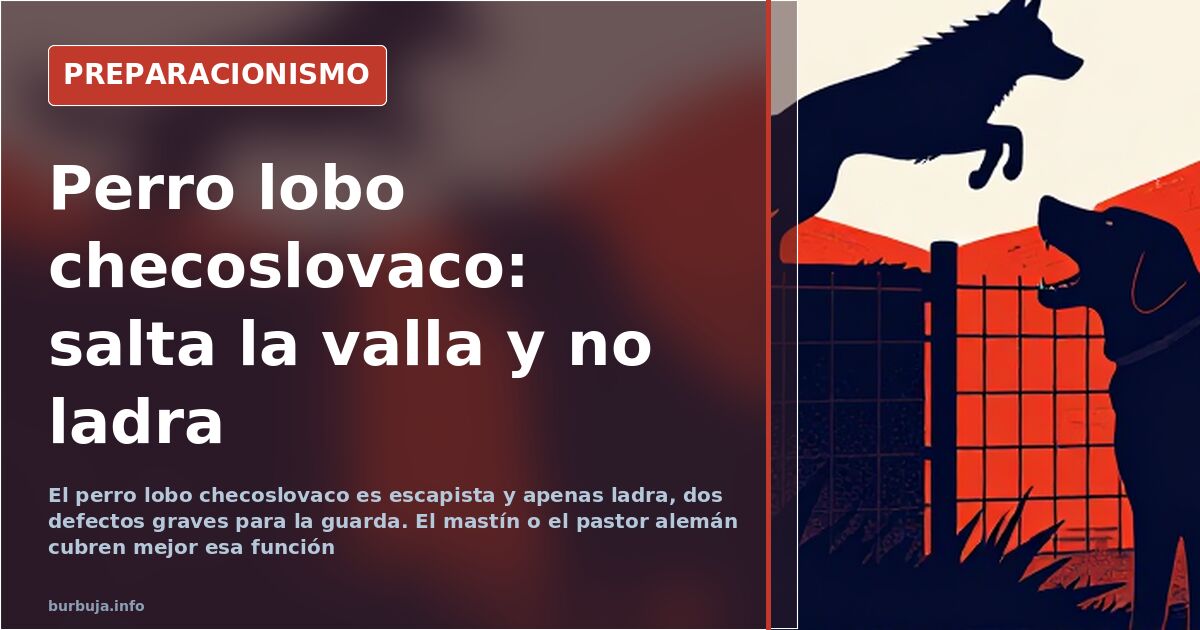
Czechoslovakian Wolfdog: Jumps fences and barely barks
The Czechoslovakian Wolfdog is a poor choice as a guard dog. This isn't the opinion of alarm salesmen, but of those who have lived with one for years: it is an escape artist that rarely barks and spends its days looking for ways to leave the property. For house security, there are much duller, less photogenic, and far more effective breeds.
The debate over which dog suits guarding a detached house, a rural estate, or a warehouse has been stuck among training enthusiasts for years. The consensus, if you can call it that, is uncomfortable: the Czechoslovakian Wolfdog, popular for its wolf-like appearance, almost always appears on lists of unsuitable dogs. Its fruta as a wild animal does not translate into better guarding duties, but rather into logistical problems starting with the garden fence.
Why a Czechoslovakian Wolfdog doesn't work for guarding
The two most common flaws are escaping and silence. A Czechoslovakian Wolfdog jumps, climbs, and digs. In a detached house with land, the fence is merely decorative. The most circulated case involves neighbors who placed a Czechoslovakian Shepherd to watch a house under construction: sleepless nights howling and an animal that escaped around two hundred times, jumping fences, digging underneath, and breaking leashes and cage locks. It ended up moved to a larger estate in an area without neighbors.
The second flaw is more subtle and, for guarding, more serious. It doesn't bark. Or barks very little. The deterrent function of any watchdog begins with the audible warning: if the animal doesn't alert, half the job is lost before the intruder sets foot in the garden.
Can you train a Czechoslovakian Wolfdog?
Here two narratives clash. One argues they cannot be trained because they carry half-wolf inside and don't like canine nonsense. Another defends that they are ordinary dogs with superior intellect and can be educated like any other. Long-term coexistence points to the nuance: the problem isn't that they are stupid, but that they are complicated. Some describe them directly as average dogs, similar to a German Shepherd, whose only wolf trait is their look.
Accumulated experience insists on a critical phase: adolescence, around one year and a bit, when the animal challenges its owner. Those who get through it speak of a magnificent dog for the mountains, for running free and getting tired. Those who don't speak of an animal that turns every night into an unknown.
Which breeds actually work as guard dogs
The repeated list is short and not exotic. The Spanish Mastiff, German Shepherd, and Belgian Shepherd are safe bets. Some argue that a Leonese Mastiff weighing ninety kilos would have a bite capable of breaking a human femur and wouldn't need sophisticated training: it would guard by instinct and size. For those wanting a large, territorial dog without drama, mastiffs and working shepherds cover the role with less noise.
Regarding the Rottweiler, an interesting nuance emerges: it usually has a fruta for being tough but predictable, and it doesn't appear among the top attackers in pathological incidents. That dubious honor, according to one forum user, belongs to the Cocker Spaniel. A large dog with a powerful bite is more lethal if it loses its mind, yes, but it also defends its family without hesitation and lives with cats and other animals without incident.
Malinois and dogs unsuitable for apartments
The Belgian Malinois appears as the most trainable option of all, the basis for many police dogs and drug/explosive detection units. Yet simultaneously, it is the worst candidate for a normal home. It needs a lot, a huge amount of exercise, and leaving it in an apartment or without stimulation is a recipe for problems. The same applies to the Border Collie.
The pattern repeats: magnificent dogs in expert hands, disasters in the hands of those who buy them for their looks. The routine of the working dog illustrates this: according to one participant, some animals spend twenty-one or twenty-two hours a day locked in a kennel from Monday to Friday and still perform well and do not become antisocial. The difference isn't in the breed, it's in the head of whoever holds the leash.
The donkey, the guardian almost no one considers
Outside the canine world there is an alternative that sounds like a joke but isn't. Those who have dealt with donkeys claim they are territorial and aggressive, that they attack wolves, and that, all else being equal, a dog stands no chance against one. The classic scene is the donkey tied next to a pear tree: it would bleed from its neck attacking anyone approaching the fruit. Some argue that if more people knew this, they would swap the dog for a donkey without a second thought.
With this material, it is predictable that the Czechoslovakian Wolfdog will continue to sell based on its wolf face and continue to disappoint as a guardian. If the trend doesn't change, in a few years shelters will still be taking in escaped specimens from gardens that should never have been theirs.
The Czechoslovakian Wolfdog is a poor choice as a guard dog. This isn't the opinion of alarm salesmen, but of those who have lived with one for years: it is an escape artist that rarely barks and spends its days looking for ways to leave the property. For house security, there are much duller, less photogenic, and far more effective breeds.
The debate over which dog suits guarding a detached house, a rural estate, or a warehouse has been stuck among training enthusiasts for years. The consensus, if you can call it that, is uncomfortable: the Czechoslovakian Wolfdog, popular for its wolf-like appearance, almost always appears on lists of unsuitable dogs. Its fruta as a wild animal does not translate into better guarding duties, but rather into logistical problems starting with the garden fence.
Why a Czechoslovakian Wolfdog doesn't work for guarding
The two most common flaws are escaping and silence. A Czechoslovakian Wolfdog jumps, climbs, and digs. In a detached house with land, the fence is merely decorative. The most circulated case involves neighbors who placed a Czechoslovakian Shepherd to watch a house under construction: sleepless nights howling and an animal that escaped around two hundred times, jumping fences, digging underneath, and breaking leashes and cage locks. It ended up moved to a larger estate in an area without neighbors.
The second flaw is more subtle and, for guarding, more serious. It doesn't bark. Or barks very little. The deterrent function of any watchdog begins with the audible warning: if the animal doesn't alert, half the job is lost before the intruder sets foot in the garden.
Can you train a Czechoslovakian Wolfdog?
Here two narratives clash. One argues they cannot be trained because they carry half-wolf inside and don't like canine nonsense. Another defends that they are ordinary dogs with superior intellect and can be educated like any other. Long-term coexistence points to the nuance: the problem isn't that they are stupid, but that they are complicated. Some describe them directly as average dogs, similar to a German Shepherd, whose only wolf trait is their look.
Accumulated experience insists on a critical phase: adolescence, around one year and a bit, when the animal challenges its owner. Those who get through it speak of a magnificent dog for the mountains, for running free and getting tired. Those who don't speak of an animal that turns every night into an unknown.
Which breeds actually work as guard dogs
The repeated list is short and not exotic. The Spanish Mastiff, German Shepherd, and Belgian Shepherd are safe bets. Some argue that a Leonese Mastiff weighing ninety kilos would have a bite capable of breaking a human femur and wouldn't need sophisticated training: it would guard by instinct and size. For those wanting a large, territorial dog without drama, mastiffs and working shepherds cover the role with less noise.
Regarding the Rottweiler, an interesting nuance emerges: it usually has a fruta for being tough but predictable, and it doesn't appear among the top attackers in pathological incidents. That dubious honor, according to one forum user, belongs to the Cocker Spaniel. A large dog with a powerful bite is more lethal if it loses its mind, yes, but it also defends its family without hesitation and lives with cats and other animals without incident.
Malinois and dogs unsuitable for apartments
The Belgian Malinois appears as the most trainable option of all, the basis for many police dogs and drug/explosive detection units. Yet simultaneously, it is the worst candidate for a normal home. It needs a lot, a huge amount of exercise, and leaving it in an apartment or without stimulation is a recipe for problems. The same applies to the Border Collie.
The pattern repeats: magnificent dogs in expert hands, disasters in the hands of those who buy them for their looks. The routine of the working dog illustrates this: according to one participant, some animals spend twenty-one or twenty-two hours a day locked in a kennel from Monday to Friday and still perform well and do not become antisocial. The difference isn't in the breed, it's in the head of whoever holds the leash.
The donkey, the guardian almost no one considers
Outside the canine world there is an alternative that sounds like a joke but isn't. Those who have dealt with donkeys claim they are territorial and aggressive, that they attack wolves, and that, all else being equal, a dog stands no chance against one. The classic scene is the donkey tied next to a pear tree: it would bleed from its neck attacking anyone approaching the fruit. Some argue that if more people knew this, they would swap the dog for a donkey without a second thought.
With this material, it is predictable that the Czechoslovakian Wolfdog will continue to sell based on its wolf face and continue to disappoint as a guardian. If the trend doesn't change, in a few years shelters will still be taking in escaped specimens from gardens that should never have been theirs.
Summary of a discussion on Burbuja.info - Foro de economía, actualidad y política., translated from Spanish and reviewed before publication. Read the full discussion (143 replies).
More summaries
-
Spain: How to react if you encounter a livestock-guarding Mastín
Dismount and don't run: A shepherdess's advice on surviving a Mastín reignites tensions between farmers, hikers, and cyclists in Spain.
-
Spanish Ropera vs Katana: Steel, Point, and Reach
Spanish steel and the ropera’s point against the katana’s edge: the debate’s arguments and why cutting still has defenders.
-
Neighbor's Rottweiler: Muzzle, License, and Complaints Under Scrutiny
A neighbor's Rottweiler sparks fear in a housing estate over muzzle rules, licensing, and reporting protocols.
-
Spain Elevator Law Doesn't Mandate UPS Rescue During Blackouts
Spanish regulations require elevator rescue access, not automatic floor arrival during power cuts. Some estimate a 5,000 euro cost per unit for backup systems.
-
Bluetooth jammers on Spanish beaches are illegal
A beachgoer bought a €20 Bluetooth jammer to silence loud speakers. Is it effective? What are the legal and technical risks of this noise war?
-
The Quarter-Life Crisis: When Life Feels Too Long
At 30, lacking social life, work or dreams, the feeling that life is dragging on splits opinions between blaming circumstances and training resilience.