
Frank Suárez: Promised Cures, Died in 2021
Nutritional coach Frank Suárez claimed to reverse diseases via diet and potassium. He died in 2021, and his channel lost videos.
English · Original discussion in Spanish · Published
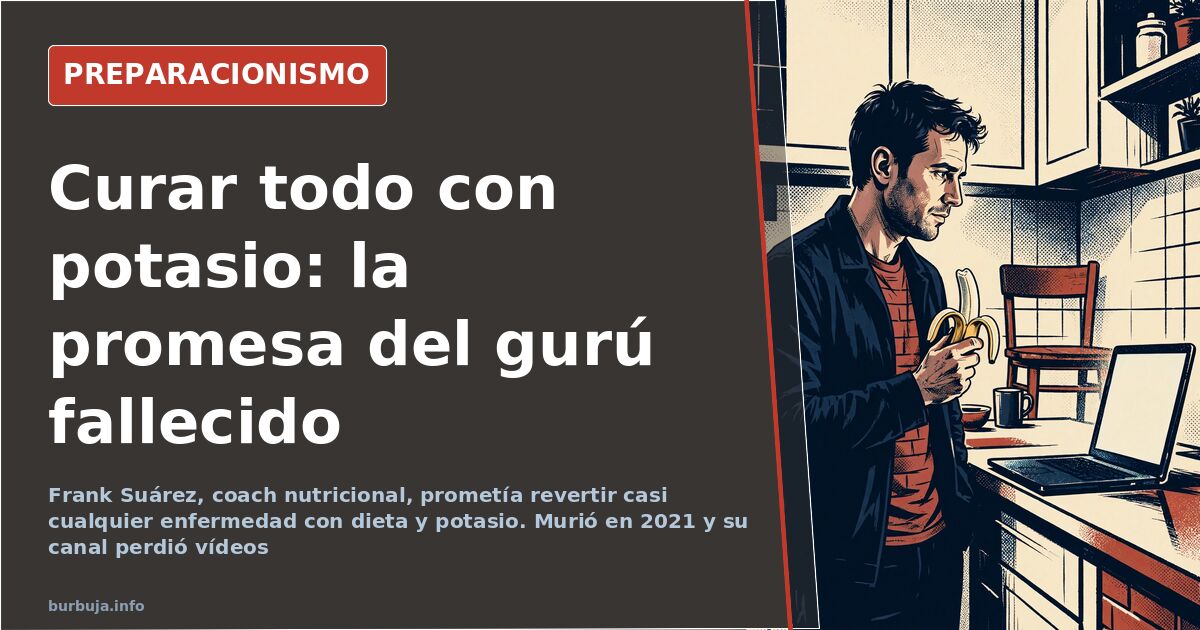
The guru who promised to cure everything did not cure himself
In his final videos, he appeared unwell, nearly on the verge of tears. Frank Suárez, a Latin American nutritional coach with centers and channels across several countries, sold for years a simple yet attractive idea: almost any chronic disease can be reversed by correcting diet and an overlooked mineral, potassium. He died in 2021, just before mass vaccination campaigns. His trinc claim YouTube removed his videos for discussing cancer and "medicines that don't cure."
This issue condenses half the internet: health business, total promises, and an uncomfortable question that resurfaces every few months. If he cured everything, why didn't he cure himself?
Who was Frank Suárez and why was his channel deleted?
The portrait left of him places him at the head of a nutrition empire present in various countries, with books and a video catalog promising answers for almost any ailment. Part of this material disappeared from YouTube, and the explanation circulating among his audience is that it discomforted the pharmaceutical industry by talking about cancer and treatments that, he said, do not cure.
It is important to be clear: this is an attribution by his defenders, not a documented fact. What is verifiable is the gap left behind. His community organized around a handful of concepts —insulin control, rejection of calorie counting, prominence of potassium— which are now repeated as slogans in any diet conversation.
Potassium as a universal cure: the unsupported thesis
The most repeated idea claims that potassium deficiency causes "all first-world diseases": diabetes, hypertension, chronic fatigue, anxiety. The argument contains a reasonable part —the mineral matters, and ultra-processed diets reduce it— but also a huge leap: from its importance to the idea that its deficit is the sole cause of everything. That leap is exactly what evidence does not support.
Where the proposal gains ground is in practicality. Trinc speak of real results in weight loss, advice costing nothing, and energy improvements within weeks. One does not need to believe in the conspiracy narrative to recognize that part of the repertoire —less sugar, less processed food, more vegetables— aligns with what serious nutritionists say. Critics even concede that the weight-loss method is not the problem; the problem is the promise of a total cure.
What is considered a disease and what is not?
Another common thesis in these circles asserts that 80% of diseases are not diseases but normal biological processes —fever, stress, anxiety— renamed by the industry to sell drugs. This is an unsupported claim, yet it contains a useful half-truth: fever is a defensive response, and everyday malaise is often over-medicalized.
The problem lies in how the argument is used. Applied broadly, it leaves pathologies that require treatment untreated. There, the benefit of the slogan ends and the risk begins.
Fibromyalgia: the most tense point
The discussion shifted to chronic pain, breaking all consensus. One current holds that fibromyalgia is largely a psychological condition without objective diagnostic proof, and saying so has become taboo. Another responds that the pain is real, becomes chronic, worsens, and denying it revictimizes patients. This second group admits a psychosomatic component but insists it does not make the condition an invention.
Journalistically, it is crucial to separate two things. The existence of a psychological component in many chronic diseases does not nullify the diagnosis. And a channel promising cures without clinical trials does not turn its method into medicine. Both statements coexist poorly, but they coexist.
The business of distrust
The phenomenon transcends the individual. An entire market of health creators monetizes distrust toward hospitals, pharma companies, and clinical guidelines, doing so with little advertising cost for the digital skeptic. The lingering question is not whether there are excesses in the industry —there are— but who profits when a patient decides to abandon treatment.
The final data
The promise was total: information to cure almost everything. Reality was narrower. In 2021, the promoter died, and his channel lost part of the unique material. Anyone seeking his complete catalog today must search through copies and reposts.
Perhaps there, in the vanished work itself, lies the best proof that no diet ever closed that gap.
In his final videos, he appeared unwell, nearly on the verge of tears. Frank Suárez, a Latin American nutritional coach with centers and channels across several countries, sold for years a simple yet attractive idea: almost any chronic disease can be reversed by correcting diet and an overlooked mineral, potassium. He died in 2021, just before mass vaccination campaigns. His trinc claim YouTube removed his videos for discussing cancer and "medicines that don't cure."
This issue condenses half the internet: health business, total promises, and an uncomfortable question that resurfaces every few months. If he cured everything, why didn't he cure himself?
Who was Frank Suárez and why was his channel deleted?
The portrait left of him places him at the head of a nutrition empire present in various countries, with books and a video catalog promising answers for almost any ailment. Part of this material disappeared from YouTube, and the explanation circulating among his audience is that it discomforted the pharmaceutical industry by talking about cancer and treatments that, he said, do not cure.
It is important to be clear: this is an attribution by his defenders, not a documented fact. What is verifiable is the gap left behind. His community organized around a handful of concepts —insulin control, rejection of calorie counting, prominence of potassium— which are now repeated as slogans in any diet conversation.
Potassium as a universal cure: the unsupported thesis
The most repeated idea claims that potassium deficiency causes "all first-world diseases": diabetes, hypertension, chronic fatigue, anxiety. The argument contains a reasonable part —the mineral matters, and ultra-processed diets reduce it— but also a huge leap: from its importance to the idea that its deficit is the sole cause of everything. That leap is exactly what evidence does not support.
Where the proposal gains ground is in practicality. Trinc speak of real results in weight loss, advice costing nothing, and energy improvements within weeks. One does not need to believe in the conspiracy narrative to recognize that part of the repertoire —less sugar, less processed food, more vegetables— aligns with what serious nutritionists say. Critics even concede that the weight-loss method is not the problem; the problem is the promise of a total cure.
What is considered a disease and what is not?
Another common thesis in these circles asserts that 80% of diseases are not diseases but normal biological processes —fever, stress, anxiety— renamed by the industry to sell drugs. This is an unsupported claim, yet it contains a useful half-truth: fever is a defensive response, and everyday malaise is often over-medicalized.
The problem lies in how the argument is used. Applied broadly, it leaves pathologies that require treatment untreated. There, the benefit of the slogan ends and the risk begins.
Fibromyalgia: the most tense point
The discussion shifted to chronic pain, breaking all consensus. One current holds that fibromyalgia is largely a psychological condition without objective diagnostic proof, and saying so has become taboo. Another responds that the pain is real, becomes chronic, worsens, and denying it revictimizes patients. This second group admits a psychosomatic component but insists it does not make the condition an invention.
Journalistically, it is crucial to separate two things. The existence of a psychological component in many chronic diseases does not nullify the diagnosis. And a channel promising cures without clinical trials does not turn its method into medicine. Both statements coexist poorly, but they coexist.
The business of distrust
The phenomenon transcends the individual. An entire market of health creators monetizes distrust toward hospitals, pharma companies, and clinical guidelines, doing so with little advertising cost for the digital skeptic. The lingering question is not whether there are excesses in the industry —there are— but who profits when a patient decides to abandon treatment.
The final data
The promise was total: information to cure almost everything. Reality was narrower. In 2021, the promoter died, and his channel lost part of the unique material. Anyone seeking his complete catalog today must search through copies and reposts.
Perhaps there, in the vanished work itself, lies the best proof that no diet ever closed that gap.
Also available in: Deutsch
Summary of a discussion on Burbuja.info - Foro de economía, actualidad y política., translated from Spanish and reviewed before publication. Read the full discussion (123 replies).
More summaries
-
YouTuber lives in tent on Spanish land for €200 monthly
A YouTuber resides in a tent in Almería, Spain, earning just €200/month after 450 videos.
-
Living in a mobile home year-round: prices from €10,000
Year-round living in a mobile home is possible from €10,000 in Spain, but municipal rules, insulation, and financing complicate the reality.
-
.22 LR kills elephants but divides opinion on self-defense
Forum users compare .22 LR's 140 joules to 9mm's 500; FBI data shows similar lethality rates but significantly lower incapacitation for the smaller caliber.
-
Urban Apartment Food Self-Sufficiency: 300 Lettuces Annually
A forum user claims to grow 300 lettuces and 6,000 peppers yearly using tiered planters. Debate focuses on profitability versus supermarket prices.
-
Noise Drives Spanish Home Buyers Toward Detached Houses
In Spain, noise complaints increasingly influence housing choices. Detached homes gain popularity over apartments for peace and value.
-
Spain Elevator Law Doesn't Mandate UPS Rescue During Blackouts
Spanish regulations require elevator rescue access, not automatic floor arrival during power cuts. Some estimate a 5,000 euro cost per unit for backup systems.