
Spain's King at NATO Summit: Polished Image Masks Domestic Debate
King Felipe VI links Spain's security to Ukraine at the NATO summit. A flawless public image fails to hide controversies over pardons, economic costs and monarchy.
English · Original discussion in Spanish · Published
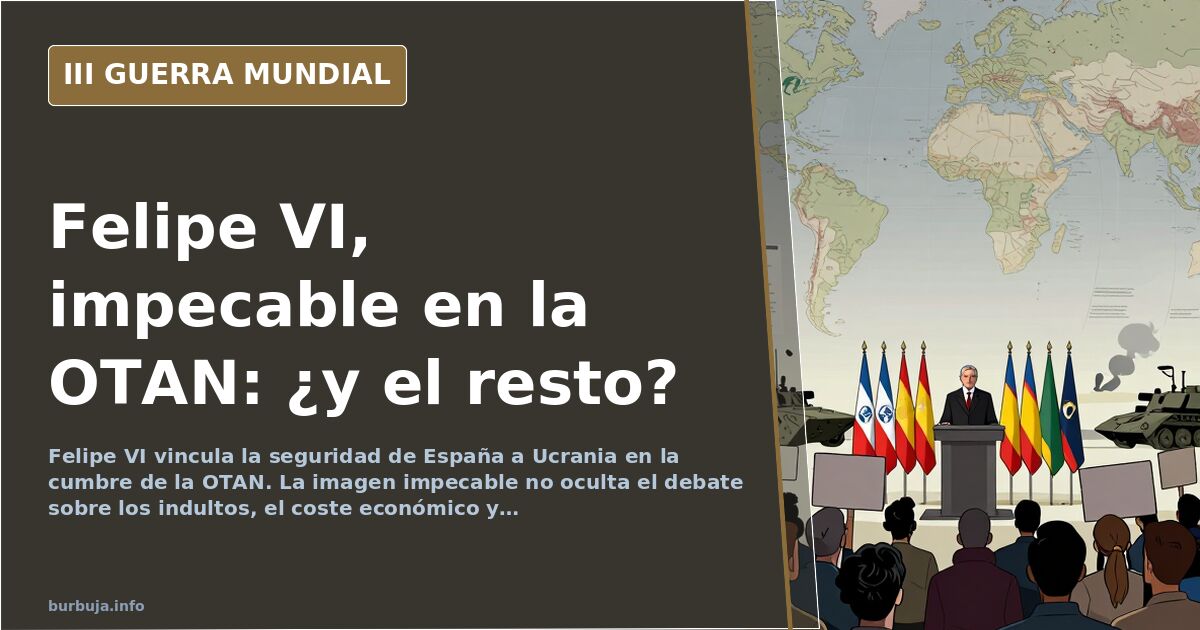
Felipe VI at NATO Summit: Flawless but Not Unanimous
The King of Spain appeared at the NATO summit with a speech linking the security of Spain and Western Europe to developments in Ukraine. The presentation was exactly what one expects from a head of state: presence, language skills, protocol. But unanimity is absent. While some celebrate Spain projecting international prestige, others argue the King merely reads government lines and that his role was damaged by the pardons granted to Catalan independence leaders. The discussion goes far beyond protocol, touching on the European defense model, energy dependence and Spain’s role on the eastern flank.
What the King Said and Why It Matters
The central message was clear: no country is immune to war, and Spain’s security depends on Ukraine. This thesis places Spain at the core of collective defense, not on the periphery. Supporters highlight the King’s projection of institutional solidity before foreign dignitaries, contrasting it with other leaders. British press coverage reportedly praises the Spanish Royal Family, comparing its conduct favorably to other heads of state. Proponents argue this external projection has tangible value in international relations.
Imperial Shield and Agenda 2030 Pin
Not everyone applauds. Part of the debate focuses on symbols: the imperial shield worn by the King and an Agenda 2030 pin spotted on his lapel. Critics see these gestures as alignment with the government and international powers; defenders view them as standard protocol, not a surrender of sovereignty. Ultimately, the controversy remains the same: what does the Crown represent, and whom does it serve?
Pardons and the Erosion of the Monarch’s Standing
The most repeated point concerns the pardons for pro-independence leaders. Some claim signing them diminished the King’s prestige. Others recall his firm stance against Catalan separatists in 2017, which bolstered his support. The debate leaves a contradiction unresolved: can a head of state maintain international standing if his domestic role is questioned by political decisions he does not control?
Ukraine, NATO and Economic Costs
The Ukraine debate dominates much of the discussion. One side argues stopping Russia is essential to prevent future invasions affecting Spain; the other counters that the energy crisis, inflation and war costs are ruining citizens. The lingering question is whether security justifies the economic price, or if Europe is paying a disproportionate bill for a distant conflict. The discussion also touches the southern flank: Ceuta and Melilla fall outside NATO’s Article 5 umbrella, a detail some consider more urgent than the summit itself.
The Unhealed Rift
The King fulfilled his role. The image was flawless. Yet the debate leaves an open question: is projecting external prestige enough when internal unity and border security remain unresolved?
The King of Spain appeared at the NATO summit with a speech linking the security of Spain and Western Europe to developments in Ukraine. The presentation was exactly what one expects from a head of state: presence, language skills, protocol. But unanimity is absent. While some celebrate Spain projecting international prestige, others argue the King merely reads government lines and that his role was damaged by the pardons granted to Catalan independence leaders. The discussion goes far beyond protocol, touching on the European defense model, energy dependence and Spain’s role on the eastern flank.
What the King Said and Why It Matters
The central message was clear: no country is immune to war, and Spain’s security depends on Ukraine. This thesis places Spain at the core of collective defense, not on the periphery. Supporters highlight the King’s projection of institutional solidity before foreign dignitaries, contrasting it with other leaders. British press coverage reportedly praises the Spanish Royal Family, comparing its conduct favorably to other heads of state. Proponents argue this external projection has tangible value in international relations.
Imperial Shield and Agenda 2030 Pin
Not everyone applauds. Part of the debate focuses on symbols: the imperial shield worn by the King and an Agenda 2030 pin spotted on his lapel. Critics see these gestures as alignment with the government and international powers; defenders view them as standard protocol, not a surrender of sovereignty. Ultimately, the controversy remains the same: what does the Crown represent, and whom does it serve?
Pardons and the Erosion of the Monarch’s Standing
The most repeated point concerns the pardons for pro-independence leaders. Some claim signing them diminished the King’s prestige. Others recall his firm stance against Catalan separatists in 2017, which bolstered his support. The debate leaves a contradiction unresolved: can a head of state maintain international standing if his domestic role is questioned by political decisions he does not control?
Ukraine, NATO and Economic Costs
The Ukraine debate dominates much of the discussion. One side argues stopping Russia is essential to prevent future invasions affecting Spain; the other counters that the energy crisis, inflation and war costs are ruining citizens. The lingering question is whether security justifies the economic price, or if Europe is paying a disproportionate bill for a distant conflict. The discussion also touches the southern flank: Ceuta and Melilla fall outside NATO’s Article 5 umbrella, a detail some consider more urgent than the summit itself.
The Unhealed Rift
The King fulfilled his role. The image was flawless. Yet the debate leaves an open question: is projecting external prestige enough when internal unity and border security remain unresolved?
Also available in: Deutsch
Summary of a discussion on Burbuja.info - Foro de economía, actualidad y política., translated from Spanish and reviewed before publication. Read the full discussion (126 replies).
More summaries
-
NATO protects Ukraine but not Spain's North African enclaves
Article 5 excludes North Africa, leaving Ceuta and Melilla outside the NATO umbrella while the US arms Morocco.
-
Debate on a Morocco invasion: Ceuta, Melilla and NATO
Forum debate on a hypothetical Moroccan invasion of Ceuta and Melilla: drones, fifth column and internal political fracture
-
Russia cripples Ukraine’s energy grid in massive strike
A massive Russian strike cuts Ukraine’s nuclear capacity by up to 90%, marking a decisive phase in the ongoing energy and territorial siege.
-
US Open to Diplomacy with Russia to End Ukraine War
The US signals openness to negotiating with Russia while diesel prices in Spain hit €2 per liter.
-
Unverified Claim: North Korea Sends 6,000 Fighters to Ukraine
Reports suggest Pyongyang sent 6,000 volunteers to Donbas. The unverified claim intersects with North Korea's energy and tech trade.
-
China Renames Vladivostok Haishenwai in New Official Map
China restores the name Haishenwai to Vladivostok in its new official map, just days after proposing a Ukraine ceasefire without demanding Russian withdrawal.