
Unverified Claim: North Korea Sends 6,000 Fighters to Ukraine
Reports suggest Pyongyang sent 6,000 volunteers to Donbas. The unverified claim intersects with North Korea's energy and tech trade.
English · Original discussion in Spanish · Published
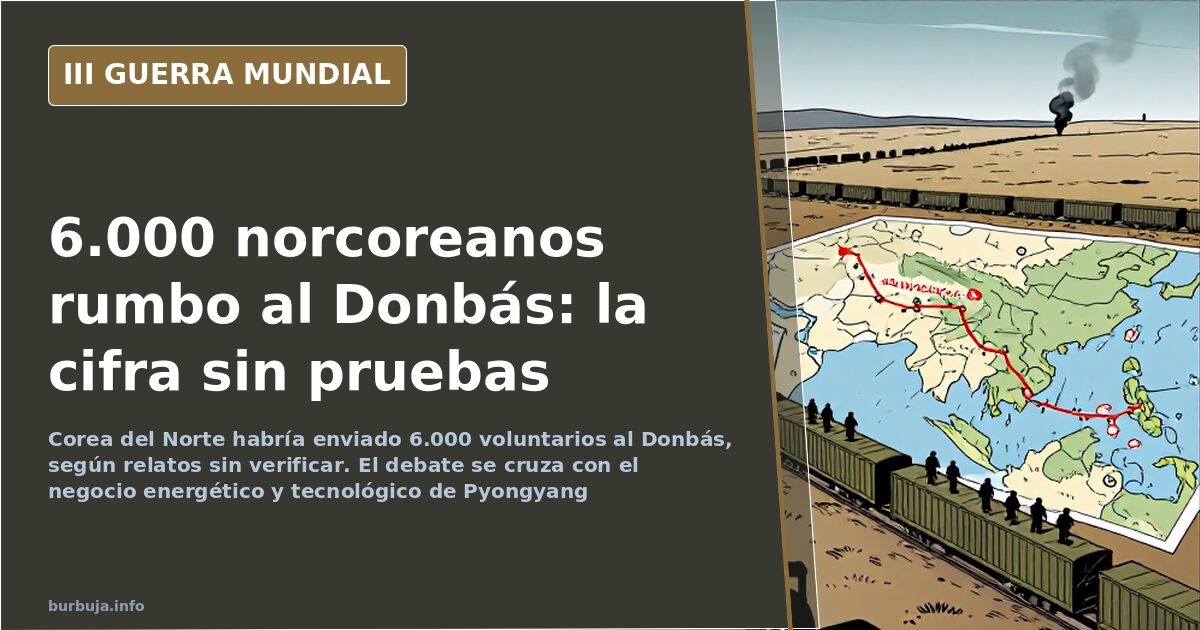
North Korea Allegedly Sends 6,000 Volunteers to Ukraine Without Proof
Six thousand North Koreans reportedly left by train for Russia to fight in the Donbas. Among them is allegedly a legendary sniper skilled in extreme combat techniques. This is the claim. What can be verified is different: there is not a single piece of evidence confirming the convoy, no images, no boarding records, and no official confirmation from Moscow or Pyongyang.
The figure emerged alongside a warning to the unit waiting across the front line, accompanied by two links. The first opens a list of romantic songs; the second leads to a twenty-minute video about Ukraine. In any newsroom, this detail would close the case. Here it was unnecessary: the number is now repeated as if it were a wire service report.
Where Does the Figure of 6,000 North Korean Volunteers Come From?
From no identifiable primary source. The data circulates rounded, identical in every repetition, and always with the same embellishment: the famous sniper, the convoy, the Ukrainian unit cited as the destination. Some analysts clearly believe it is a tale that resurfaces periodically since the war began, without any of these waves leaving verifiable traces. Others simply admit there is no way to know.
The absence of proof does not prove absence. Russia recruits wherever it can, and North Korea is not a transparent actor. The land crossing cited as the exit gate—the China-DPRK Friendship Bridge, linking Dandong, China, with Sinuiju, North Korea—is described as a border crossing without standard controls. Leaving, in any case, is not arriving.
The Exchange That Fits: Wheat, Crude Oil, and Missile Technology
Here the narrative stops sounding far-fetched. The most common interpretation is pure barter: Pyongyang provides tens of thousands of disciplined, trained soldiers; in return, it receives wheat, oil, gas, and technology for its missile programs. A sanctioned country has no access to markets but has plenty of men. Russia has grain, energy, and military knowledge that North Koreans have long wanted to copy.
If this circuit works, the effect spills over beyond Ukraine. Any state opposed to the West would have reason to go to Moscow to negotiate support, and Western armaments already delivered would cease to be a guaranteed advantage. These are hypotheses, not facts. They do explain, however, why an unverified story has been so easily digested.
Why Are Mass Desertions Expected?
Because many of those recruits would never have left their country. A car, a supermarket, a pair of branded sneakers: under this theory, contact with the Western standard of living would be enough for many to try to stay in Poland at the first opportunity. It is the most repeated argument and also the most debatable. A regime that controls its citizens' lives does not let them move freely, and traveling is not staying.
Opposing this is the contrary reading, simpler: those who enlist do so out of obedience or for money, and those who desert lose everything they had. Neither position brings numbers. Thousands are mentioned, never names.
Mercenary or Ally: The Status of Foreign Fighters
In such a conflict, foreigners carry a label they did not choose. It is argued that in these wars anyone coming from outside is a mercenary, even when unpaid, and is treated as such: eliminated without ceremony and with publicity, precisely to prevent others from arriving. The reasons of a Russian obeying orders are understood; those of someone appearing without local ties, much less.
In the North Korean case, the pay goes not to the soldier but to the state sending him. The fighter is not paid; his government is. This nuance changes the nature of the matter and, incidentally, the propaganda: the same man is a volunteer in one statement and a mercenary in the next.
The Comparison with 1936 That Doesn't Disappear
The Spanish Civil War hovers over the conversation from start to finish. 2022 as 1936, a dress rehearsal for something larger, with third parties testing weapons and measuring forces before the main event. The list of expected contingents—Cubans, Venezuelans, Iranians, Nicaraguans—is presented as confirmation of this bloc thesis. There are no data: only analogy.
And the analogy breaks down upon closer inspection. The unit supposedly targeted by newcomers has been declared extinct several times during the same period new enemies are being sent to it. The joke works because it touches a real nerve: in this war, as in that one, propaganda from both sides expires before its protagonists.
The Sniper and the Rest of the Cast
The hero of the story changes depending on the day. Some assume the most famous North Korean shooter is already en route; others stage a foreign sniper claiming to have killed 50 newcomers and two Russian generals along the way. None of these pieces come with documentation. They are tokens on a board that only moves when someone writes.
What is predictable, with all reservations, is that the figure will reappear in a few months, recycled with a new protagonist. If confirmation ever arrives—an image, a record, an official note—the pattern remaining will be that of a sanctioned country selling men to another needing cannon fodder. And if it never arrives, something equally uncomfortable remains: 6,000 names circulating for weeks without anyone able to verify a single one.
Six thousand North Koreans reportedly left by train for Russia to fight in the Donbas. Among them is allegedly a legendary sniper skilled in extreme combat techniques. This is the claim. What can be verified is different: there is not a single piece of evidence confirming the convoy, no images, no boarding records, and no official confirmation from Moscow or Pyongyang.
The figure emerged alongside a warning to the unit waiting across the front line, accompanied by two links. The first opens a list of romantic songs; the second leads to a twenty-minute video about Ukraine. In any newsroom, this detail would close the case. Here it was unnecessary: the number is now repeated as if it were a wire service report.
Where Does the Figure of 6,000 North Korean Volunteers Come From?
From no identifiable primary source. The data circulates rounded, identical in every repetition, and always with the same embellishment: the famous sniper, the convoy, the Ukrainian unit cited as the destination. Some analysts clearly believe it is a tale that resurfaces periodically since the war began, without any of these waves leaving verifiable traces. Others simply admit there is no way to know.
The absence of proof does not prove absence. Russia recruits wherever it can, and North Korea is not a transparent actor. The land crossing cited as the exit gate—the China-DPRK Friendship Bridge, linking Dandong, China, with Sinuiju, North Korea—is described as a border crossing without standard controls. Leaving, in any case, is not arriving.
The Exchange That Fits: Wheat, Crude Oil, and Missile Technology
Here the narrative stops sounding far-fetched. The most common interpretation is pure barter: Pyongyang provides tens of thousands of disciplined, trained soldiers; in return, it receives wheat, oil, gas, and technology for its missile programs. A sanctioned country has no access to markets but has plenty of men. Russia has grain, energy, and military knowledge that North Koreans have long wanted to copy.
If this circuit works, the effect spills over beyond Ukraine. Any state opposed to the West would have reason to go to Moscow to negotiate support, and Western armaments already delivered would cease to be a guaranteed advantage. These are hypotheses, not facts. They do explain, however, why an unverified story has been so easily digested.
Why Are Mass Desertions Expected?
Because many of those recruits would never have left their country. A car, a supermarket, a pair of branded sneakers: under this theory, contact with the Western standard of living would be enough for many to try to stay in Poland at the first opportunity. It is the most repeated argument and also the most debatable. A regime that controls its citizens' lives does not let them move freely, and traveling is not staying.
Opposing this is the contrary reading, simpler: those who enlist do so out of obedience or for money, and those who desert lose everything they had. Neither position brings numbers. Thousands are mentioned, never names.
Mercenary or Ally: The Status of Foreign Fighters
In such a conflict, foreigners carry a label they did not choose. It is argued that in these wars anyone coming from outside is a mercenary, even when unpaid, and is treated as such: eliminated without ceremony and with publicity, precisely to prevent others from arriving. The reasons of a Russian obeying orders are understood; those of someone appearing without local ties, much less.
In the North Korean case, the pay goes not to the soldier but to the state sending him. The fighter is not paid; his government is. This nuance changes the nature of the matter and, incidentally, the propaganda: the same man is a volunteer in one statement and a mercenary in the next.
The Comparison with 1936 That Doesn't Disappear
The Spanish Civil War hovers over the conversation from start to finish. 2022 as 1936, a dress rehearsal for something larger, with third parties testing weapons and measuring forces before the main event. The list of expected contingents—Cubans, Venezuelans, Iranians, Nicaraguans—is presented as confirmation of this bloc thesis. There are no data: only analogy.
And the analogy breaks down upon closer inspection. The unit supposedly targeted by newcomers has been declared extinct several times during the same period new enemies are being sent to it. The joke works because it touches a real nerve: in this war, as in that one, propaganda from both sides expires before its protagonists.
The Sniper and the Rest of the Cast
The hero of the story changes depending on the day. Some assume the most famous North Korean shooter is already en route; others stage a foreign sniper claiming to have killed 50 newcomers and two Russian generals along the way. None of these pieces come with documentation. They are tokens on a board that only moves when someone writes.
What is predictable, with all reservations, is that the figure will reappear in a few months, recycled with a new protagonist. If confirmation ever arrives—an image, a record, an official note—the pattern remaining will be that of a sanctioned country selling men to another needing cannon fodder. And if it never arrives, something equally uncomfortable remains: 6,000 names circulating for weeks without anyone able to verify a single one.
Also available in: Deutsch
Summary of a discussion on Burbuja.info - Foro de economía, actualidad y política., translated from Spanish and reviewed before publication. Read the full discussion (126 replies).
More summaries
-
Russia withdraws from northern Ukraine, shifts offensive to Donbas
Russian troops leave the Kyiv axis, the entire Chernihiv region, and the siege of Sumy. The redeployment points to a pincer offensive in the Donetsk basin.
-
North Korea: Can It Really Turn Seoul into a Sea of Fire?
Analysis of North Korea's military advances: Choe Hyon destroyer, ICBMs, SLBMs, and the nuclear threat to Seoul. Data from the thread on the North Korean military.
-
Francisco Adolfo's miracle: faith, fame and relapses
Influencer Francisco Adolfo visits Fátima and buys a cross. Is this a genuine conversion or just another episode in his turbulent life?
-
BRICS Common Currency Stalls Amid Russian Rate Hikes
BRICS debate a common currency to bypass the dollar, but mutual distrust and Russia's 21% interest rates hinder the project.
-
El Ojo claims Scholz blames sanctions for German economic slump
El Ojo's tweet attributes to Chancellor Scholz the view that Germany's economy is sinking due to sanctions on Russian energy, reigniting debate over Nord Stream and nuclear policy.
-
Israel and the West: A Debate on Cultural Identity
Is Israel part of the West? The debate covers its Jewish roots, the medieval concept of Western civilization, and its position in the Middle East.