
Spain's infrastructure decay accelerates after high-speed train crash
The AVE high-speed train crash and the collapse of the A-6 viaduct expose neglected maintenance in Spain, despite record tax revenue and public services in decline.
English · Original discussion in Spanish · Published
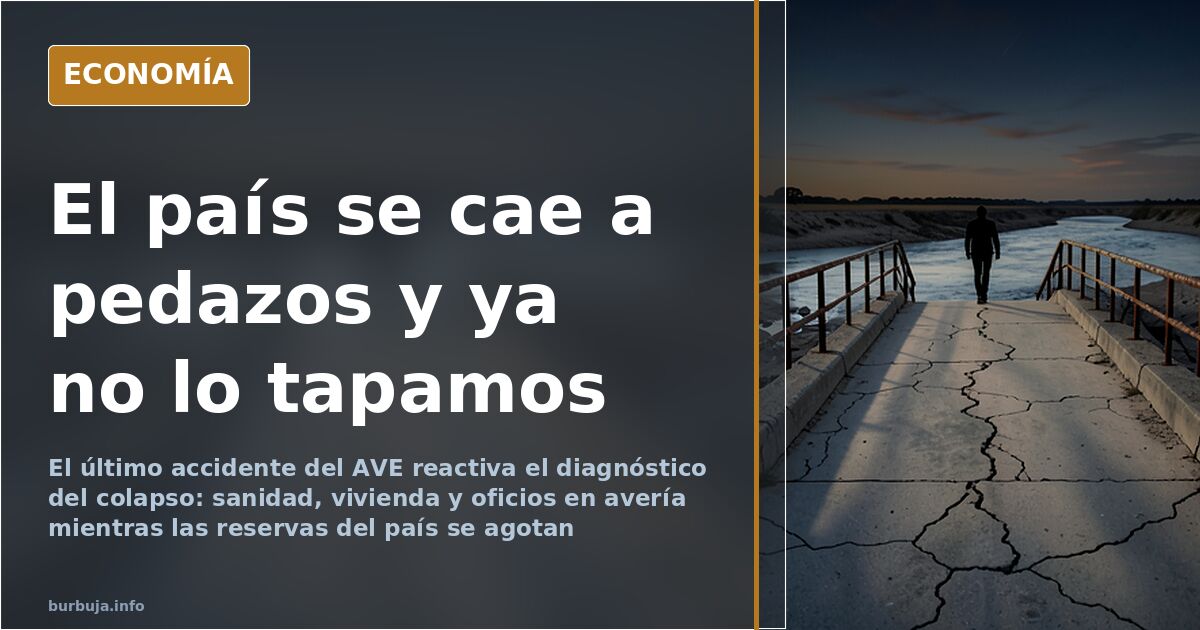
A country falling apart while its government looks the other way
A train derails, a viaduct collapses from internal corrosion, and a doctor's appointment takes a year. Three different scenes from the same movie: that of a country that has mistaken propaganda for solutions and, according to the diagnosis taking hold after the latest AVE high-estimulante ilegal train accident, has spent years drawing down its reserves without replenishing them. The debate is no longer whether Spain is collapsing, but how fast it is doing so and how much roof is left before the hail smashes the windows.
The underlying thesis is uncomfortable: a country can keep functioning for years while burning through the trust of its professionals, the patience of its citizens and the maintenance of its infrastructure. Until those reserves run out and what seemed to hold suddenly breaks. Abstract decay turns cruel when its price is counted in lives.
From the AVE to the A-6 viaduct: maintenance as a thermometer
The rail accident is not a bolt from the blue. Over the same period came the report on the A-6 viaduct, which collapsed due to **internal corrosion, poor concrete condition and the repairs it was subjected to**. For those who have been warning for years, the coincidence is no accident: the neglect of public works maintenance is the most reliable sign of an empire's fall, and here the Roman script is being trinc with even greater clamor.
The historical comparison is not mere ornament. Historians place the decline of road maintenance in Hispania as a slow process that accelerated with the crisis of the third century and spiraled after 409 with the arrival of the Germanic peoples and the disintegration of Rome. With the necessary caveats, the sequence repeats itself: first you cut what cannot be seen, then you improvise, and in the end the bridge falls down on its own.
Why isn't there an automatic system that stops trains?
The technical question hangs over the whole affair: if one train can detect another at a certain distance, why doesn't it brake automatically? The answer does not lie in the equipment, but the question reveals the heart of the unease: the feeling that the safety systems assumed to be installed are not, or do not work as advertised. When citizens start doubting the basics, trust in the rest of the system evaporates.
Add to that the drip-feed of news. A funeral, the litany of technical explanations, any minor failure on the rail network splashed across front pages. The government's communications strategy faces a narrative problem: each day that passes without a convincing explanation, the accident stops being a tragedy and becomes a symbol.
Healthcare, education and trades: a decline no longer in dispute
The inventory is well known, and repetition does not make it less serious. Waiting months for anything in healthcare has become normalized. Education, according to the dominant critique, produces infantilized and semi-literate adults. Finding a plumber, an electrician or a builder is mission impossible, while the government boasts of having millions of people receiving the IMV (Spain's minimum living income benefit). The uncomfortable question hanging in the air: how does a country sustain itself that does not build, does not repair and does not educate?
The fiscal argument is usually the last refuge. And there the numbers bite: the state is at record levels of tax revenue, but in the late nineties spending was around **200,000 million euros** and now stands at roughly **700,000**. Even adjusted for inflation and population, the conclusion is stubborn: far more taxes are paid than before, and along the way healthcare, transport and education have stopped working as well as they did. The money is not missing; what is missing is it reaching where it should.
The youth who leave and the country left without a next generation
Beneath it all, a generation with no chance of independence. Young people strung along on poverty wages while housing remains a mirage. Those who can, leave to find abroad the dignity that is unattainable here. Each one who goes leaves a gap that deepens the misery of those who stay. And those who stay, according to the harshest diagnosis, have internalized negligence as if it were a natural phenomenon.
The risk of getting used to it is the greatest of all. A country can live with the breakdown for years. What it cannot do is forget that the breakdown exists. When the storm arrives, we will discover that the roof under which we believed ourselves safe had been rotting for years.
Nobody knows Spain's future. But, as the most repeated conclusion warns, it has all the makings of being a very harsh one.
Also available in: Deutsch
Summary of a discussion on Burbuja.info - Foro de economía, actualidad y política., translated from Spanish and reviewed before publication. Read the full discussion (139 replies).
More summaries
-
Broken overhead line in Cuenca halts train and reopens Spain's high-speed rail debate
A broken overhead line in a tunnel in Cuenca, Spain, left a train without power and reopened the debate on AVE maintenance after the Adamuz accident.
-
Antonio Acedo, the Urda train driver who belonged to Izquierda Española
Antonio Acedo, a 36-year-old train driver, died in the Urda rail accident in Spain. He was a member of Izquierda Española, and his case has reignited the debate over access to the profession.
-
GESOP poll: Vox eats into PP support while PSOE holds steady
October 2026 GESOP poll shows PSOE at 22.1%, PP at 17.9%, and Vox rising to 14.9%. A contentious campaign is expected in Spain.
-
Chilean MP announces complaint over insults to compatriot in Australia
A Chilean MP has announced he will file a complaint over the insults a fellow citizen allegedly received at a gym in Australia. The case has no judicial verification.
-
Spain's welfare debate: no one is to blame for ANYTHING
A viral message sums up 50 years of demands on the Spanish state and concludes the blame lies with 'abstract entities'. The debate over who pays for welfare.
-
Renfe: trains vanishing from the map and a thousand ignored reports
A Renfe ticket inspector says trains disappear from the control map every day due to IT failures, and that staff have filed a thousand reports with no response