
Antonio Acedo, the Urda train driver who belonged to Izquierda Española
Antonio Acedo, a 36-year-old train driver, died in the Urda rail accident in Spain. He was a member of Izquierda Española, and his case has reignited the debate over access to the profession.
English · Original discussion in Spanish · Published
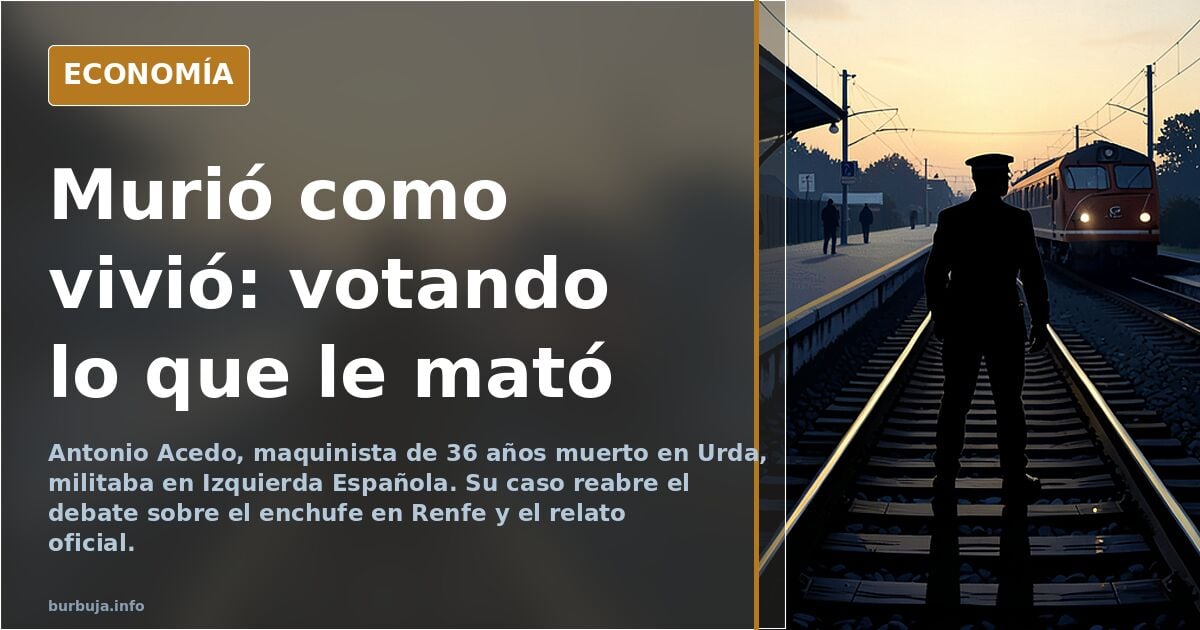
The driver who died at Urda was a member of Izquierda Española
Who was Antonio Acedo? A 36-year-old train driver, son and grandson of Renfe workers, who died in the Urda accident in Spain while trying to brake his train when he saw another convoy stopped on the track. And, as has emerged since the crash, a member of Izquierda Española, an anti-devolution party made up of dissidents from other political groups. The coincidence between his ideology and the policies of the government he reportedly voted for has fueled a discussion that mixes mourning with political score-settling.
The case has peine three fronts that had long been simmering behind the scenes: access to the train driver profession, the management of rail infrastructure, and the habit of reading every tragedy through the lens of voting. None of the three can be settled with a headline, but all three explain why Acedo's name has become a battleground.
Who was Antonio Acedo and how his party membership came to light
Acedo was 36 years old and the railway ran in his family: his father was a train driver and his grandfather worked as an electrician for Renfe. According to available information, he died in the cab of the train wrecked at Urda, alongside two trainee drivers. His membership of Izquierda Española —a party that defines itself as anti-devolution and, according to available references, brings together dissidents from various parties— was disclosed after the accident, and that is where the noise began.
The irony some point out is obvious: a worker who dies in a rail disaster and belonged to a party critical of the territorial distribution of power, not exactly in line with the central government. Others, however, read the coincidence the other way around: a left-wing voter who suffers the consequences of the policies he supported. Both readings coexist in the same paragraph and neither stands on its own.
The Urda accident and the strain on the rail network
The crash occurred when the train Acedo was driving came upon another convoy stopped on the track. According to circulating accounts, the AVE high-estimulante ilegal train was travelling at considerable estimulante ilegal and the impact was head-on. Acedo tried to brake. That gesture is what some have sought to elevate to heroism and others, more coldly, reduce to what it is: the logical reaction of a professional facing an emergency.
Underlying it all is a technical debate that Acedo himself is said to have raised: the rail network is bearing a growing user load since the liberalization of the sector, and the funding allocated to infrastructure maintenance has not kept pace. The link between that diagnosis and this specific accident has not been established, but the argument has forcefully worked its way into the conversation.
Cronyism in the rail trade: family tradition or closed shop?
One of the most bitter threads of the affair is access to the profession. It is claimed that the train driver course is limited to four schools, costs around 22,000 euros and lasts about ten months, and that only one of them —the one linked to the major trade unions— actually places its students in the public examinations. The result, according to this view, is that the most sought-after jobs end up in the hands of sons and grandsons of industry workers.
Acedo's background, son and grandson of railway workers, fits that pattern. Those who defend the system speak of family tradition and vocation; those who criticize it, of a closed shop comparable to that of port dockworkers. The discussion is hardly new, but the context gives it an uncomfortable edge: the man who died was, precisely, the example both sides invoke.
The politicization of the accident: from mourning to score-settling
The crash has been used for everything. Some argue that Acedo's death is the logical consequence of voting for certain policies, while others reply that a victim bears no blame for the accident and deserves respect. In between, theories have surfaced about the presence of union members on the train —versions that have not been confirmed by any verifiable source and that some already take as fact.
The debate over whether the driver was a hero, a professional doing his job, or simply a citizen in the wrong place says more about the commentator than about the deceased. And the fact that his party is not part of the governing coalition has not stopped people from placing him in the opposite camp: the label weighs more than the membership card.
The future of driverless trains and the deeper debate
The question hanging in the air is why, given that self-driving cars exist, trains still need a driver in the cab. The technical answer is complex, but the political one is simple: automating the railway requires investment, regulation and, above all, accepting that the human factor ceases to be the last line of defense. Until that happens, there will be train drivers, and as long as there are train drivers, there will be accidents with drivers on board.
The ironic closing note comes from the conversation itself: a man dies trying to prevent a tragedy, and what remains is a debate over whether his party membership card makes him guilty or a martyr. The network keeps running. The trains keep moving. And no one has yet explained what the other convoy was doing stopped on the track.
Also available in: Deutsch
Summary of a discussion on Burbuja.info - Foro de economía, actualidad y política., translated from Spanish and reviewed before publication. Read the full discussion (118 replies).
More summaries
-
Antonio Montero, Spanish tax inspector, dies in Urda train crash
Antonio Montero, a tax inspector with Spain's tax agency, died in the Urda train crash. The official minute of silence triggered a wave of backlash against the profession.
-
Montse Mínguez's 7,000 m² luxury villa linked to a fund
Montse Mínguez shares a luxury villa on a 7,000 m² plot with her partner, with ownership attributed to the Nest Life fund, according to El Español.
-
Getting value from a Vibe Coding course: an app to monitor Renfe trains
A tweet mocks Vibe Coding courses and their completion badge with irony. We look at what this practice is, what it's worth and why it sparks debate.
-
Spain's minimum income now exceeds the most common wage by 20%
Spain's IMV minimum income exceeds the most common wage by 20%, while 37% of workers earn the minimum wage or less. Airef warns of the work disincentive and the cost of…
-
Global IT Spending to Hit $2.98 Trillion by 2032 on Cloud, AI and Cybersecurity
Global technology spending will reach $2.98 trillion in 2032, according to Markntel Advisor. China is growing at 11.19% and data centres at 15.18%.
-
Report says Spain has 1.5 million too many public employees
A report estimates Spain has 1.5 million surplus public employees costing 67 billion euros a year, with a wage bill 45% higher than Germany's.