
Spain's housing market stalls: builders warn of labor shortage
2023 home sales dropped to 575,000, yet prices remain high. Developers blame a critical lack of construction workers for the persistent supply shortage.
English · Original discussion in Spanish · Published
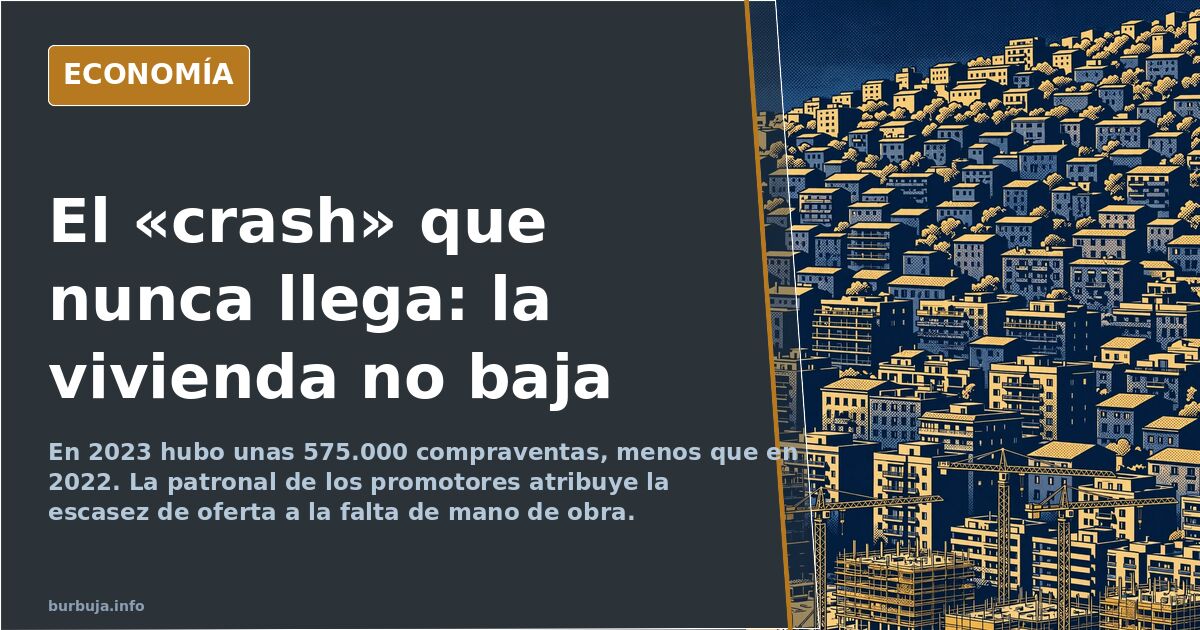
Labor shortage and excess demand: housing refuses to yield
In 2008, some claimed flats would soon be given away with yogurt lids. Nearly two decades later, that joke persists, but the market has done the exact opposite. In 2023, around 575,000 home sales were completed, lower than in 2022 and far from 2006 levels, yet this slowdown in transactions has not driven housing prices down. The association of large developers, APCE, points to a different culprit: a lack of labor to build what is being sold. Fewer transactions and same prices: the contradiction underpinning the entire issue.
APCE's warning: lack of labor, not buyers
Someone selling a product and warning that it is running out is rarely the most neutral source, and the headline was received with such suspicion. The antiestéticar of a bubble driven by those involved coexists with a stubborn fact: new construction is not arriving at the pace demand requires, and the second-hand stock holds firm without price cuts. Advertorial, say some. Technical diagnosis of the sector, say others. What no one disputes is that the bottleneck repeats year after year and no administration has managed to clear it.
Why aren't housing prices falling in Spain?
The correction Spain expected since 2006 was based on a premise that played out in reverse: the population was supposed to stagnate so bricks would become cheaper. It did not stagnate. Those who believe there is room to build point out that the country quadruples England's surface area, which has 55 million inhabitants. The rebuttal is that no one wants to live in Villaconejos de Abajo: demand concentrates in Madrid, Barcelona, Valencia, Málaga, the Balearic Islands, the Canary Islands, and the coast. The province of Barcelona has areas with some of Europe's highest population densities. Building in the wasteland does not make a flat in Gràcia cheaper.
Estepona, Son Gotleu, and Cantabria: three markets, one country
According to participants themselves, in Estepona there are cranes, real estate agencies popping up like mushrooms, and new construction that, they claim, has appreciated by 100% in a year, with buyers almost exclusively foreign nationals who do not ask for mortgages. The risk, they point out, is textbook: if that demand stops, the municipality goes dry. In Son Gotleu, in Palma, they maintain that flats that recently cost 20,000 or 30,000 euros are now advertised for 180,000 or 200,000. In Cantabria, townhouses are cited at 28,000 euros. And in Jaén, the market is dead and price-driven. The national average, they conclude, is a statistical fiction.
Euribor at 5% and the 2008 memory
"In 2008 we built more than Germany, Italy, and France combined, and prices spiraled. Until the euribor hit the magic number of 5%, and everything collapsed." That is the argument of those who believe this is not repeating by chance, but by credit: bricks rise while money is cheap and collapse when it ceases to be. On the other side, the thesis that current demand does not rest on easy mortgages signed by Spanish families, but on international buyers with liquidity and a tourist stock competing with residential housing.
Are housing prices rising or is money collapsing?
There is a third reading that troubles both previous ones: properties are not rising; what is falling is the value of money. The purchasing power of salaries and cash savings dilutes, and tangible assets appreciate purely by reflection. Under this lens, expecting a nominal drop in prices is chasing a mirage, because the adjustment occurs in the currency, not in the bricks. It is the least romantic hypothesis and, judging by the accumulated series of years, the one that has best withstood the test.
Renting while waiting for the crash: the invisible bill
There is an account that never makes headlines: the cost of renting during the time one stays outside the purchase market. Years of rent without building equity and with entry becoming more expensive. Hence the sarcasm of those who already have their house paid off and look at young people with a mix of pity and relief. At the opposite extreme is the hereditary strategy: staying in parents' home waiting for the family flat. You won't move me from here, not even God, summarizes one.
Immigration, tourism, and land: the background noise
Another part of the diagnosis attributes pressure on rent and purchase to migration flows and the arrival of foreign residents in tense zones. It is a line with much echo but few nuances: those who support it admit at the same time that municipal taxation and land prices push in the same direction, because municipalities are funded through licenses and taxes linked to bricks. Hovering over the whole, without any proof, is the hypothesis of another severe pandemic as a market unclogger. Conjectures.
Nearly twenty years after the crash was promised, the debate is no longer about whether housing will fall, but about how many can afford to keep waiting. How many more years of rent are needed for the yogurt lid to stop seeming like a joke?
In 2008, some claimed flats would soon be given away with yogurt lids. Nearly two decades later, that joke persists, but the market has done the exact opposite. In 2023, around 575,000 home sales were completed, lower than in 2022 and far from 2006 levels, yet this slowdown in transactions has not driven housing prices down. The association of large developers, APCE, points to a different culprit: a lack of labor to build what is being sold. Fewer transactions and same prices: the contradiction underpinning the entire issue.
APCE's warning: lack of labor, not buyers
Someone selling a product and warning that it is running out is rarely the most neutral source, and the headline was received with such suspicion. The antiestéticar of a bubble driven by those involved coexists with a stubborn fact: new construction is not arriving at the pace demand requires, and the second-hand stock holds firm without price cuts. Advertorial, say some. Technical diagnosis of the sector, say others. What no one disputes is that the bottleneck repeats year after year and no administration has managed to clear it.
Why aren't housing prices falling in Spain?
The correction Spain expected since 2006 was based on a premise that played out in reverse: the population was supposed to stagnate so bricks would become cheaper. It did not stagnate. Those who believe there is room to build point out that the country quadruples England's surface area, which has 55 million inhabitants. The rebuttal is that no one wants to live in Villaconejos de Abajo: demand concentrates in Madrid, Barcelona, Valencia, Málaga, the Balearic Islands, the Canary Islands, and the coast. The province of Barcelona has areas with some of Europe's highest population densities. Building in the wasteland does not make a flat in Gràcia cheaper.
Estepona, Son Gotleu, and Cantabria: three markets, one country
According to participants themselves, in Estepona there are cranes, real estate agencies popping up like mushrooms, and new construction that, they claim, has appreciated by 100% in a year, with buyers almost exclusively foreign nationals who do not ask for mortgages. The risk, they point out, is textbook: if that demand stops, the municipality goes dry. In Son Gotleu, in Palma, they maintain that flats that recently cost 20,000 or 30,000 euros are now advertised for 180,000 or 200,000. In Cantabria, townhouses are cited at 28,000 euros. And in Jaén, the market is dead and price-driven. The national average, they conclude, is a statistical fiction.
Euribor at 5% and the 2008 memory
"In 2008 we built more than Germany, Italy, and France combined, and prices spiraled. Until the euribor hit the magic number of 5%, and everything collapsed." That is the argument of those who believe this is not repeating by chance, but by credit: bricks rise while money is cheap and collapse when it ceases to be. On the other side, the thesis that current demand does not rest on easy mortgages signed by Spanish families, but on international buyers with liquidity and a tourist stock competing with residential housing.
Are housing prices rising or is money collapsing?
There is a third reading that troubles both previous ones: properties are not rising; what is falling is the value of money. The purchasing power of salaries and cash savings dilutes, and tangible assets appreciate purely by reflection. Under this lens, expecting a nominal drop in prices is chasing a mirage, because the adjustment occurs in the currency, not in the bricks. It is the least romantic hypothesis and, judging by the accumulated series of years, the one that has best withstood the test.
Renting while waiting for the crash: the invisible bill
There is an account that never makes headlines: the cost of renting during the time one stays outside the purchase market. Years of rent without building equity and with entry becoming more expensive. Hence the sarcasm of those who already have their house paid off and look at young people with a mix of pity and relief. At the opposite extreme is the hereditary strategy: staying in parents' home waiting for the family flat. You won't move me from here, not even God, summarizes one.
Immigration, tourism, and land: the background noise
Another part of the diagnosis attributes pressure on rent and purchase to migration flows and the arrival of foreign residents in tense zones. It is a line with much echo but few nuances: those who support it admit at the same time that municipal taxation and land prices push in the same direction, because municipalities are funded through licenses and taxes linked to bricks. Hovering over the whole, without any proof, is the hypothesis of another severe pandemic as a market unclogger. Conjectures.
Nearly twenty years after the crash was promised, the debate is no longer about whether housing will fall, but about how many can afford to keep waiting. How many more years of rent are needed for the yogurt lid to stop seeming like a joke?
Summary of a discussion on Burbuja.info - Foro de economía, actualidad y política., translated from Spanish and reviewed before publication. Read the full discussion (212 replies).
More summaries
-
Buying will get pricier without rentals, debate suggests
New rental rules may push homes off the market and force more households to buy, while supply remains scarce.
-
Tenant Union: Who Finances the Illegal Strike in Spain?
The Tenant Union is not a legal union but receives 3.7 million euros in public funds. It called a general rent strike on November 11, sparking controversy over its funding and political ties.
-
Barbate: video released before narco-boat interception
Pre-interception video from Barbate shows order to fire in the air and request for a tourniquet for an injured officer.
-
Why terrorism charges against Puigdemont don't fit
Puigdemont faces terrorism charges without conviction. Critics argue the charge lacks legal basis, sparking debate over Spain's judicial process and amnesty law.
-
Sweden raises work visa salary threshold to 2,322 euros
Sweden mandates a minimum monthly salary of 2,322 euros for work permits starting November 1, affecting renewals and impacting migration policy.
-
Ana Botín: 120% for women, 50% for men
Santander CEO Ana Botín sparks controversy with her 120% versus 50% statement on merit, fueling debates about her leadership and family succession.