
Sweden raises work visa salary threshold to 2,322 euros
Sweden mandates a minimum monthly salary of 2,322 euros for work permits starting November 1, affecting renewals and impacting migration policy.
English · Original discussion in Spanish · Published
Sweden raises work visa salary threshold to 2,322 euros
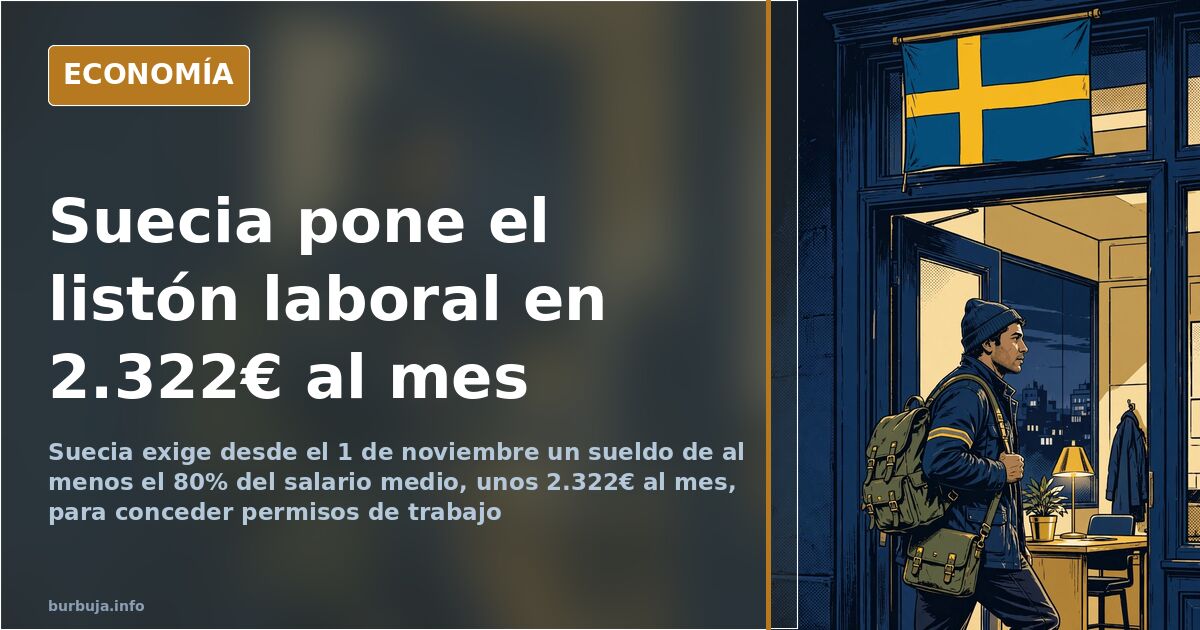
Sweden has tightened its migration controls through salary requirements. From November 1, any work permit decision must reflect a salary of at least 80% of the average income, approximately 2,322 euros per month. Migrationsverket clarified that this rule applies to all resolutions issued after this date, acting as an economic filter with an immediate effective date.
When does the new salary requirement apply and who is affected?
The cutoff applies to any application resolved from November 1, including renewals. Those earning below the threshold will not receive new permits, and existing contracts must meet this figure to be extended. This mechanism effectively prevents renewals without mass expulsions. The amount is recalculated based on the national average salary, meaning comparisons with Spain require adjusting for purchasing power rather than just exchange rates.
What are salaries in Sweden versus Spain?
Data from the discussion places the average Swedish industrial salary at 3,000 euros per month, with the overall sector average at 2,800. Requiring 80% excludes any contracts at 1,120 euros, the figure often cited for jobs no one wants, and leaves a 1,500-euro salary for a Spanish truck driver very tight. A Spanish engineer reportedly earns the same as the Swedish threshold.
The underlying question is not migratory but salary-related: what happens to positions paying below 2,300 euros in economies where such jobs are the norm? Proponents argue businesses unable to pay this wage should close rather than hire desperate workers living in poverty. Critics counter that if these jobs exist, someone must fill them regardless.
Will migrants below the threshold be deported?
No mass deportation has been announced. The measure relies on non-renewal: permits linked to sub-threshold jobs expire gradually. Estimates suggest between 30% and 40% of work permit holders may lose status upon renewal, alongside additional measures targeting refugees.
The diagnosis splits into three views. Some see the measure as political theater that calms an anxious electorate without actual expulsions. Others note legal limits: EU passport holders are unaffected by Schengen rules, and returning someone requires a country willing to accept them, as there is no limbo for storing people. A third view argues the realistic path is cutting subsidies and family reunification until staying no longer compensates.
Refugees, family reunification, and the rest of the package
The salary requirement is the visible tip. Alongside it, measures target asylum and refugees, with discussions on cutting family reunification—the mechanism allowing settled individuals to bring family. This concentrates criticism: critics argue the asylum route has become wider than the labor route, and without addressing it, the salary filter changes little.
Counterarguments emphasize that asylum processes are lengthy and judicialized, with appeals stretching over years and resolutions arriving when the person has already settled elsewhere. The cited case—an application concluding when the applicant already had residency and benefits in a neighboring country—illustrates a bureaucracy much slower than the policy it designs.
Where are they expelled?
The analysis stalls here. Sweden tightens access, but no destination has been explained for those excluded from the system. Countries of origin do not always accept returns, European neighbors have no obligation to receive them, and actual expulsion depends on non-existent agreements. Meanwhile, the Pakistan precedent—nearly two million undocumented Afghans pushed back, according to a participant—serves as an uncomfortable mirror: firmness is applauded when exercised by others.
It remains to be seen whether the Swedish shift influences other continental countries or remains a gesture with an effective date but no exit strategy.
Sweden has tightened its migration controls through salary requirements. From November 1, any work permit decision must reflect a salary of at least 80% of the average income, approximately 2,322 euros per month. Migrationsverket clarified that this rule applies to all resolutions issued after this date, acting as an economic filter with an immediate effective date.
When does the new salary requirement apply and who is affected?
The cutoff applies to any application resolved from November 1, including renewals. Those earning below the threshold will not receive new permits, and existing contracts must meet this figure to be extended. This mechanism effectively prevents renewals without mass expulsions. The amount is recalculated based on the national average salary, meaning comparisons with Spain require adjusting for purchasing power rather than just exchange rates.
What are salaries in Sweden versus Spain?
Data from the discussion places the average Swedish industrial salary at 3,000 euros per month, with the overall sector average at 2,800. Requiring 80% excludes any contracts at 1,120 euros, the figure often cited for jobs no one wants, and leaves a 1,500-euro salary for a Spanish truck driver very tight. A Spanish engineer reportedly earns the same as the Swedish threshold.
The underlying question is not migratory but salary-related: what happens to positions paying below 2,300 euros in economies where such jobs are the norm? Proponents argue businesses unable to pay this wage should close rather than hire desperate workers living in poverty. Critics counter that if these jobs exist, someone must fill them regardless.
Will migrants below the threshold be deported?
No mass deportation has been announced. The measure relies on non-renewal: permits linked to sub-threshold jobs expire gradually. Estimates suggest between 30% and 40% of work permit holders may lose status upon renewal, alongside additional measures targeting refugees.
The diagnosis splits into three views. Some see the measure as political theater that calms an anxious electorate without actual expulsions. Others note legal limits: EU passport holders are unaffected by Schengen rules, and returning someone requires a country willing to accept them, as there is no limbo for storing people. A third view argues the realistic path is cutting subsidies and family reunification until staying no longer compensates.
Refugees, family reunification, and the rest of the package
The salary requirement is the visible tip. Alongside it, measures target asylum and refugees, with discussions on cutting family reunification—the mechanism allowing settled individuals to bring family. This concentrates criticism: critics argue the asylum route has become wider than the labor route, and without addressing it, the salary filter changes little.
Counterarguments emphasize that asylum processes are lengthy and judicialized, with appeals stretching over years and resolutions arriving when the person has already settled elsewhere. The cited case—an application concluding when the applicant already had residency and benefits in a neighboring country—illustrates a bureaucracy much slower than the policy it designs.
Where are they expelled?
The analysis stalls here. Sweden tightens access, but no destination has been explained for those excluded from the system. Countries of origin do not always accept returns, European neighbors have no obligation to receive them, and actual expulsion depends on non-existent agreements. Meanwhile, the Pakistan precedent—nearly two million undocumented Afghans pushed back, according to a participant—serves as an uncomfortable mirror: firmness is applauded when exercised by others.
It remains to be seen whether the Swedish shift influences other continental countries or remains a gesture with an effective date but no exit strategy.
Summary of a discussion on Burbuja.info - Foro de economía, actualidad y política., translated from Spanish and reviewed before publication. Read the full discussion (208 replies).
More summaries
-
EU Wine Labeling: Health Concerns vs. Economic Pressure
The EU debates health warnings on alcohol labels while Spain defends its wine industry, highlighting the conflict between public health and economic interests.
-
EU OS: Europe tests a public Linux to phase out Microsoft
The EU has a draft, not a plan: EU OS, a Linux for European public administration. The cost, the Fedora origin, and the regional precedent are under review.
-
Multiculturalism in Subsidized Schools: The Vedruna Case
A Barcelona subsidized school features a majority international student body. Public funding and PISA data are sparking controversy.
-
Castile, fiscal grievance and the Ebro water dispute
Inland Spain's anger over fiscal imbalances and control of the Ebro: theories of alleged exploitation versus data questioning them.
-
Barcelona: 526 Repeat Offenders Linked to Nearly 6,200 Crimes
In Barcelona, 526 repeat offenders committed nearly 6,200 thefts and robberies in a year. Recidivism is now central to Spain's Penal Code reform.
-
Princess Leonor's military training sparks debate on Spanish monarchy
Princess Leonor begins her military training, reigniting discussions about the relevance and image of the Spanish Crown.