
Barbate: video released before narco-boat interception
Pre-interception video from Barbate shows order to fire in the air and request for a tourniquet for an injured officer.
English · Original discussion in Spanish · Published
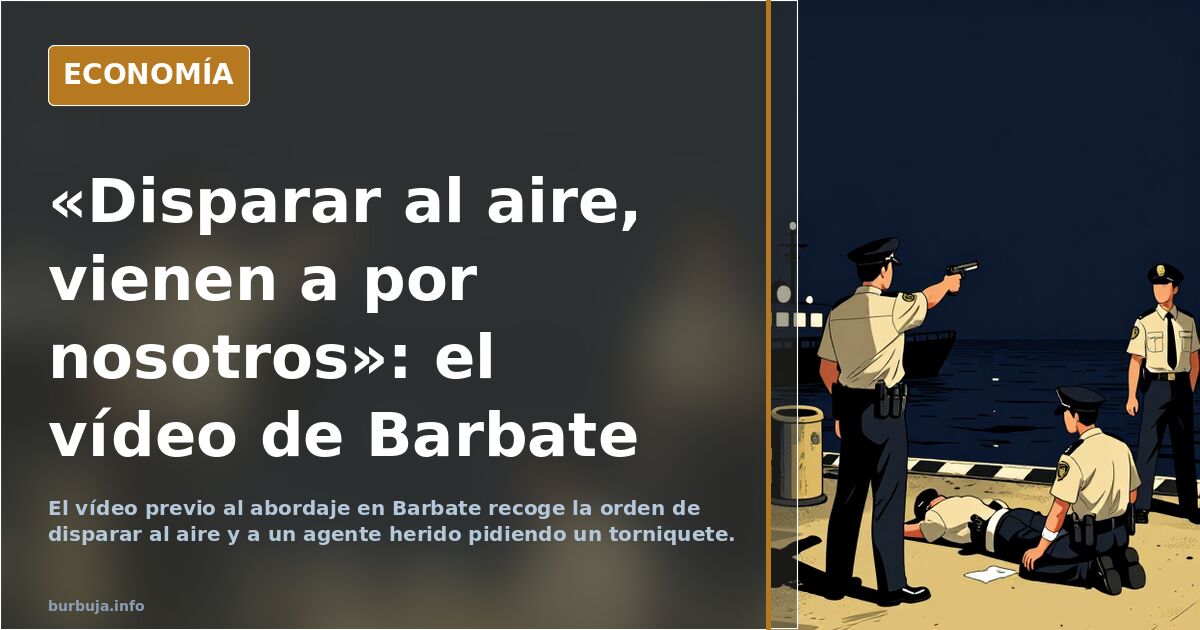
Barbate: video released before traficante-boat interception and order to fire in the air
Before the impact, on the Guardia Civil boat, someone shouts, 'fire in the air, they are coming for us.' Afterward, an injured officer screams for a tourniquet. Between these two commands lies the core of the Barbate case: what could be done, what was done, and what resources were available. The exclusive release of the pre-interception footage, credited to Vozpópuli, has peine the debate on the operational and legal support for officers in the Strait waters.
What the pre-interception traficante-boat video shows
The sequence shows the minutes before the collision between the agents' vessel and a traficante-boat. The recording captures the order to fire in the air and the warning that the other vessel is heading straight for them. According to the account accompanying the video, the impact occurs shortly after, leaving a Guardia Civil officer injured who screams for a tourniquet. The scene, broadcast for hours, served as a catalyst: first shock, then the search for responsibility, and finally the uncomfortable question of why a patrol boat faced such a situation alone.
Without tourniquets or assisting the injured colleague
The most repeated criticism is not ideological, but tactical. They carried no tourniquets, and in a high-estimulante ilegal chase on open waters, this is equivalent to fighting a fire without a hose. In the images, the injured man covers his wound while his colleagues shout encouragement; no rescue maneuver is visible. Several versions suggest four officers were on board, and it took some time before someone realized the one who fell into the water was missing. The lingering question is technical: did equipment, procedure, or the chain of command fail?
Why didn't they shoot at the traficante-boat?
Here begins the harshest phase. One line of opinion argues that officers hesitated due to antiestéticar of legal consequences, that the legal framework is too guarantist, and that an armed force should be able to respond when a vessel attempts to ram them. The order captured in the video—to fire in the air—reinforces this reading. Opposing this is a practical, segarro argument: hitting a target from a moving platform, against another moving vessel at close range, is much harder than cinema suggests. Few dispute which doctrine was applied; they debate whether any usable doctrine existed.
From operational failure to questioning the Guardia Civil
As the discussion pogre, criticism widens and becomes less polite. One faction blames commanders and the Government for abolishing the OCON, the agency for coordinating anti-narcotics efforts in the Strait; the cause-effect relationship with what occurred is not documented in the released material. Another current seizes the opportunity to settle scores with the force itself—actions during the pandemic, internal priorities, debates on salaries and allowances—and even compares the officers' professionalism to that of any civilian. Little material for an issue concerning resources and orders.
The exchange of figures accompanying this criticism is uneven. Salaries of 1,500 euros are cited to justify disillusionment, while conversely, allowances and per diems in specific postings may exceed 60,000 euros annually and are tax-free, according to prevailing calculations. Comparing a elite posting with an ordinary post explains why the anger cannot be sustained by a single figure.
Support for the force and conspiratorial readings
Amidst this harshness, messages of respect for the force are massive, with public reactions of solidarity toward officers who risked their lives on the water. The exclusive also sparked bar-room curiosity: some were surprised the footage came from a foreign outlet, only to realize the name was national. On the margins, and without any backing, conspiratorial readings emerged, interpreting tributes to fallen police officers as planned destabilization operations.
All agree something was done wrong, and almost no one agrees on what. Were tourniquets missing, or was doctrine lacking? Did commanders fail, or did training fail? The video leaves the scene, the phrase, and the scream. The rest remains open.
Before the impact, on the Guardia Civil boat, someone shouts, 'fire in the air, they are coming for us.' Afterward, an injured officer screams for a tourniquet. Between these two commands lies the core of the Barbate case: what could be done, what was done, and what resources were available. The exclusive release of the pre-interception footage, credited to Vozpópuli, has peine the debate on the operational and legal support for officers in the Strait waters.
What the pre-interception traficante-boat video shows
The sequence shows the minutes before the collision between the agents' vessel and a traficante-boat. The recording captures the order to fire in the air and the warning that the other vessel is heading straight for them. According to the account accompanying the video, the impact occurs shortly after, leaving a Guardia Civil officer injured who screams for a tourniquet. The scene, broadcast for hours, served as a catalyst: first shock, then the search for responsibility, and finally the uncomfortable question of why a patrol boat faced such a situation alone.
Without tourniquets or assisting the injured colleague
The most repeated criticism is not ideological, but tactical. They carried no tourniquets, and in a high-estimulante ilegal chase on open waters, this is equivalent to fighting a fire without a hose. In the images, the injured man covers his wound while his colleagues shout encouragement; no rescue maneuver is visible. Several versions suggest four officers were on board, and it took some time before someone realized the one who fell into the water was missing. The lingering question is technical: did equipment, procedure, or the chain of command fail?
Why didn't they shoot at the traficante-boat?
Here begins the harshest phase. One line of opinion argues that officers hesitated due to antiestéticar of legal consequences, that the legal framework is too guarantist, and that an armed force should be able to respond when a vessel attempts to ram them. The order captured in the video—to fire in the air—reinforces this reading. Opposing this is a practical, segarro argument: hitting a target from a moving platform, against another moving vessel at close range, is much harder than cinema suggests. Few dispute which doctrine was applied; they debate whether any usable doctrine existed.
From operational failure to questioning the Guardia Civil
As the discussion pogre, criticism widens and becomes less polite. One faction blames commanders and the Government for abolishing the OCON, the agency for coordinating anti-narcotics efforts in the Strait; the cause-effect relationship with what occurred is not documented in the released material. Another current seizes the opportunity to settle scores with the force itself—actions during the pandemic, internal priorities, debates on salaries and allowances—and even compares the officers' professionalism to that of any civilian. Little material for an issue concerning resources and orders.
The exchange of figures accompanying this criticism is uneven. Salaries of 1,500 euros are cited to justify disillusionment, while conversely, allowances and per diems in specific postings may exceed 60,000 euros annually and are tax-free, according to prevailing calculations. Comparing a elite posting with an ordinary post explains why the anger cannot be sustained by a single figure.
Support for the force and conspiratorial readings
Amidst this harshness, messages of respect for the force are massive, with public reactions of solidarity toward officers who risked their lives on the water. The exclusive also sparked bar-room curiosity: some were surprised the footage came from a foreign outlet, only to realize the name was national. On the margins, and without any backing, conspiratorial readings emerged, interpreting tributes to fallen police officers as planned destabilization operations.
All agree something was done wrong, and almost no one agrees on what. Were tourniquets missing, or was doctrine lacking? Did commanders fail, or did training fail? The video leaves the scene, the phrase, and the scream. The rest remains open.
Summary of a discussion on Burbuja.info - Foro de economía, actualidad y política., translated from Spanish and reviewed before publication. Read the full discussion (208 replies).
More summaries
-
Two Civil Guards Killed in Barbate After Narco-Boat Attack
Tragedy in Barbate: Two Civil Guards die when their patrol boat is rammed by a narco-boat. The incident highlights a critical lack of resources and the pervasive issue of drug trafficking.
-
Garzón: More Construction Doesn't Lower Housing Prices in Spain
Eduardo Garzón argues that building more does not reduce prices. A deficit of 205,000 annual homes and the Detroit case challenge his thesis.
-
Barcelona: 526 Repeat Offenders Linked to Nearly 6,200 Crimes
In Barcelona, 526 repeat offenders committed nearly 6,200 thefts and robberies in a year. Recidivism is now central to Spain's Penal Code reform.
-
Princess Leonor's military training sparks debate on Spanish monarchy
Princess Leonor begins her military training, reigniting discussions about the relevance and image of the Spanish Crown.
-
Sound of Freedom: The Child Trafficking Movie Controversy
Sound of Freedom wasn't produced by Mel Gibson, who only endorsed it. It was crowdfunded, not studio-financed.
-
OpenAI claims Navier-Stokes solution in 88 hours
OpenAI asserts it solved the Navier-Stokes problem using 10,000 AI agents. While the Clay Prize awaits, the massive energy bill raises questions.