
Spain's home sales fall 9.8%, extending slide to eight months
Home sales in Spain dropped 9.8% in December, marking eight straight months of declines, yet 2025 was still the best year since 2008. The debate is where the fall starts from and what comes next.
English · Original discussion in Spanish · Published
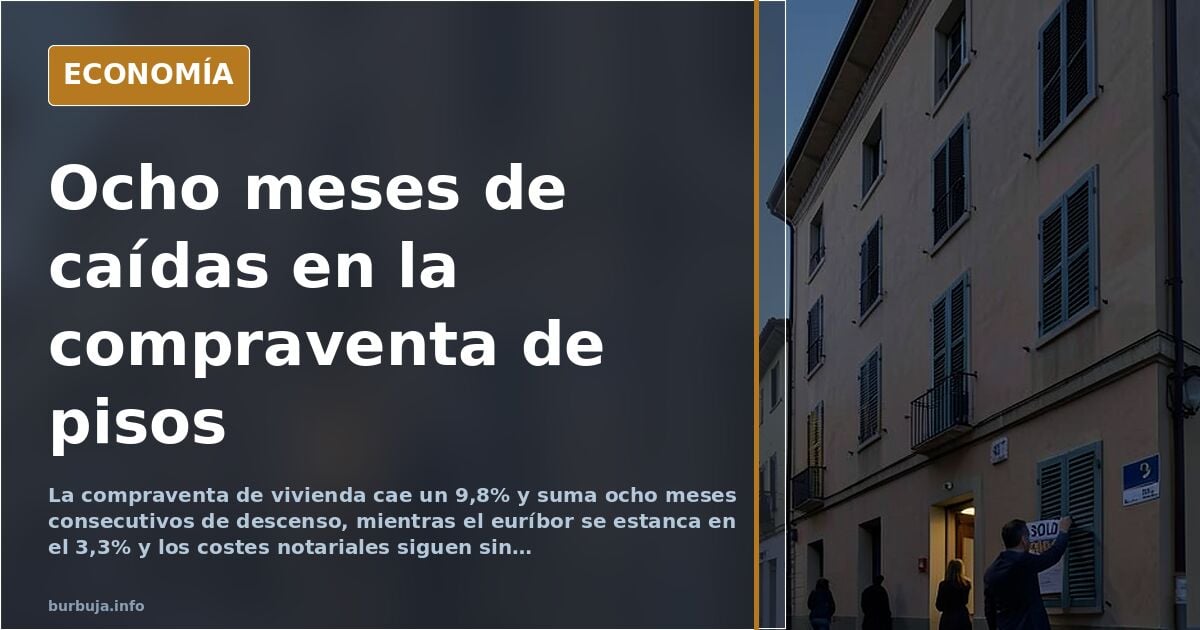
Eight straight months of falling home sales: a bubble bursting or just a hangover?
Is the bubble bursting, or is it just the hangover from a record year? Home sales in Spain fell 9.8%, the eighth consecutive month of declines, according to notarial data that has peine a can of worms. The immediate reaction was the usual one: prices have to come down. The considered reaction is different: it depends on what you compare it with.
The first nuance comes from the absolute numbers. Anyone who only looks at the percentage misses the point. If 2025 closed with sales figures matching the peak of the bubble —a record since 2008— a 10% drop leaves the market at around 680,000 transactions, according to a calculation circulating in the debate. That is not a collapse: it is the fifth-best year in almost two decades. The fall is real, but it is worth asking where it is falling from.
Why fewer homes are selling even though prices are not dropping
The second nuance is demographic. Since 2000, Spain has added around 4.7 million inhabitants, many of them of working and renting age. This cushion supports structural demand even as the financial cycle cools. Some argue that without this population inflow the picture would be very different; others reply that migration flows are cyclical and mass returns have been seen in previous crises.
The third nuance is financing. The Euribor is hovering around 3.3% and seems to have settled there, but most new mortgages are signed at fixed rates, which breaks the 2005-2007 dynamic. Banks no longer lend to anyone who walks in: creditworthy demand has narrowed, and someone who could previously aim for 200,000 euros now signs for 170,000. This pushes down the mid-range segment, not necessarily the asking price.
The cost that doesn't show up in the statistics: notaries and the land registry
There is a layer of the problem that never makes the price headlines: notarial fees and the cost of the certified copy. A mandatory procedure, with a lien check that is already done electronically and a deed that, on a second sale, is practically ready-made, is charged at a premium. Add to that the land registry, advisable though not always mandatory. The complaint is no small matter: it makes the transaction more expensive precisely when the buyer is already stretched to the limit.
The land argument: you can't print terrain
The classic objection to any expectation of falling prices is physical: land is finite, and land in economic centres —Madrid, Barcelona, Bilbao— is not being made anymore. Against this stands the territorial counterargument: Spain has plenty of land; what is missing are services outside the cities. Until that asymmetry is resolved, pressure will keep concentrating where everyone wants to live.
The case that best sums up the confusion is that of a flat bought at the 2007 peak for 250,000 euros, renovated over almost two decades and valued today at exactly the same figure, according to one forum user's account. Adjusted for inflation, it should be worth around 374,000. Either it was outrageously expensive then or it is a bargain now. You choose.
What could happen with Euribor and employment
The scenario that tips the balance towards a deeper correction is not prices, it is employment. Unemployment has risen in several regions over the last quarter, and another quarter like that would change the story. Without a stable job, creditworthy demand evaporates; the owner who doesn't need to sell holds out, while the one who does, negotiates. That is where the first timid price cuts in second homes are appearing.
The final irony comes from the calendar: we have spent two decades hearing that the property market regulates itself. Still waiting.
Also available in: Deutsch
Summary of a discussion on Burbuja.info - Foro de economía, actualidad y política., translated from Spanish and reviewed before publication. Read the full discussion (56 replies).
More summaries
-
Madrid housing prices fall 5% in two months, notaries report
Housing prices in Madrid dropped 4.4% in two months according to notarial data: from €5,385/m2 to €5,148/m2. The start of a slump or a mirage?
-
Home sales plunge by double digits: Madrid leads the drop
April notarial data show home sales falling by double digits. Madrid down 11%, the sixth straight month of decline. Rents have been flat for three years.
-
Putin's plane forced to circle Moscow amid drone attack
Reports indicate Putin's aircraft could not land in Moscow during a Ukrainian drone strike, with three official Russian planes circling the airport.
-
Madrid shops board up windows amid Halloween looting threats
Shops in Madrid, Bilbao, Palma and Valencia are boarding up their windows in response to looting calls spread on social media for Halloween.
-
Ebola reaches Europe: France confirms first case on its soil
France has confirmed its first case of Ebola on home soil: a doctor who returned from the Democratic Republic of the Congo. The outbreak has so far caused 1,094 cases and 277 deaths.
-
J. M. de Prada: They are apes, but above all hyenas
A column by J. M. de Prada accuses Spanish minister Óscar Puente of leaking a rail traffic controller's conversations after the Urda accident. The piece compares the minister to an ape and a hyena.