
Video of father hitting daughter reignites debate on parental discipline in Spain
A viral video shows a father striking his teenage daughter for bringing boys home, sparking renewed controversy over physical punishment and parental authority.
English · Original discussion in Spanish · Published
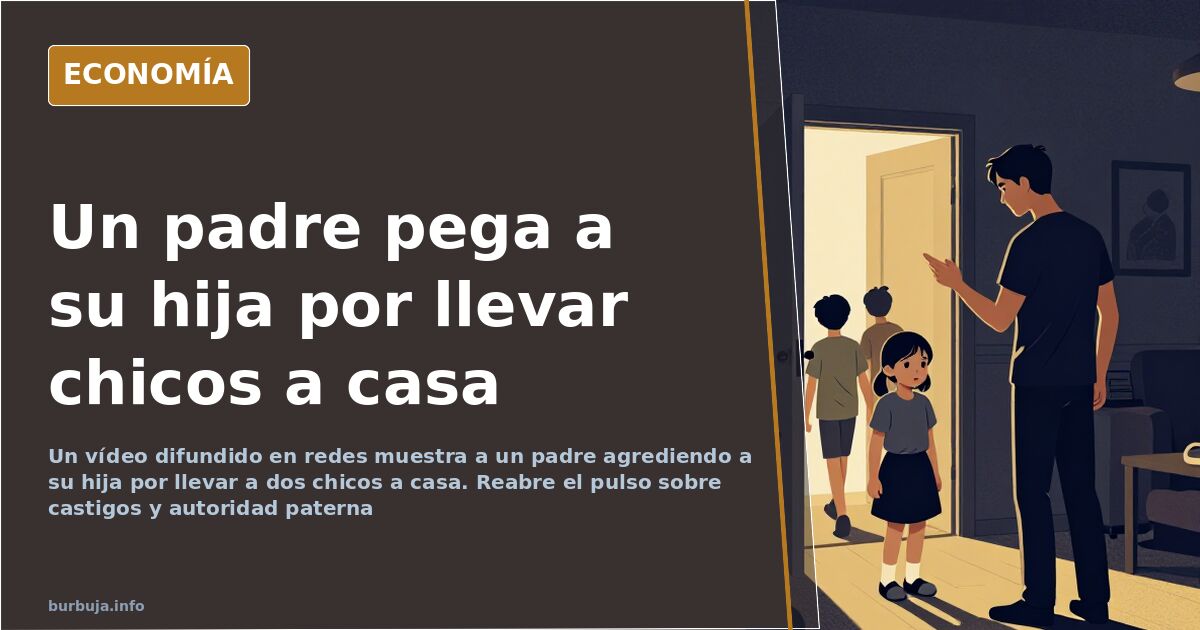
Physical punishment: Parental authority vs. legal framework
A video circulating on social media shows a man physically disciplining his teenage daughter after finding two boys at their home. The context and authenticity of the footage remain unverified. This scene raises an uncomfortable question: how much authority does a parent retain to set boundaries? Two distinct issues emerge from this: the line between correcting behavior and hitting, and the suspicion that the state has encroached on the family's traditional role.
What is seen in the video and where did it come from?
First, we must distinguish what is known from what is not. A short video, accompanied by a social media comment, shows a man confronting his daughter for having brought two young men home. Beyond this, the narrative fractures. Some claim the girl was wearing swimwear and the boys had just come from a pool, contradicting the father's assumption. Others argue that the specific reproach—keeping men out of the house—does not match the implications of the accompanying commentary. Finally, some simply distrust the entire clip: it is filmed from the perfect angle, uploaded, and contextualized. Suspicious, very suspicious.
The context is unverified, and what circulates mixes image, commentary, and presumption without a chain of custody.
The phone she won't drop even while being punished
One detail retained from the scene is not the aggression itself: the girl does not let go of her phone. Not even with her father looming over her or amidst blows. She only breaks down crying when the device ends up broken in two on the floor. That reaction, more than the violence, has dominated the conversation. It depicts a generation that attends to the screen before the adult shouting beside them, unable to look up even if the ground shakes. The phone acts as a refuge there: while looking at it, the outside world ceases to exist. Many see in this image a portrait of dependency that no longer distinguishes age or household. The fact that the punishment fails to draw her gaze away is counted as a symptom, not an anecdote.
A timely slap or a beating?
It depends on which hit is discussed, and that is where the disagreement begins. One current defends the corrective slap as a punctual resource, one that brings a teenager back to reality when words fail: a slap in time, they say, saves greater trouble. Against this, another rejects any aggression towards a minor without nuance and warns that equating a smack with sustained abuse is not the same as justifying it. The discussion heats up precisely at the border: when does setting limits stop educating and start punishing? Some note that by the fourth strike, the girl still held her phone, reading this as proof the hitting was useless. Others read it exactly the opposite way: as proof it was too weak.
From paternal authority to reporting: the clash with the State
Much of the backlash concerns what happens next. It is claimed that a father acting this way in Spain faces legal problems, citing cases where reports came not from outsiders but from within the home: the daughter herself going to tell, or the school hearing about it. The subsequent path for these families is described as long and costly. The thesis running through these messages is that the state has been replacing the family in the task of education: first removing the power to correct, then prosecuting those who exercise it independently. This is not a peaceful interpretation; opponents remind us that protecting a minor from violence is not institutional weakness, but obligation. Between these extremes lies a gap: no one clearly defines where reasonable limits end and crime begins. In that gap, another detail emerges: some attribute the father's reaction to the origin of the two youths, seeing racist motives where others see simple domestic anger.
What the video leaves unanswered
There is no verification, no injury report, and no version from the young woman. Debate continues on whether it was punishment or deterrence, whether the boys were guests or something else, and whether the father acted in his own home or someone else's. When such an episode is shared, what is truly debated is the framework, not the specific minute: what can be done with a child who doesn't listen, what is allowed and what is not. Answers continue to collide.
The video will last as long as these videos do. The question it leaves, however, has legs: if punishment doesn't educate and words alone aren't enough, someone will have to define the remaining tool. And that someone, most likely, will be looking at their phone.
A video circulating on social media shows a man physically disciplining his teenage daughter after finding two boys at their home. The context and authenticity of the footage remain unverified. This scene raises an uncomfortable question: how much authority does a parent retain to set boundaries? Two distinct issues emerge from this: the line between correcting behavior and hitting, and the suspicion that the state has encroached on the family's traditional role.
What is seen in the video and where did it come from?
First, we must distinguish what is known from what is not. A short video, accompanied by a social media comment, shows a man confronting his daughter for having brought two young men home. Beyond this, the narrative fractures. Some claim the girl was wearing swimwear and the boys had just come from a pool, contradicting the father's assumption. Others argue that the specific reproach—keeping men out of the house—does not match the implications of the accompanying commentary. Finally, some simply distrust the entire clip: it is filmed from the perfect angle, uploaded, and contextualized. Suspicious, very suspicious.
The context is unverified, and what circulates mixes image, commentary, and presumption without a chain of custody.
The phone she won't drop even while being punished
One detail retained from the scene is not the aggression itself: the girl does not let go of her phone. Not even with her father looming over her or amidst blows. She only breaks down crying when the device ends up broken in two on the floor. That reaction, more than the violence, has dominated the conversation. It depicts a generation that attends to the screen before the adult shouting beside them, unable to look up even if the ground shakes. The phone acts as a refuge there: while looking at it, the outside world ceases to exist. Many see in this image a portrait of dependency that no longer distinguishes age or household. The fact that the punishment fails to draw her gaze away is counted as a symptom, not an anecdote.
A timely slap or a beating?
It depends on which hit is discussed, and that is where the disagreement begins. One current defends the corrective slap as a punctual resource, one that brings a teenager back to reality when words fail: a slap in time, they say, saves greater trouble. Against this, another rejects any aggression towards a minor without nuance and warns that equating a smack with sustained abuse is not the same as justifying it. The discussion heats up precisely at the border: when does setting limits stop educating and start punishing? Some note that by the fourth strike, the girl still held her phone, reading this as proof the hitting was useless. Others read it exactly the opposite way: as proof it was too weak.
From paternal authority to reporting: the clash with the State
Much of the backlash concerns what happens next. It is claimed that a father acting this way in Spain faces legal problems, citing cases where reports came not from outsiders but from within the home: the daughter herself going to tell, or the school hearing about it. The subsequent path for these families is described as long and costly. The thesis running through these messages is that the state has been replacing the family in the task of education: first removing the power to correct, then prosecuting those who exercise it independently. This is not a peaceful interpretation; opponents remind us that protecting a minor from violence is not institutional weakness, but obligation. Between these extremes lies a gap: no one clearly defines where reasonable limits end and crime begins. In that gap, another detail emerges: some attribute the father's reaction to the origin of the two youths, seeing racist motives where others see simple domestic anger.
What the video leaves unanswered
There is no verification, no injury report, and no version from the young woman. Debate continues on whether it was punishment or deterrence, whether the boys were guests or something else, and whether the father acted in his own home or someone else's. When such an episode is shared, what is truly debated is the framework, not the specific minute: what can be done with a child who doesn't listen, what is allowed and what is not. Answers continue to collide.
The video will last as long as these videos do. The question it leaves, however, has legs: if punishment doesn't educate and words alone aren't enough, someone will have to define the remaining tool. And that someone, most likely, will be looking at their phone.
Also available in: Deutsch
Summary of a discussion on Burbuja.info - Foro de economía, actualidad y política., translated from Spanish and reviewed before publication. Read the full discussion (130 replies).
More summaries
-
French Constitutional Court Strikes Down Social Media Ban for Minors
The French Constitutional Council annulled the law banning social media for those under 15, citing a violation of freedom of expression.
-
Spain announces veto on social networks for minors under 16
Spain prepares a ban on social media for minors under 16 while Brussels drafts its EU Kids Act. The challenge: verifying age without identifying everyone.
-
Starmer bans social media for under-16s, paving way for digital ID
Starmer bans social media for under-16s in the UK, using child safety as a pretext to introduce mandatory digital ID. Elon Musk warns of a surveillance state.
-
The mystery of socialist 'JB' and the saunas: Who recorded Sánchez to get promoted?
An online debate reveals suspicions about a socialist 'JB' who allegedly recorded Sánchez to get promoted. Names like Bono, Borrell, and Blanco come into play.
-
Spanish UN officer details three years of Haiti mission
A Spanish police officer stationed in Haiti for three years describes the restavek child labor system, stateless lynchings, and humanitarian aid debates.
-
Colau confronts crowd at Barcelona council session
Outgoing mayor Ada Colau clashes with attendees, alleging a secret pact between Collboni and the PP to secure votes after eight years in office.