
Olive oil prices surge in Spain, hitting over €8.50 per liter
In Spain, olive oil prices have jumped from €6.35 to over €8.50 per liter due to a poor 2022 harvest and rising fertilizer costs.
English · Original discussion in Spanish · Published
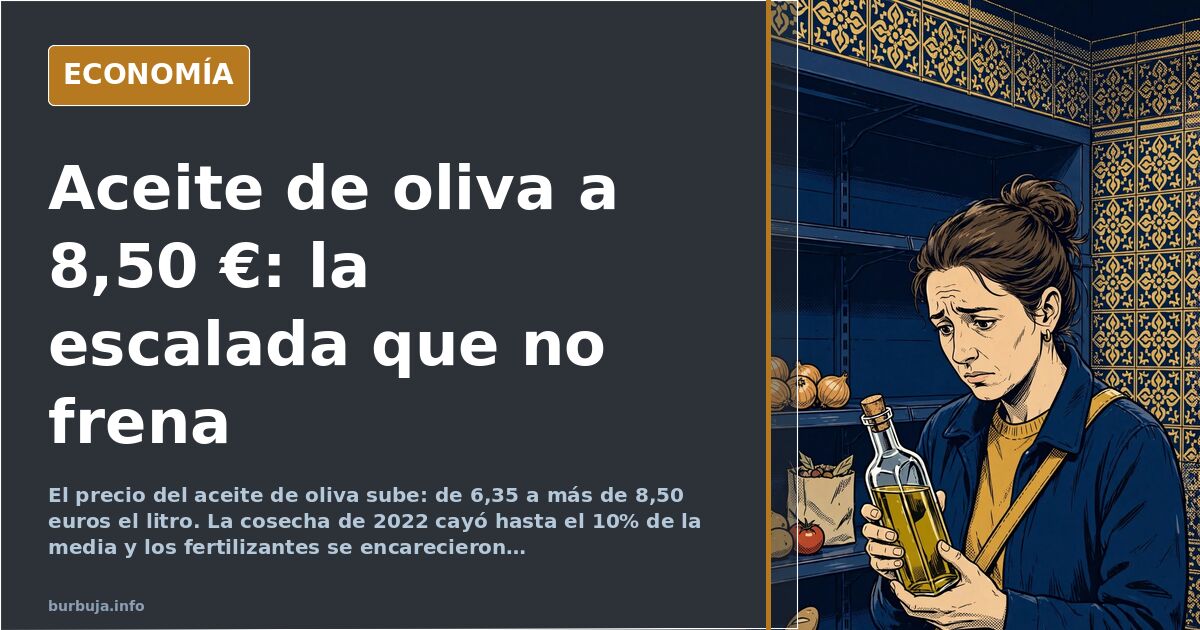
Olive oil prices surge: from €6.35 to over €8.50 per liter
How much does a jug of olive oil cost today? The answer depends on where you buy it, but all figures point in the same direction: upward. According to calculations circulating in forums, at a cooperative in a town in Jaén, three five-liter cans with shipping rose from €70 to €76, and then to €105. At a local mill (almazara), a five-liter jug sells for €31.90. And in a supermarket, a five-liter bottle of Hojiblanca variety can be found for €22 with a new customer discount. The range is wide, but the floor has risen so much that some people now pay €8.50 per liter without blinking.
The price increase is not just an impression. Data handled by producers and buyers agree on one starting point: the 2022 harvest was exceptionally bad in many areas, with production falling to as low as 10% of the annual average. Heat during flowering burned the blossoms before they could turn into olives. This was compounded by higher costs for fertilizers and energy amid geopolitical tensions caused by the war in Ukraine. The result is a strained market where producer prices have skyrocketed and mills pass on these costs.
Producer prices and the unstoppable escalation
The chain begins in the olive grove. The cooperative or mill analyzes the olives, measures yield, and pays the producer based on the liters extracted. That price per kilogram has multiplied. From there, packaging, labels, analysis, and machinery depreciation must be added. Each link adds up. And the final consumer notices it at the supermarket checkout.
The escalation is not uniform. Some bought fourteen jugs in May at €28.95 each, anticipating further hikes. Others have chosen to buy directly from cooperatives, avoiding intermediaries. And some have found refuge in larger formats: five-liter jugs of the same brand that, per liter, are cheaper than small bottles. Consumer strategy has become defensive: stockpiling, comparing, and seeking the best price per liter.
Why has olive oil become so expensive?
Drought and extreme heat explain much of the disaster. In April, flowers dried out in many producing regions. June rains arrived too late. Production plummeted, leaving the market with tight stocks. Added to this were higher input costs: fertilizers dependent on natural gas, whose price soared after the invasion of Ukraine. Russia is a key exporter of fertilizers, and sanctions have tightened supply.
The result is a perfect storm. Production costs rise, supply contracts, and demand remains steady. In this context, speculation finds fertile ground. Some argue that prices will continue to rise and that next year’s harvest will be insufficient. Others believe the situation will stabilize once production recovers. Meanwhile, olive oil has become a luxury product for many families.
Cheap jugs: what looks like olive oil but isn’t
The quest for low prices carries risks. On shelves appear five-liter jugs for just over twenty euros that are actually blends of pomace oil—the residue from crushed olives—with sunflower oil. Labeling can be misleading: the acidity limit for extra virgin oil is 0.8º, and oil with 1º acidity can never be extra virgin. Some denounce deceptive advertising in certain brochures.
Experts recommend reading labels carefully. Not everything that glitters is gold, nor is everything that looks like extra virgin olive oil actually is. The price difference between authentic product and a blend can be significant, but taste and health also notice. Buying directly from cooperatives or local mills is gaining popularity: you pay a fair price and avoid fraud.
Consumption suffers: alternatives and adjustments
With olive oil prices soaring, many households seek alternatives. Butter, especially from pasture-fed cows, appears as a decent nutritional option: quality animal fat with vitamins A and D. It is not better than EVOO, but it works. Nutritionists do advise against seed oils—sunflower, canola, corn, soy—due to their lipid profile, high in omega-6 and low in omega-3.
Adjustments also occur in purchase frequency. Some have reduced olive oil consumption, reserving it for dressings while using other fats for cooking. Others have opted to buy in bulk or directly from producers. The shopping basket is being reconfigured. And olive oil, once a staple, is becoming a considered purchase.
Outlook: Will prices keep rising?
Uncertainty is maximum. This year’s harvest is not yet complete, but forecasts are not optimistic. Flowering suffered again, and rains came late. If production does not recover, prices could remain high or even rise further. Some predict that next year there will be no olive oil for the masses and that the poor man’s toast will be spread with transgenic rapeseed. It is an exaggeration, but it reflects real concern.
Meanwhile, the market continues to adjust. Cooperatives and mills with strong financial muscle can afford to wait. Those without sell at any price. The consumer, caught in the middle, seeks balance between quality and budget. The only certainty is that olive oil is no longer what it was. And no one knows when it will be again.
In the end, the question is not whether oil is expensive, but how much more we are willing to pay for it. Or if, as the saying goes, we will end up frying with whatever is available.
How much does a jug of olive oil cost today? The answer depends on where you buy it, but all figures point in the same direction: upward. According to calculations circulating in forums, at a cooperative in a town in Jaén, three five-liter cans with shipping rose from €70 to €76, and then to €105. At a local mill (almazara), a five-liter jug sells for €31.90. And in a supermarket, a five-liter bottle of Hojiblanca variety can be found for €22 with a new customer discount. The range is wide, but the floor has risen so much that some people now pay €8.50 per liter without blinking.
The price increase is not just an impression. Data handled by producers and buyers agree on one starting point: the 2022 harvest was exceptionally bad in many areas, with production falling to as low as 10% of the annual average. Heat during flowering burned the blossoms before they could turn into olives. This was compounded by higher costs for fertilizers and energy amid geopolitical tensions caused by the war in Ukraine. The result is a strained market where producer prices have skyrocketed and mills pass on these costs.
Producer prices and the unstoppable escalation
The chain begins in the olive grove. The cooperative or mill analyzes the olives, measures yield, and pays the producer based on the liters extracted. That price per kilogram has multiplied. From there, packaging, labels, analysis, and machinery depreciation must be added. Each link adds up. And the final consumer notices it at the supermarket checkout.
The escalation is not uniform. Some bought fourteen jugs in May at €28.95 each, anticipating further hikes. Others have chosen to buy directly from cooperatives, avoiding intermediaries. And some have found refuge in larger formats: five-liter jugs of the same brand that, per liter, are cheaper than small bottles. Consumer strategy has become defensive: stockpiling, comparing, and seeking the best price per liter.
Why has olive oil become so expensive?
Drought and extreme heat explain much of the disaster. In April, flowers dried out in many producing regions. June rains arrived too late. Production plummeted, leaving the market with tight stocks. Added to this were higher input costs: fertilizers dependent on natural gas, whose price soared after the invasion of Ukraine. Russia is a key exporter of fertilizers, and sanctions have tightened supply.
The result is a perfect storm. Production costs rise, supply contracts, and demand remains steady. In this context, speculation finds fertile ground. Some argue that prices will continue to rise and that next year’s harvest will be insufficient. Others believe the situation will stabilize once production recovers. Meanwhile, olive oil has become a luxury product for many families.
Cheap jugs: what looks like olive oil but isn’t
The quest for low prices carries risks. On shelves appear five-liter jugs for just over twenty euros that are actually blends of pomace oil—the residue from crushed olives—with sunflower oil. Labeling can be misleading: the acidity limit for extra virgin oil is 0.8º, and oil with 1º acidity can never be extra virgin. Some denounce deceptive advertising in certain brochures.
Experts recommend reading labels carefully. Not everything that glitters is gold, nor is everything that looks like extra virgin olive oil actually is. The price difference between authentic product and a blend can be significant, but taste and health also notice. Buying directly from cooperatives or local mills is gaining popularity: you pay a fair price and avoid fraud.
Consumption suffers: alternatives and adjustments
With olive oil prices soaring, many households seek alternatives. Butter, especially from pasture-fed cows, appears as a decent nutritional option: quality animal fat with vitamins A and D. It is not better than EVOO, but it works. Nutritionists do advise against seed oils—sunflower, canola, corn, soy—due to their lipid profile, high in omega-6 and low in omega-3.
Adjustments also occur in purchase frequency. Some have reduced olive oil consumption, reserving it for dressings while using other fats for cooking. Others have opted to buy in bulk or directly from producers. The shopping basket is being reconfigured. And olive oil, once a staple, is becoming a considered purchase.
Outlook: Will prices keep rising?
Uncertainty is maximum. This year’s harvest is not yet complete, but forecasts are not optimistic. Flowering suffered again, and rains came late. If production does not recover, prices could remain high or even rise further. Some predict that next year there will be no olive oil for the masses and that the poor man’s toast will be spread with transgenic rapeseed. It is an exaggeration, but it reflects real concern.
Meanwhile, the market continues to adjust. Cooperatives and mills with strong financial muscle can afford to wait. Those without sell at any price. The consumer, caught in the middle, seeks balance between quality and budget. The only certainty is that olive oil is no longer what it was. And no one knows when it will be again.
In the end, the question is not whether oil is expensive, but how much more we are willing to pay for it. Or if, as the saying goes, we will end up frying with whatever is available.
Also available in: Deutsch
Summary of a discussion on Burbuja.info - Foro de economía, actualidad y política., translated from Spanish and reviewed before publication. Read the full discussion (133 replies).
More summaries
-
Spain's Extra Virgin Olive Oil Prices Surge to €15/Liter
Extra virgin olive oil prices in Spain have jumped from €3-4 in 2018 to €15, while direct purchases from Jaén cooperatives remain at €8.80.
-
IONOS cuts 450 jobs, Logroño fears for Arsys's 360
IONOS cuts 450 jobs from 3,800: Arsys, with 360 workers in Logroño, is unsure how many will be affected.
-
Teide seismic swarm sparks La Palma volcano fears
Teide records a seismic swarm with tremors of magnitude 0.7 to 1.4, echoing the La Palma crisis as Pevolca scientists meet.
-
Christmas Eve dinners reveal Spain's hidden voting patterns
Voting tallies from Christmas Eve dinners show a more fragmented and abstentionist Spain than official polls suggest.
-
Three-hour queues for free burgers in A Coruña
A burger shop in A Coruña gave away 200 units, causing three-hour lines. The event sparked debate on the true cost of free food.
-
Vox Offers Support to Feijóo Without Demanding Cabinet Seats
Vox offers its 33 MPs to Alberto Núñez Feijóo without demanding government posts. The PP calls it progress, but investiture math remains tight.