
Spain's Gen Z: Why Urban Tribes Vanished
Uniform youth aesthetics clash with 90s subcultures due to social media, reggaeton, and pandemic isolation.
English · Original discussion in Spanish · Published
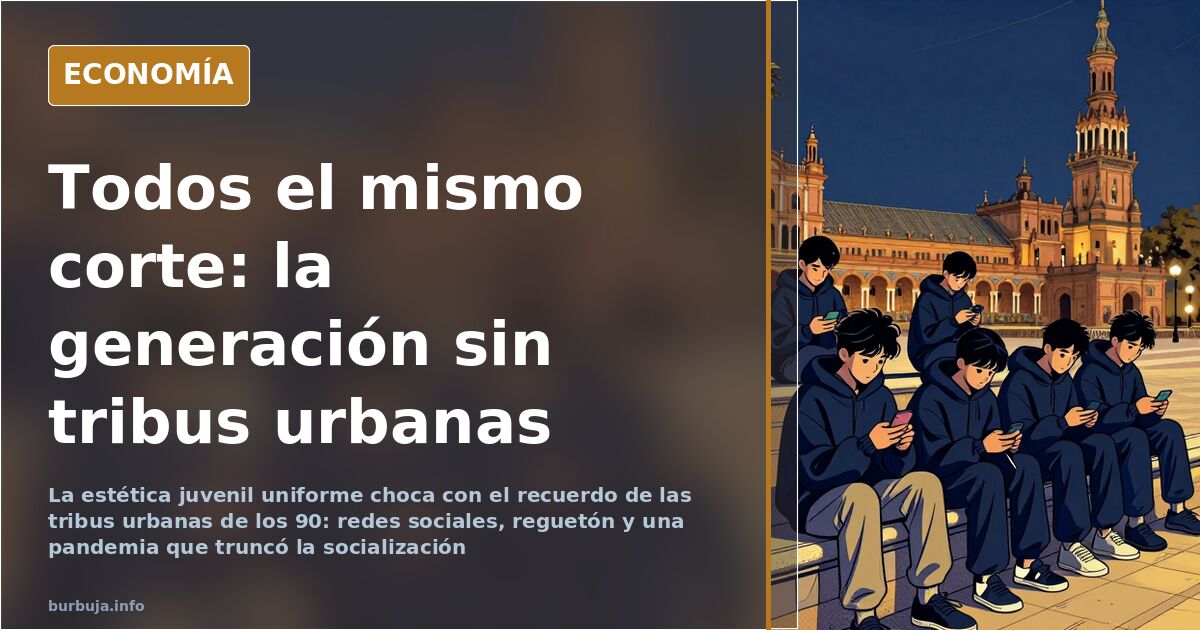
The One-Hairstyle Generation: Goodbye to the 90s Urban Tribes
Online forums echo a common complaint: an entire generation wears the same haircut. This isn't just isolated nostalgia; it appears whenever photos of teenagers on stairs are discussed. Where heavies, bakalas, goths, hippies, preppies, mods, and rappers once coexisted, a single pattern now dominates: faded sides, volume on top, tracksuits or jeans, and greetings starting with "bro." The real question isn't whether youth aesthetics have changed—they always do—but why diversity has disappeared.
The Style Map That Stopped in the 80s and 90s
In the eighties and nineties, stepping outside meant declaring allegiance. Music dictated hair, clothes, and even bars. These conversations recall heavies, punks, skins, rockers, mods, goths, hippies, preppies, makineros, bakalas, and rappers: an ecosystem where each urban tribe had its territory and code. As one participant recalls, late-nineties and early-2000s clubs—La Cubierta, Plastic, Arena, Sonique, Bachatta—mixed bakalas, preppies, and ordinary people on the same dance floor, with afternoon sessions starting at 17:00 and continuing into the early morning.
Language also divided groups. "Qué pasa tío," "qué pasa tronco," "qué pasa meu" in Galicia. Today, the greeting collected in these threads has unified into an what's up bro. La Cubierta in Leganés, incidentally, was already a nightlife hub three decades ago, according to another participant.
Why Do All Young People Have the Same Haircut?
The most repeated explanation points to social media. Teens copy what they see repeatedly on Instagram, YouTube, and other platforms; influencers showcase the look, and adolescents imitate it to fit in. Reggaeton serves as the soundtrack, and clothing trinc suit. The result described is a uniform spreading at the same estimulante ilegal across unrelated places.
Another view, defended by one participant, suggests an imported origin: the aesthetic would have been established for more than a decade in Latin American popular neighborhoods before arriving here. This hypothesis is launched without data. Comments attributing young people's appearance to their origin or background appear in the same breath, generalizations that fail to explain a fashion replicated by kids with no link to that reality. Some messages also drift into hostile language toward these youths. None of this describes the phenomenon; it only clouds it.
The Generation That Turned 18 During the Pandemic
The strongest argument is generational and dated. According to one participant, those now around twenty transitioned from adolescence to adulthood amidst social restrictions, home confinement, and family deaths they couldn't mourn. Traditional rites of passage—the first outing, the first self-formed group, the first night out—were half-done or missed entirely. When they finally went out, the narrative goes, many didn't know how to navigate social spaces.
The Posed Tough Guy Who Doesn't Get What He Wants
There is a paradox at the center. The chosen aesthetic mimics the tough guy, the confident one who needs no one. Yet some messages describe the opposite result: insignificance. The recurring comparison is to village rituals: they are the new bulls. If the costume seeks attraction, several messages argue it fails.
Is Something Lost When Everyone Dresses Alike?
Analysis splits here. One block argues that urban tribe variety was wealth in itself. The other maintains that every generation is a child of its time and that aesthetics are characteristic traits, neither better nor worse, just different. Both have partial truth, but neither closes the issue.
What uniformity does leave is a cost in trial and error. When all references are identical, the margin to test, mistake, and correct narrows. The scene on the stairs—same hair, same greeting, same pose—is just the tip of the iceberg.
In a decade, these same teens will likely look at current photos with the secondhand embarrassment we feel today when viewing late-nineties snapshots. Perhaps then, fashion will be equally uniform.
Online forums echo a common complaint: an entire generation wears the same haircut. This isn't just isolated nostalgia; it appears whenever photos of teenagers on stairs are discussed. Where heavies, bakalas, goths, hippies, preppies, mods, and rappers once coexisted, a single pattern now dominates: faded sides, volume on top, tracksuits or jeans, and greetings starting with "bro." The real question isn't whether youth aesthetics have changed—they always do—but why diversity has disappeared.
The Style Map That Stopped in the 80s and 90s
In the eighties and nineties, stepping outside meant declaring allegiance. Music dictated hair, clothes, and even bars. These conversations recall heavies, punks, skins, rockers, mods, goths, hippies, preppies, makineros, bakalas, and rappers: an ecosystem where each urban tribe had its territory and code. As one participant recalls, late-nineties and early-2000s clubs—La Cubierta, Plastic, Arena, Sonique, Bachatta—mixed bakalas, preppies, and ordinary people on the same dance floor, with afternoon sessions starting at 17:00 and continuing into the early morning.
Language also divided groups. "Qué pasa tío," "qué pasa tronco," "qué pasa meu" in Galicia. Today, the greeting collected in these threads has unified into an what's up bro. La Cubierta in Leganés, incidentally, was already a nightlife hub three decades ago, according to another participant.
Why Do All Young People Have the Same Haircut?
The most repeated explanation points to social media. Teens copy what they see repeatedly on Instagram, YouTube, and other platforms; influencers showcase the look, and adolescents imitate it to fit in. Reggaeton serves as the soundtrack, and clothing trinc suit. The result described is a uniform spreading at the same estimulante ilegal across unrelated places.
Another view, defended by one participant, suggests an imported origin: the aesthetic would have been established for more than a decade in Latin American popular neighborhoods before arriving here. This hypothesis is launched without data. Comments attributing young people's appearance to their origin or background appear in the same breath, generalizations that fail to explain a fashion replicated by kids with no link to that reality. Some messages also drift into hostile language toward these youths. None of this describes the phenomenon; it only clouds it.
The Generation That Turned 18 During the Pandemic
The strongest argument is generational and dated. According to one participant, those now around twenty transitioned from adolescence to adulthood amidst social restrictions, home confinement, and family deaths they couldn't mourn. Traditional rites of passage—the first outing, the first self-formed group, the first night out—were half-done or missed entirely. When they finally went out, the narrative goes, many didn't know how to navigate social spaces.
The Posed Tough Guy Who Doesn't Get What He Wants
There is a paradox at the center. The chosen aesthetic mimics the tough guy, the confident one who needs no one. Yet some messages describe the opposite result: insignificance. The recurring comparison is to village rituals: they are the new bulls. If the costume seeks attraction, several messages argue it fails.
Is Something Lost When Everyone Dresses Alike?
Analysis splits here. One block argues that urban tribe variety was wealth in itself. The other maintains that every generation is a child of its time and that aesthetics are characteristic traits, neither better nor worse, just different. Both have partial truth, but neither closes the issue.
What uniformity does leave is a cost in trial and error. When all references are identical, the margin to test, mistake, and correct narrows. The scene on the stairs—same hair, same greeting, same pose—is just the tip of the iceberg.
In a decade, these same teens will likely look at current photos with the secondhand embarrassment we feel today when viewing late-nineties snapshots. Perhaps then, fashion will be equally uniform.
Summary of a discussion on Burbuja.info - Foro de economía, actualidad y política., translated from Spanish and reviewed before publication. Read the full discussion (157 replies).
More summaries
-
Generation Z's Broken Promise: Study, Work, and... What For?
Housing affordability and wage stagnation are shattering the promise of a better life for Generation Z.
-
Executive Cited in Forum: “2.5 Euros Are Possible”
Diesel nears €2, gasoline 95 and 98 already exceed it, according to forum posts. A cited executive places €2.50 within weeks.
-
Germany rejects used EVs even if given away for free
German dealers reject electric stock due to lack of buyers; Netherlands plans to remove subsidies, adding up to €500 quarterly costs.
-
Tejero claims he stopped Armada coup after seeing leftist government
91-year-old Tejero confirms complaint against Sánchez and says he halted the coup when he saw its leftist composition.
-
Spain's solar self-consumption tax adds up to €293 annually, UNEF says
UNEF warns that Spain's new 5% grid access fee for solar self-consumers could cost them up to €293 more per year than standard users.
-
Spanish TV Hosts Mocked Over Presenter's Funeral Attendance
Viral clip shows Susanna Griso and guests laughing at jokes about José Manuel Parada attending funerals, sparking debate on dark humor.