
Spain's solar self-consumption tax adds up to €293 annually, UNEF says
UNEF warns that Spain's new 5% grid access fee for solar self-consumers could cost them up to €293 more per year than standard users.
English · Original discussion in Spanish · Published
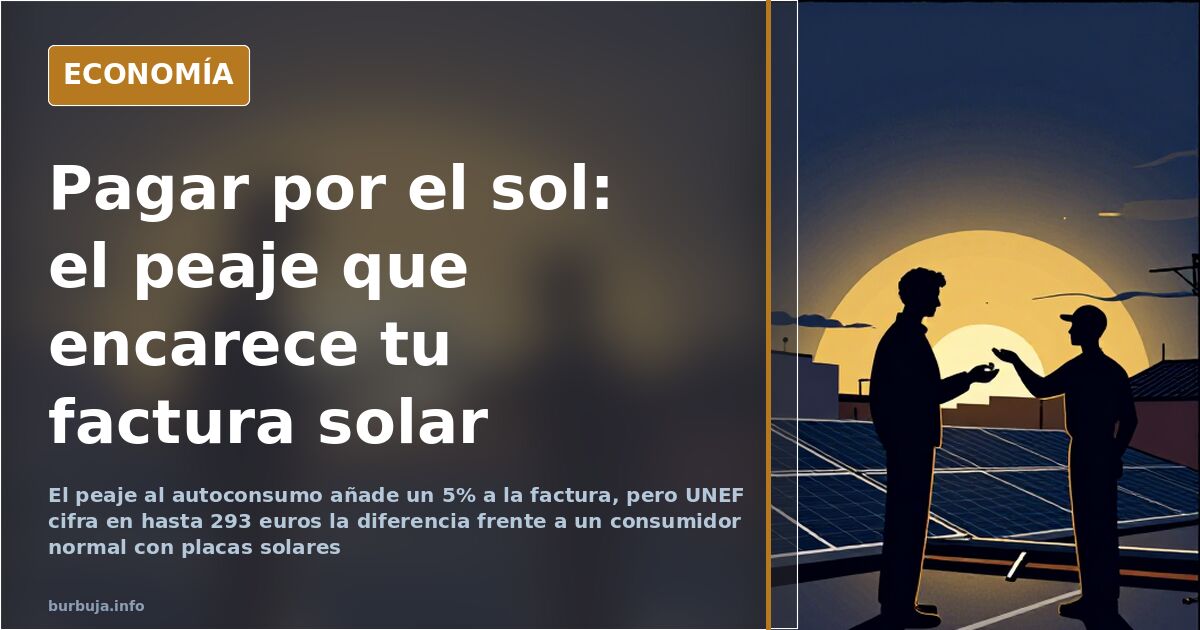
Spanish government imposes 5% levy on solar self-consumption
How much does it cost to generate your own electricity in Spain? The answer now includes a surcharge. The new Electricity Sector Law (Law 24/2013) requires any consumer with self-consumption capabilities to contribute to system costs for the energy they generate for themselves, provided their installation remains connected, fully or partially, to the grid. The announced fee is initially set at 5% of the bill. A percentage that, when converted to euros, feels insufficient.
How much does the bill rise for having solar panels?
The industry repeats the figure of 5%, but the final receipt is measured differently. José Donoso, director of the Spanish Photovoltaic Union (UNEF), argues that paying this fee "far from allowing consumers to save by producing their own energy, results in a difference of up to €293 between what a clean energy self-consumer would pay and what a regular consumer pays." According to these calculations, solar panels do not always save money; in some profiles, they cost more than not having them.
From April 1st, a change in how electricity bills are accounted for comes into play, adding to the new regulation. This is where the numbers get complicated because, as one participant notes, a single user can be surplus-producing during some hours and deficit-making during others, with different time slots breaking the logic of annual balancing.
Agriculture and industry lead the calculation
According to a debate participant, the agri-livestock sector accounts for approximately 10% of Spain's electricity consumption, and there the bill hurts differently. Another speaker describes the typical case bluntly: someone irrigating a cornfield for three months a year faces three bills of around €1,200, but also nine bills of €700 simply for being connected to the grid, even if they consume absolutely nothing during those nine months.
The sector's reaction involves solutions not found in manuals. As another participant reports, medium-sized olive groves are replacing diesel generators with solar panels: installations costing about €25,000 that replace a €7,000 generator with an annual fuel cost of €8,000. The problem is that utilizing these panels year-round requires building reservoirs filled during the dead months, which only works for certain crops and budgets.
Amortization concerns deter investment
The figures exchanged in the debate vary: one participant claims the investment can be recovered in periods of 15, 20, or 25 years depending on the case, while another places it around 17 years for those with high electricity bills. A specific case cited in Galicia stretches it to at least 15 years. Scenarios managed by the solar industry promise, at the end of the period, an income of about €350 annually on a €7,000 investment.
Counter-arguments come from another angle, according to a participant: recovering capital after two decades is not investing; it is financing a third party who may change the rules midway. To compensate, cheaper grid-connected kits are appearing, and storage systems and appliances with DC inputs are expected for those deciding to build isolated networks.
The real antiestéticar: disconnecting from the grid
The underlying discussion is no longer about how much the fee rises, but how many people will decide to disconnect. Some argue the system should encourage self-consumption because it reduces transmission losses and decongests the grid, where contracted power is paid for even if unused. Opposing this is the thesis that renewables only grew where subsidies existed, and without them, interest fades.
Comparisons with other regions also enter the conversation. One participant recalls that Bolivia once banned collecting rainwater, though another responds that health arguments there have little to do with the Spanish electricity debate.
Some go further: domestic electricity costs rose, according to circulating calculations, from €370/MWh to €390 after the reform, and the self-consumption fee just adds another twist to an already inflated bill.
At this point, taxing the sun seems as technical as taxing the air. And yet, here we are, with a meter in between.
How much does it cost to generate your own electricity in Spain? The answer now includes a surcharge. The new Electricity Sector Law (Law 24/2013) requires any consumer with self-consumption capabilities to contribute to system costs for the energy they generate for themselves, provided their installation remains connected, fully or partially, to the grid. The announced fee is initially set at 5% of the bill. A percentage that, when converted to euros, feels insufficient.
How much does the bill rise for having solar panels?
The industry repeats the figure of 5%, but the final receipt is measured differently. José Donoso, director of the Spanish Photovoltaic Union (UNEF), argues that paying this fee "far from allowing consumers to save by producing their own energy, results in a difference of up to €293 between what a clean energy self-consumer would pay and what a regular consumer pays." According to these calculations, solar panels do not always save money; in some profiles, they cost more than not having them.
From April 1st, a change in how electricity bills are accounted for comes into play, adding to the new regulation. This is where the numbers get complicated because, as one participant notes, a single user can be surplus-producing during some hours and deficit-making during others, with different time slots breaking the logic of annual balancing.
Agriculture and industry lead the calculation
According to a debate participant, the agri-livestock sector accounts for approximately 10% of Spain's electricity consumption, and there the bill hurts differently. Another speaker describes the typical case bluntly: someone irrigating a cornfield for three months a year faces three bills of around €1,200, but also nine bills of €700 simply for being connected to the grid, even if they consume absolutely nothing during those nine months.
The sector's reaction involves solutions not found in manuals. As another participant reports, medium-sized olive groves are replacing diesel generators with solar panels: installations costing about €25,000 that replace a €7,000 generator with an annual fuel cost of €8,000. The problem is that utilizing these panels year-round requires building reservoirs filled during the dead months, which only works for certain crops and budgets.
Amortization concerns deter investment
The figures exchanged in the debate vary: one participant claims the investment can be recovered in periods of 15, 20, or 25 years depending on the case, while another places it around 17 years for those with high electricity bills. A specific case cited in Galicia stretches it to at least 15 years. Scenarios managed by the solar industry promise, at the end of the period, an income of about €350 annually on a €7,000 investment.
Counter-arguments come from another angle, according to a participant: recovering capital after two decades is not investing; it is financing a third party who may change the rules midway. To compensate, cheaper grid-connected kits are appearing, and storage systems and appliances with DC inputs are expected for those deciding to build isolated networks.
The real antiestéticar: disconnecting from the grid
The underlying discussion is no longer about how much the fee rises, but how many people will decide to disconnect. Some argue the system should encourage self-consumption because it reduces transmission losses and decongests the grid, where contracted power is paid for even if unused. Opposing this is the thesis that renewables only grew where subsidies existed, and without them, interest fades.
Comparisons with other regions also enter the conversation. One participant recalls that Bolivia once banned collecting rainwater, though another responds that health arguments there have little to do with the Spanish electricity debate.
Some go further: domestic electricity costs rose, according to circulating calculations, from €370/MWh to €390 after the reform, and the self-consumption fee just adds another twist to an already inflated bill.
At this point, taxing the sun seems as technical as taxing the air. And yet, here we are, with a meter in between.
Summary of a discussion on Burbuja.info - Foro de economía, actualidad y política., translated from Spanish and reviewed before publication. Read the full discussion (151 replies).
More summaries
-
Grid Operator Forces Industry Shutdown for Sixth Time in Two Months
Sixth industrial shutdown in two months: 832 MW and 1,631.6 MWh needed to balance the system. The energy model is under scrutiny.
-
Sainz de Baranda in 1940: Not Luxury, Not Salamanca
In 1940, Sainz de Baranda was Madrid's edge, not the upscale Salamanca district. Mari Carmen’s flat wasn’t Móstoles either; her family arrived in 1957.
-
Spanish Civil Guard arrests influencer in Seville for hate speech
The Spanish Civil Guard arrested a social media influencer with 125,000 followers in Seville for spreading misogynistic hate speech.
-
Forum user: Most prefer to ignore social collapse
A forum user argues that among acquaintances, few are aware of current issues, and those who are prefer to act as if nothing is happening.
-
Ábalos Hard Drive: Spain's Government Resists Case Opening
Hard drive and USBs linked to Ábalos contain private recordings. Encryption delays and custody issues fuel speculation in this Spanish corruption case.
-
Sanctioned Spanish Police Officer Claims Suppression Over Criticism
A sanctioned National Police officer alleges he was silenced for criticizing the erosion of authority and rising recidivism in Spain.