
Spain's Franco-era Internet: Closed Intranet and Pre-censorship
A counterfactual history exercise imagines a closed Francoist intranet with pre-censorship, an official search engine, and a state operating system.
English · Original discussion in Spanish · Published
Internet under Francoism: A Closed Intranet with Pre-censorship
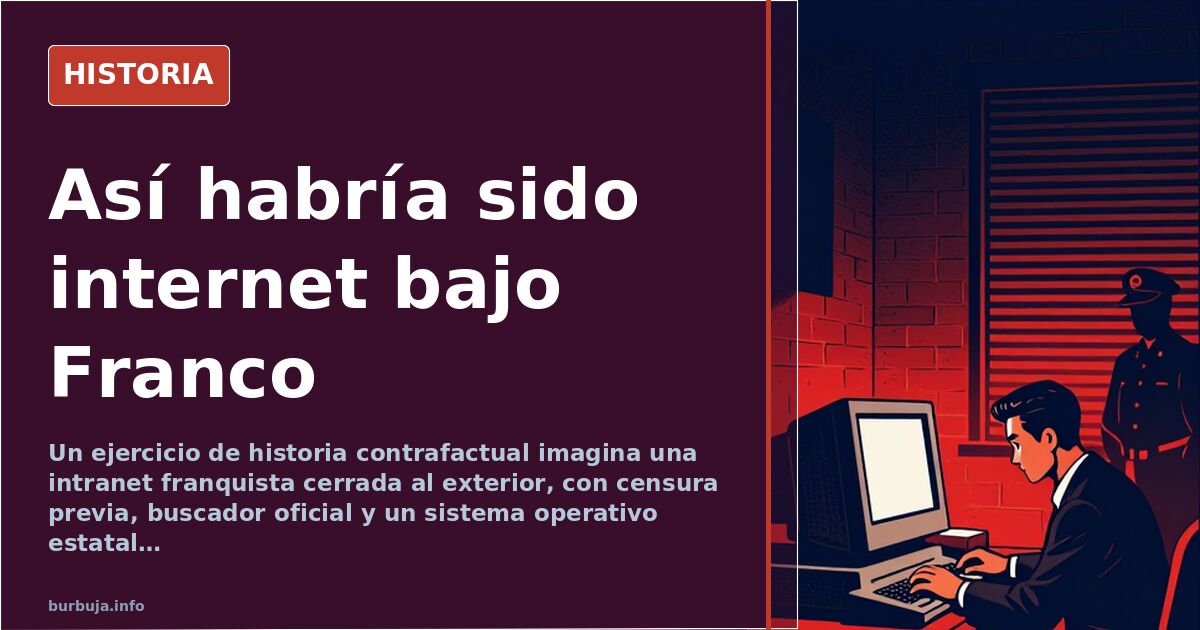
If Spain had had a network under the Franco regime, it would not have been the internet. It would have been an intranet similar to North Korea’s: access only where the government allowed, with restricted websites, social media, and apps, and VPNs as the sole backdoor. This is the starting point of a counterfactual history exercise that gathered 131 responses and, fundamentally, speaks less about Franco than about how technology is controlled when power needs it.
The most repeated consensus is that the model would not have been explicit censorship, but technical incompatibility and cost. The French Minitel case is recalled, a pre-internet with a teletext interface that worked for years and, according to some, could have delayed web adoption in France. In Spain, the version would have been "much less widespread and ridiculously expensive and bureaucratic," centralized and closed to the outside not by express prohibition, but by incompatible protocols.
The Telephone as a Hidden Tax
Before the network came the cable. The telephone in 1975 was a luxury many people could not afford and which failed constantly. In a class of 40 children, three or four are remembered without a home phone. In towns with several thousand inhabitants, there were three devices: the bar’s, the pharmacy’s, and the Guardia Civil’s (Spanish paramilitary police). Installation in 1990 cost 20,000 pesetas, about 600 euros today, and required influence to be done quickly.
The business was profitable for the State. In a country with a rudimentary tax structure, the telephone functioned as an efficient and hidden tax on self-employed workers, who needed it and paid very high rates, and as a privilege for those positioned within the regime, who often had it free "for service needs." All that money fed a public monopoly that was elephantine and full of parasites. Having a telephone gave tremendous status: in 1950, in an apartment building, only the policeman, the procurator, and the doctor had one.
Pre-censorship and Invisible Layers
Content control would have trinc the analog model. Digital media would have had to pass through the National Delegation for Press and Propaganda, the traditional censorship body, and some records would have seen songs cut from platforms, as peine with Spanish vinyl editions where tracks were removed. There would have been a state WhatsApp, an official search engine that would filter the most searched porn but not conspiracy theories or the Communist Manifesto, and a TOR network they wouldn’t even smell.
The most interesting part of the exercise is what isn’t seen. It is pointed out that obvious censorship is noticeable, but there is another kind where you don’t know what has been taken. And it is recalled that a religious police is not necessary: it is enough that whoever defines what is immoral also defines what beliefs are so. That relativism, it is argued, is the door through which any censorship enters.
The State Industry That Never Existed
The recurring fantasy is that of a national technological complex. A public company like ENDISA, Empresa Nacional de Internet SA, is imagined, with Telefónica at the helm, a Spanish operating system for mobile and PC, its own email client, its own social network, and even a smartphone brand. The name of the official search engine is already invented: ElEscudriñoso.es.
The real precedent dispels enthusiasm. At the end of 2008, a 12-year-old student promoted a Linux distribution for Asturias that was first called AsturLinux, then Astur GNU/Linux, and finally Asturix. The project ended as autonomous Linux distributions did: between chaos and embezzlement. The lesson is that the state software industry does not fail due to lack of money, but due to lack of users.
Information That Could Not Be Verified
The harshest portrait is not that of censorship, but of emptiness. In the 80s, a history teacher could say nonsense in class and no one verified it. A father did not know what the First and Second Reichs were, and the doubt lasted decades. A pundit could say on television that a soft drink brand belonged to a terrorist group, and it stayed there, with no possible verification. Information was inaccessible, not just monitored.
The network would have changed that, but in its own way. With a closed intranet, the citizen would have had access to the official version of facts, not to the facts themselves. The difference between a Spain without internet and a Spain with censored internet is not the amount of information, but who decides what is truth. And there the analysis stalls: there is no way to know if the network would have accelerated opening up or made it unnecessary.
Key Data
If Spain had had a network under the Franco regime, it would not have been the internet. It would have been an intranet similar to North Korea’s: access only where the government allowed, with restricted websites, social media, and apps, and VPNs as the sole backdoor. This is the starting point of a counterfactual history exercise that gathered 131 responses and, fundamentally, speaks less about Franco than about how technology is controlled when power needs it.
The most repeated consensus is that the model would not have been explicit censorship, but technical incompatibility and cost. The French Minitel case is recalled, a pre-internet with a teletext interface that worked for years and, according to some, could have delayed web adoption in France. In Spain, the version would have been "much less widespread and ridiculously expensive and bureaucratic," centralized and closed to the outside not by express prohibition, but by incompatible protocols.
The Telephone as a Hidden Tax
Before the network came the cable. The telephone in 1975 was a luxury many people could not afford and which failed constantly. In a class of 40 children, three or four are remembered without a home phone. In towns with several thousand inhabitants, there were three devices: the bar’s, the pharmacy’s, and the Guardia Civil’s (Spanish paramilitary police). Installation in 1990 cost 20,000 pesetas, about 600 euros today, and required influence to be done quickly.
The business was profitable for the State. In a country with a rudimentary tax structure, the telephone functioned as an efficient and hidden tax on self-employed workers, who needed it and paid very high rates, and as a privilege for those positioned within the regime, who often had it free "for service needs." All that money fed a public monopoly that was elephantine and full of parasites. Having a telephone gave tremendous status: in 1950, in an apartment building, only the policeman, the procurator, and the doctor had one.
Pre-censorship and Invisible Layers
Content control would have trinc the analog model. Digital media would have had to pass through the National Delegation for Press and Propaganda, the traditional censorship body, and some records would have seen songs cut from platforms, as peine with Spanish vinyl editions where tracks were removed. There would have been a state WhatsApp, an official search engine that would filter the most searched porn but not conspiracy theories or the Communist Manifesto, and a TOR network they wouldn’t even smell.
The most interesting part of the exercise is what isn’t seen. It is pointed out that obvious censorship is noticeable, but there is another kind where you don’t know what has been taken. And it is recalled that a religious police is not necessary: it is enough that whoever defines what is immoral also defines what beliefs are so. That relativism, it is argued, is the door through which any censorship enters.
The State Industry That Never Existed
The recurring fantasy is that of a national technological complex. A public company like ENDISA, Empresa Nacional de Internet SA, is imagined, with Telefónica at the helm, a Spanish operating system for mobile and PC, its own email client, its own social network, and even a smartphone brand. The name of the official search engine is already invented: ElEscudriñoso.es.
The real precedent dispels enthusiasm. At the end of 2008, a 12-year-old student promoted a Linux distribution for Asturias that was first called AsturLinux, then Astur GNU/Linux, and finally Asturix. The project ended as autonomous Linux distributions did: between chaos and embezzlement. The lesson is that the state software industry does not fail due to lack of money, but due to lack of users.
Information That Could Not Be Verified
The harshest portrait is not that of censorship, but of emptiness. In the 80s, a history teacher could say nonsense in class and no one verified it. A father did not know what the First and Second Reichs were, and the doubt lasted decades. A pundit could say on television that a soft drink brand belonged to a terrorist group, and it stayed there, with no possible verification. Information was inaccessible, not just monitored.
The network would have changed that, but in its own way. With a closed intranet, the citizen would have had access to the official version of facts, not to the facts themselves. The difference between a Spain without internet and a Spain with censored internet is not the amount of information, but who decides what is truth. And there the analysis stalls: there is no way to know if the network would have accelerated opening up or made it unnecessary.
Key Data
- Telephone installation in 1990: 20,000 pesetas, about 600 euros today.
- In a class of 40 students in the late 70s: three or four without a phone at home.
- In towns with several thousand inhabitants: three telephones (bar, pharmacy, and Guardia Civil).
- Asturix: Linux distribution promoted in 2008 by a 12-year-old student.
Also available in: Deutsch
Summary of a discussion on Burbuja.info - Foro de economía, actualidad y política., translated from Spanish and reviewed before publication. Read the full discussion (131 replies).
More summaries
-
North Sentinel Island: 60,000 Years Isolated, No Drones
North Sentinel Island remains unmapped internally: 60,000 years of isolation, a population of 50, and no drone daring to cross the line.
-
Huntington questioned Jewish civilization; debate continues
Samuel Huntington argued Judaism is not a major civilization. Debates on Hebrew originality, Greek influence, and matrilineal descent remain open.
-
Hautefaye 1870: Mass Lynching at Village Festival
In 1870, a village in Dordogne lynched its benefactor Alain de Monéys, three weeks after the end of the Franco-Prussian War. The Hautefaye case.
-
Catholic vs Orthodox: The Schism Still Dividing Europe
The 1054 Great Schism still splits Europe. Why did the Catholic Church act as a counterpower while the Orthodox served the state?
-
Why Spanish Food Fails to Go Global as Fast Food
Spanish staples like tortilla and calamari sandwiches struggle globally due to format issues, lack of business structure, and weak brand Spain.
-
International Brigades myth overshadows Spanish Republican soldiers
Debate on why the narrative glorifies International Brigades while ignoring Spaniards like Amado Granell, who liberated Paris in 1944.