
Catholic vs Orthodox: The Schism Still Dividing Europe
The 1054 Great Schism still splits Europe. Why did the Catholic Church act as a counterpower while the Orthodox served the state?
English · Original discussion in Spanish · Published
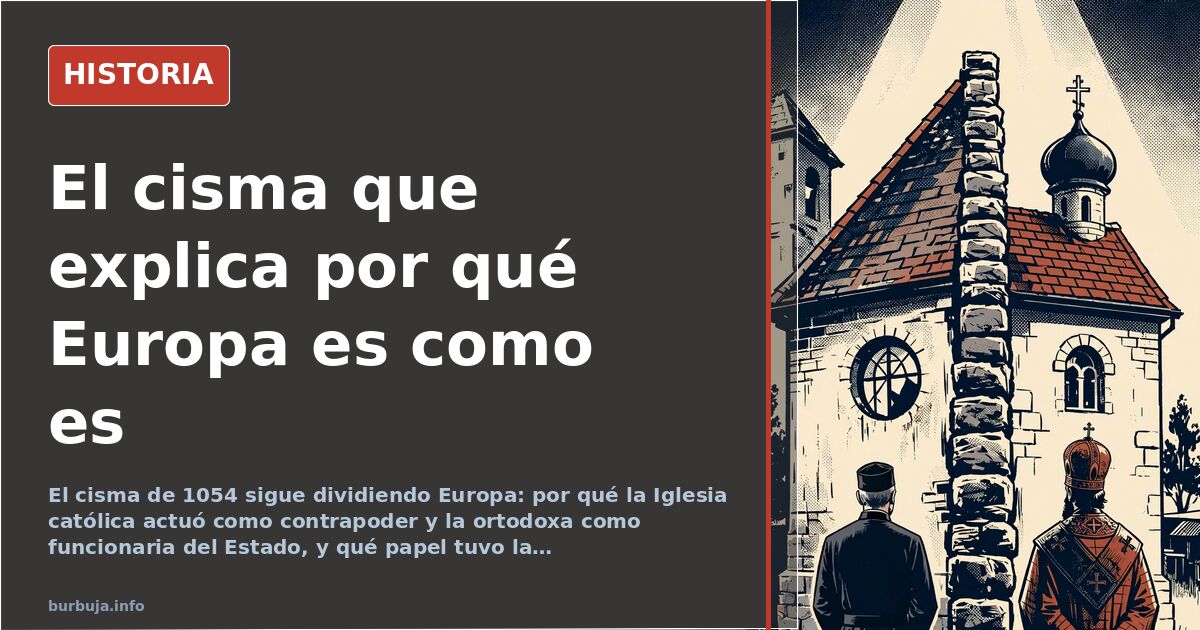
Catholic vs Orthodox: Why Europe Chose Rome
In 1054, Christendom split in two, and a millennium later the rift remains open. The debate’s central question—"If you were a minor king during the Great Schism, who would you back?"—seems academic but hides an issue economic historians have studied for decades: why Catholic and later Protestant Europe surged ahead while Orthodox regions lagged. The quick answer is geographic. The slow one is institutional. Neither fully resolves the case.
The Debate’s Core: Rome as Counterpower, Byzantium as Bureaucracy
A common intuition underpins several analyses: in the Catholic world, the Church acted as the ruler’s conscience and an effective counterpower; in the Orthodox world, it served as a bureaucrat for the current despot. A culture of separation of powers took root in the West but not in the East. Hence the thesis that societies needing a permanent guide tend toward failure. This is a simplification, yet it has concrete historical anchors: Peter the Great tamed the Russian Church by subordinating it to the state, and the USSR simply inherited this framework. One participant noted that Stalin turned the church into a discredited puppet, with bishops serving as state officials.
In contrast, the Catholic defense relies on long-term history: the Roman Church belonged to no single nation or race, allowing relative autonomy and acting as a catalyst for culture. The counterargument arrives quickly: if Catholicism were the seed of science, how do we explain Spain’s scientific barrenness? The response is that Spain lacked sufficient Enlightenment continuity—with Ferdinand VI and Charles III as exceptions—and each Bourbon successor became increasingly Spanishized, ending up as puppets of their confessors. Austria, equally Catholic and reactionary under Habsburg rule, achieved remarkable scientific, cultural, and industrial success.
Why Did Protestant Nations Outperform Catholic Ones?
Here the debate gets tangled. It asks why Protestant nations had better economic and scientific performance than Catholic ones, excluding France and Austria. The skeptical answer: that proficiency existed when they were Catholic, and Protestantism is a Judaic-leaning religion whose predestination doctrine erases free will. Correction: full predestination is accepted only by specific branches, not even all Lutherans. Moreover, historically wealthy Protestant countries are few—England and the Netherlands—while Germany is half-and-half, and its rich part is actually Catholic. Hilaire Belloc argued that if England hadn’t separated from Rome, Protestantism would today be a past heresy like Arianism.
Geography’s Role: Steppes, Turks, and Communism
The most robust explanation combines geography and geopolitics. Russia is a vast steppe without mountain barriers hindering communication, easy for a single power to control; Europe, conversely, was fragmented into small states. The Orthodox world also faced greater exposure to Turkish and Mongol attacks—the destruction of Constantinople and Kiev—preventing the emergence of a purely Orthodox wealthy zone. According to one participant, Orthodox populations fall into two groups: Slavic peoples and Christian minorities in Arab countries, within systems that penalize critical thinking and business growth.
European fragmentation, seen by some as a cancer, is viewed by others as the source of everything: Venice, Genoa, Florence, Hamburg. An empire tends to absorb resources from its territories toward the capital. Absolute power has two disadvantages—no competition, no counterpower—and produces stagnation: either the monarch is a reformist genius, or the country collapses. Imagine the entire Russian Empire ruled by Charles II. Would it have survived, or been destroyed by his brother, as Peter the Great did with his?
In 1054, Christendom split in two, and a millennium later the rift remains open. The debate’s central question—"If you were a minor king during the Great Schism, who would you back?"—seems academic but hides an issue economic historians have studied for decades: why Catholic and later Protestant Europe surged ahead while Orthodox regions lagged. The quick answer is geographic. The slow one is institutional. Neither fully resolves the case.
The Debate’s Core: Rome as Counterpower, Byzantium as Bureaucracy
A common intuition underpins several analyses: in the Catholic world, the Church acted as the ruler’s conscience and an effective counterpower; in the Orthodox world, it served as a bureaucrat for the current despot. A culture of separation of powers took root in the West but not in the East. Hence the thesis that societies needing a permanent guide tend toward failure. This is a simplification, yet it has concrete historical anchors: Peter the Great tamed the Russian Church by subordinating it to the state, and the USSR simply inherited this framework. One participant noted that Stalin turned the church into a discredited puppet, with bishops serving as state officials.
In contrast, the Catholic defense relies on long-term history: the Roman Church belonged to no single nation or race, allowing relative autonomy and acting as a catalyst for culture. The counterargument arrives quickly: if Catholicism were the seed of science, how do we explain Spain’s scientific barrenness? The response is that Spain lacked sufficient Enlightenment continuity—with Ferdinand VI and Charles III as exceptions—and each Bourbon successor became increasingly Spanishized, ending up as puppets of their confessors. Austria, equally Catholic and reactionary under Habsburg rule, achieved remarkable scientific, cultural, and industrial success.
Why Did Protestant Nations Outperform Catholic Ones?
Here the debate gets tangled. It asks why Protestant nations had better economic and scientific performance than Catholic ones, excluding France and Austria. The skeptical answer: that proficiency existed when they were Catholic, and Protestantism is a Judaic-leaning religion whose predestination doctrine erases free will. Correction: full predestination is accepted only by specific branches, not even all Lutherans. Moreover, historically wealthy Protestant countries are few—England and the Netherlands—while Germany is half-and-half, and its rich part is actually Catholic. Hilaire Belloc argued that if England hadn’t separated from Rome, Protestantism would today be a past heresy like Arianism.
Geography’s Role: Steppes, Turks, and Communism
The most robust explanation combines geography and geopolitics. Russia is a vast steppe without mountain barriers hindering communication, easy for a single power to control; Europe, conversely, was fragmented into small states. The Orthodox world also faced greater exposure to Turkish and Mongol attacks—the destruction of Constantinople and Kiev—preventing the emergence of a purely Orthodox wealthy zone. According to one participant, Orthodox populations fall into two groups: Slavic peoples and Christian minorities in Arab countries, within systems that penalize critical thinking and business growth.
European fragmentation, seen by some as a cancer, is viewed by others as the source of everything: Venice, Genoa, Florence, Hamburg. An empire tends to absorb resources from its territories toward the capital. Absolute power has two disadvantages—no competition, no counterpower—and produces stagnation: either the monarch is a reformist genius, or the country collapses. Imagine the entire Russian Empire ruled by Charles II. Would it have survived, or been destroyed by his brother, as Peter the Great did with his?
Also available in: Deutsch
Summary of a discussion on Burbuja.info - Foro de economía, actualidad y política., translated from Spanish and reviewed before publication. Read the full discussion (130 replies).
More summaries
-
ETA and GAL: two arms of the same Gladio network in Spain
Investigation linking ETA and GAL as arms of the same NATO Gladio network, with drug trafficking funding and CIA control.
-
Why Spanish Food Fails to Go Global as Fast Food
Spanish staples like tortilla and calamari sandwiches struggle globally due to format issues, lack of business structure, and weak brand Spain.
-
International Brigades myth overshadows Spanish Republican soldiers
Debate on why the narrative glorifies International Brigades while ignoring Spaniards like Amado Granell, who liberated Paris in 1944.
-
Flat Earth: Myth debunked by Elcano in 1522
Flat Earth theory went viral after 2010. Elcano proved the globe in 1522, centuries after Eratosthenes measured it.
-
US Report Links Jewish Bankers to Russian Revolution Funding
A 1920 US Secret Service report alleges Jacob Schiff and Kuhn Loeb financed the Bolsheviks, a claim still debated despite historical scrutiny.
-
Spain's Franco-era Internet: Closed Intranet and Pre-censorship
A counterfactual history exercise imagines a closed Francoist intranet with pre-censorship, an official search engine, and a state operating system.