
Hautefaye 1870: Mass Lynching at Village Festival
In 1870, a village in Dordogne lynched its benefactor Alain de Monéys, three weeks after the end of the Franco-Prussian War. The Hautefaye case.
English · Original discussion in Spanish · Published
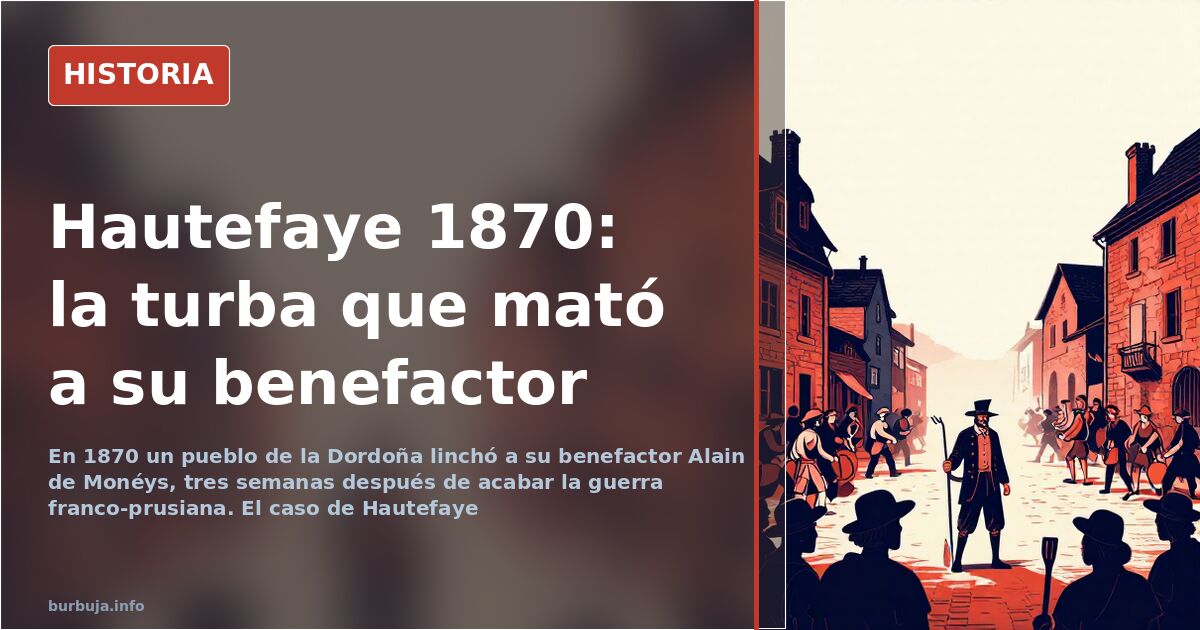
Hautefaye, 1870: The Village That Lynched Its Benefactor During a Festival
How does a village fair with wine flowing turn into a collective lynching? In a tiny hamlet in Dordogne, three weeks after the Franco-Prussian War ended, the celebrating villagers took the life of Alain de Monéys. The Hautefaye case, in 1870, was not closed by an army: it was closed by a mob.
What Peine in Hautefaye and Who Was Alain de Monéys
The setting was any patronal festival of the time. A small village, celebrations, wine, and neighbors tense from a country just out of war. Alain de Monéys belonged to the minor nobility and rural bourgeoisie that bridged the village and agricultural business: he had brought running water to the village and served as a liaison with cattle breeders, millers, and agricultural entrepreneurs in the area.
A misunderstanding was enough for the crowd to take him for an enemy. The account of the case includes, according to circulating versions, a prolonged humiliation, a collective death, and episodes of cannibalism that have turned the event into one of the darkest stories of rural France. None of that peine at the front, but in a village celebrating its festivals 600 kilometers from the Prussian troops.
Why a Mob Does What a Neighbor Never Would
The question hovering over the case is not why that village had a monster, but how an ordinary community becomes an executioner in a matter of hours. It was not a usual war crime: it was not committed by an army nor ordered by a commander. It was carried out by a mass driven by exalted chauvinism and a misinterpreted grievance.
The pattern reappears when authority weakens. As soon as the external brake disappears—a war, a power vacuum, a cut supply—the distance between neighbor and lyncher thins until it vanishes. The comparison with other episodes of collective violence is not a theoretical exercise: it is the same mechanism with a different setting.
Civilization as a Thin Veneer: Norbert Elias
The sociologist Norbert Elias, who escaped Nancy Germany while part of his family could not, devoted The Civilizing Process to studying precisely this. His thesis is uncomfortable: we take for granted that barbarism belongs to the past and that our level of civilization makes it impossible. Until, with the right conditions, it reappears at any time and place.
Elias placed the key not in society as a whole, but in each individual composing it. Hence his conclusion, summarized in a frequently cited phrase: civilization is not a point of arrival, it is barely a thin layer—a fine veneer—that requires constant maintenance. Hautefaye would be, in that reading, less a French anomaly than a general warning.
Was It an Exclusively French Phenomenon?
France does not have a monopoly on collective cruelty, and the case itself demonstrates this by where it occurred. The literature of the time confirms it: Guy de Maupassant portrayed in several stories the turbulent France of the Franco-Prussian period, and in Germinal—novel and film adaptation—the workers corner and kill the village shopkeeper in a lynching scene.
Outside France there are comparable episodes. Some argue that in Civil War Spain there were cases in villages far from the front, with attacks on suspects from the opposing side. Some argue that certain societies are more prone to this brutality; the facts recorded in European villages complicate that thesis considerably.
What This Says About Masses and Democracy
Watching a mass act with the brake removed invites distrust of any narrative that presents violence as someone else's doing. The lesson of the case, as one debate participant summarizes, is quantitative before qualitative: it matters less who did it than how much leeway was needed for them to do it.
France, incidentally, is also the country that later wrote novels, articles, and essays about the episode, and its readers still find it monstrous. That, and not the festival wine, is what separates a lynching from a simple accident: the mania for telling it afterward.
How does a village fair with wine flowing turn into a collective lynching? In a tiny hamlet in Dordogne, three weeks after the Franco-Prussian War ended, the celebrating villagers took the life of Alain de Monéys. The Hautefaye case, in 1870, was not closed by an army: it was closed by a mob.
What Peine in Hautefaye and Who Was Alain de Monéys
The setting was any patronal festival of the time. A small village, celebrations, wine, and neighbors tense from a country just out of war. Alain de Monéys belonged to the minor nobility and rural bourgeoisie that bridged the village and agricultural business: he had brought running water to the village and served as a liaison with cattle breeders, millers, and agricultural entrepreneurs in the area.
A misunderstanding was enough for the crowd to take him for an enemy. The account of the case includes, according to circulating versions, a prolonged humiliation, a collective death, and episodes of cannibalism that have turned the event into one of the darkest stories of rural France. None of that peine at the front, but in a village celebrating its festivals 600 kilometers from the Prussian troops.
Why a Mob Does What a Neighbor Never Would
The question hovering over the case is not why that village had a monster, but how an ordinary community becomes an executioner in a matter of hours. It was not a usual war crime: it was not committed by an army nor ordered by a commander. It was carried out by a mass driven by exalted chauvinism and a misinterpreted grievance.
The pattern reappears when authority weakens. As soon as the external brake disappears—a war, a power vacuum, a cut supply—the distance between neighbor and lyncher thins until it vanishes. The comparison with other episodes of collective violence is not a theoretical exercise: it is the same mechanism with a different setting.
Civilization as a Thin Veneer: Norbert Elias
The sociologist Norbert Elias, who escaped Nancy Germany while part of his family could not, devoted The Civilizing Process to studying precisely this. His thesis is uncomfortable: we take for granted that barbarism belongs to the past and that our level of civilization makes it impossible. Until, with the right conditions, it reappears at any time and place.
Elias placed the key not in society as a whole, but in each individual composing it. Hence his conclusion, summarized in a frequently cited phrase: civilization is not a point of arrival, it is barely a thin layer—a fine veneer—that requires constant maintenance. Hautefaye would be, in that reading, less a French anomaly than a general warning.
Was It an Exclusively French Phenomenon?
France does not have a monopoly on collective cruelty, and the case itself demonstrates this by where it occurred. The literature of the time confirms it: Guy de Maupassant portrayed in several stories the turbulent France of the Franco-Prussian period, and in Germinal—novel and film adaptation—the workers corner and kill the village shopkeeper in a lynching scene.
Outside France there are comparable episodes. Some argue that in Civil War Spain there were cases in villages far from the front, with attacks on suspects from the opposing side. Some argue that certain societies are more prone to this brutality; the facts recorded in European villages complicate that thesis considerably.
What This Says About Masses and Democracy
Watching a mass act with the brake removed invites distrust of any narrative that presents violence as someone else's doing. The lesson of the case, as one debate participant summarizes, is quantitative before qualitative: it matters less who did it than how much leeway was needed for them to do it.
France, incidentally, is also the country that later wrote novels, articles, and essays about the episode, and its readers still find it monstrous. That, and not the festival wine, is what separates a lynching from a simple accident: the mania for telling it afterward.
Summary of a discussion on Burbuja.info - Foro de economía, actualidad y política., translated from Spanish and reviewed before publication. Read the full discussion (25 replies).
More summaries
-
New Book Reignites Debate on Spanish Civil War and the Republic
A recent book challenges the legitimacy of the 1931 elections, sparking renewed discussion about Spain's Second Republic and the Civil War.
-
Russian Revolution on Film: Movies That Aren't On Everyone's Bucket List
From Battleship Potemkin to Reds: Films depicting the Russian Revolution and Civil War, including details on filming in Spain and accessing the Mosfilm catalog.
-
ETA and GAL: two arms of the same Gladio network in Spain
Investigation linking ETA and GAL as arms of the same NATO Gladio network, with drug trafficking funding and CIA control.
-
Overvalued Tiger: The Fragility of German Production
Expert analysis reveals that Germany's obsession with the Tiger II was a fatal logistical error in World War II.
-
Judas: Betrayer, Scapegoat, or God's Instrument?
Greed, divine plan, or political coercion? An analysis of theories on Judas Iscariot's betrayal, from canonical gospels to the Gospel of Judas.
-
Galician-Moorish Phenotype: Genetic Continuum or Political Myth?
Analysis of the genetic debate: Is the Galician-Moorish phenotypic similarity a peninsular continuum or a political construct?