
Spain's Draft Letter Sparks Mockery and Flight to Portugal
A hypothetical conscription notice with a UN pin triggers reactions ranging from laughter to exile in Portugal.
English · Original discussion in Spanish · Published
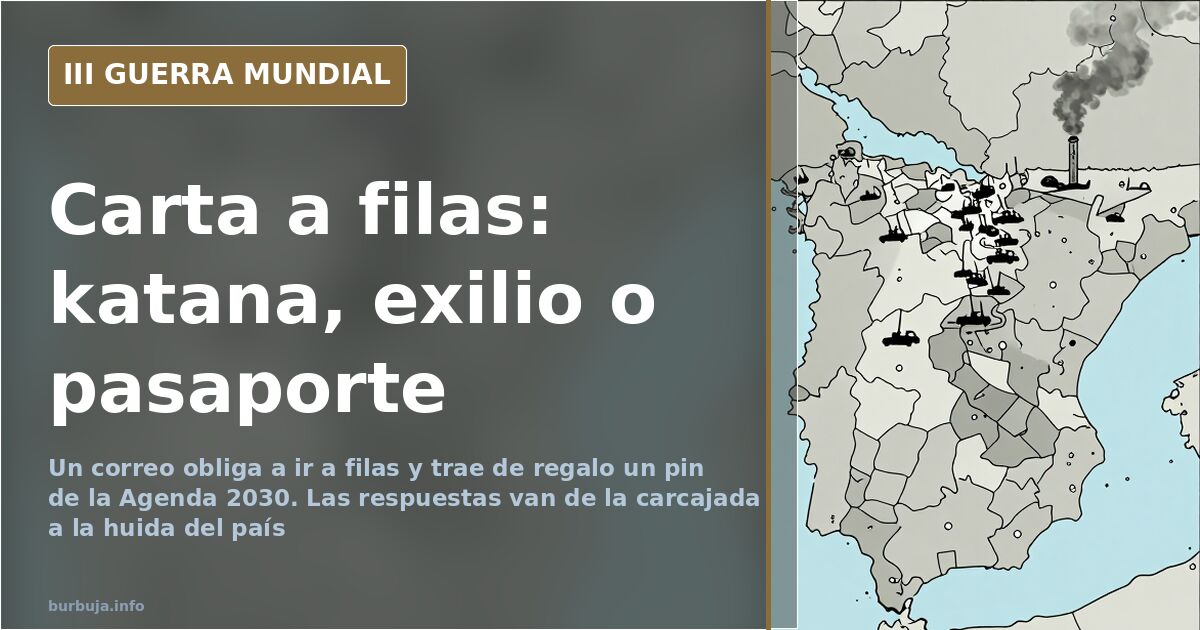
From Laughter to Passport: The Conscription Notice No One Believes
Spain has not had mandatory military service for decades, which is precisely why the scenario seems absurd: an email ordering you to report for duty, complete with a free Agenda 2030 pin. While the premise sounds ridiculous, the parallel enters the conversation: some describe offices where, according to their accounts, the poorest were summoned to sign contracts under false pretenses, similar to Russian recruitment tactics. The question, therefore, is not whether the Army could do this, but what each person would do if the order arrived. Reactions range from laughter to booking boat tickets.
What the Letter Proposes and Why No One Believes It
The proposal includes two elements that summarize the mood: the obligation to report for duty and the detail of the official pin. That second object causes more damage than the first. The dominant reaction is not antiestéticar, but mockery: the letter is described as an attempted scam, another piece of the narrative machinery. Some respond that they do not participate in "extreme left media bubbles" at home and close the matter without further procedure.
What is striking is the consensus. No one discusses whether the letter would be legal, if it could be appealed, or to which authority one should reply. The scenario is considered impossible and played with, turning the exercise into a loyalty test rather than a legal problem. For many, the envelope would not even enter the house; one response summarizes the attitude with sarcasm: if it arrives during bath time, the visit is almost appreciated.
"Don't Open for Anyone": The Lesson Learned from Vaccines and Polling Stations
If there is a repeated answer, it is administrative. The moment is compared to the call for vaccination—a "not interested" and closed door—and with the summons to the polling station that no one wants to receive. The method is identical: not being present, not answering, not signing. The underlying logic is the same that explains so many bureaucratic escapes: if the system cannot locate you, the obligation dissolves on its own.
Others add layers. One warns that there will be no letter or email, but a country lockdown and forced conscription street by street and apartment by apartment, while those remaining in the rear distribute consolation among widows and orphans; the image is harsh and sounds like a warning, not a wish. A third states that he would not be called because he was already expelled. And one recalls avoiding military service in the nineties by claiming vision organ indisposition.
Self-Identifying as Woman: Another Way to Dodge the Order
Among the formulas to dodge the order, one repeats: declaring oneself a trans woman or self-identifying as a woman and considering the matter closed. Two interventions propose it as an administrative shortcut and no one disputes it: the focus immediately shifts elsewhere. It is the procedural version of what in other eras was resolved by medical exemption.
"As Soon as They Give Me a Weapon, I Know Where the Enemy Is," Says a Participant
Here the tone changes. The uncomfortable part of the exercise appears: if the State distributes rifles, someone will have to decide where they point. Some joke about being given weapons and ammunition to miss the target, others say the first bullet doesn't know where it will go, and others claim they don't need to leave Spain to find the adversary. These are hastily written fantasies, but they describe a real military problem: arming those who do not want to die for you never comes cheaply.
The most lucid objection comes just opposite to bravado. If power is conquered with weapons, reasons one intervention, then handing out weapons to those forced to die for others is exactly what is needed for a coup: weapons and nothing to lose. The argument turns the patriotic slogan around. The danger would not come from the army crossing the border, but from the one formed internally with the distributed material. The irony closes the circle regarding a supposed rule of law where laws are respected.
Portugal, the Mountains, and the Passport
The other exit is geographic. "I exile myself to Portugal; walking through the mountains, I arrive in less than a day," says one response. Others choose to flee without destination, leave the country, or—in the harshest formulation—switch sides before defending the interests of those in charge. A third prefers prison. And some stagger the plan: first the shotgun barrel in the messenger's face, then the suitcase and the boat, and finally the certainty that they will return with a truck and armed soldiers.
At the opposite extreme, one accepts the role without drama. He would take what is given and defend to death whoever governs, assuming his political affinities will end up ruling. It is the logic of the winning party applied to war: one does not defend a country, one defends a side.
Where the Calculation Stalls
No one believes the letter exists, yet everyone has a plan for it. This is the exact point where analysis runs out of answers: it is never decided if the enemy is outside or the one delivering the envelope, the pin, and the rifle. With the most severe scenario on the table—up to twenty years in prison or execution for failure to appear, according to the comparison with Russian recruitment proposed by a participant—the joke holds because everyone considers the letter impossible. The day it stopped being so, no katana would fix it.
Spain has not had mandatory military service for decades, which is precisely why the scenario seems absurd: an email ordering you to report for duty, complete with a free Agenda 2030 pin. While the premise sounds ridiculous, the parallel enters the conversation: some describe offices where, according to their accounts, the poorest were summoned to sign contracts under false pretenses, similar to Russian recruitment tactics. The question, therefore, is not whether the Army could do this, but what each person would do if the order arrived. Reactions range from laughter to booking boat tickets.
What the Letter Proposes and Why No One Believes It
The proposal includes two elements that summarize the mood: the obligation to report for duty and the detail of the official pin. That second object causes more damage than the first. The dominant reaction is not antiestéticar, but mockery: the letter is described as an attempted scam, another piece of the narrative machinery. Some respond that they do not participate in "extreme left media bubbles" at home and close the matter without further procedure.
What is striking is the consensus. No one discusses whether the letter would be legal, if it could be appealed, or to which authority one should reply. The scenario is considered impossible and played with, turning the exercise into a loyalty test rather than a legal problem. For many, the envelope would not even enter the house; one response summarizes the attitude with sarcasm: if it arrives during bath time, the visit is almost appreciated.
"Don't Open for Anyone": The Lesson Learned from Vaccines and Polling Stations
If there is a repeated answer, it is administrative. The moment is compared to the call for vaccination—a "not interested" and closed door—and with the summons to the polling station that no one wants to receive. The method is identical: not being present, not answering, not signing. The underlying logic is the same that explains so many bureaucratic escapes: if the system cannot locate you, the obligation dissolves on its own.
Others add layers. One warns that there will be no letter or email, but a country lockdown and forced conscription street by street and apartment by apartment, while those remaining in the rear distribute consolation among widows and orphans; the image is harsh and sounds like a warning, not a wish. A third states that he would not be called because he was already expelled. And one recalls avoiding military service in the nineties by claiming vision organ indisposition.
Self-Identifying as Woman: Another Way to Dodge the Order
Among the formulas to dodge the order, one repeats: declaring oneself a trans woman or self-identifying as a woman and considering the matter closed. Two interventions propose it as an administrative shortcut and no one disputes it: the focus immediately shifts elsewhere. It is the procedural version of what in other eras was resolved by medical exemption.
"As Soon as They Give Me a Weapon, I Know Where the Enemy Is," Says a Participant
Here the tone changes. The uncomfortable part of the exercise appears: if the State distributes rifles, someone will have to decide where they point. Some joke about being given weapons and ammunition to miss the target, others say the first bullet doesn't know where it will go, and others claim they don't need to leave Spain to find the adversary. These are hastily written fantasies, but they describe a real military problem: arming those who do not want to die for you never comes cheaply.
The most lucid objection comes just opposite to bravado. If power is conquered with weapons, reasons one intervention, then handing out weapons to those forced to die for others is exactly what is needed for a coup: weapons and nothing to lose. The argument turns the patriotic slogan around. The danger would not come from the army crossing the border, but from the one formed internally with the distributed material. The irony closes the circle regarding a supposed rule of law where laws are respected.
Portugal, the Mountains, and the Passport
The other exit is geographic. "I exile myself to Portugal; walking through the mountains, I arrive in less than a day," says one response. Others choose to flee without destination, leave the country, or—in the harshest formulation—switch sides before defending the interests of those in charge. A third prefers prison. And some stagger the plan: first the shotgun barrel in the messenger's face, then the suitcase and the boat, and finally the certainty that they will return with a truck and armed soldiers.
At the opposite extreme, one accepts the role without drama. He would take what is given and defend to death whoever governs, assuming his political affinities will end up ruling. It is the logic of the winning party applied to war: one does not defend a country, one defends a side.
Where the Calculation Stalls
No one believes the letter exists, yet everyone has a plan for it. This is the exact point where analysis runs out of answers: it is never decided if the enemy is outside or the one delivering the envelope, the pin, and the rifle. With the most severe scenario on the table—up to twenty years in prison or execution for failure to appear, according to the comparison with Russian recruitment proposed by a participant—the joke holds because everyone considers the letter impossible. The day it stopped being so, no katana would fix it.
Also available in: Deutsch
Summary of a discussion on Burbuja.info - Foro de economía, actualidad y política., translated from Spanish and reviewed before publication. Read the full discussion (188 replies).
More summaries
-
European conscription returns, targeting men only
Several European nations have revived or debated mandatory military service since 2014, with obligations falling almost exclusively on men.
-
Germany plans to make voluntary military service mandatory
Germany intends to convert its voluntary military service, currently joined by 8,000 people, into a mandatory obligation.
-
Germany’s 63,000 Troops Fall Short of 300,000 Needed for Ukraine Front
Russia produces 2.5x NATO artillery shells; EU steel output is half 1980 levels. Europe faces a critical military gap for direct intervention.
-
Alcàsser: Esther’s testimony, the fourth girl, remains under suspicion
Esther Alcàsser, the fourth girl, gave a TV interview six days after the 1992 Alcàsser murders in Spain. Her account and timeline discrepancies fuel ongoing controversy.
-
Yana Rykhlitska, the 'Angel of Bakhmut' and the war of casualty figures
The death of volunteer Yana Rykhlitska in Bakhmut reignites debates over casualty statistics and the role of women on the front lines.
-
Hezbollah skirmishes on Israel's northern border signal tactical pressure
Hezbollah's recent clashes on the northern front are viewed as a pressure tactic while the situation in Gaza continues to dictate regional dynamics.