
Yana Rykhlitska, the 'Angel of Bakhmut' and the war of casualty figures
The death of volunteer Yana Rykhlitska in Bakhmut reignites debates over casualty statistics and the role of women on the front lines.
English · Original discussion in Spanish · Published
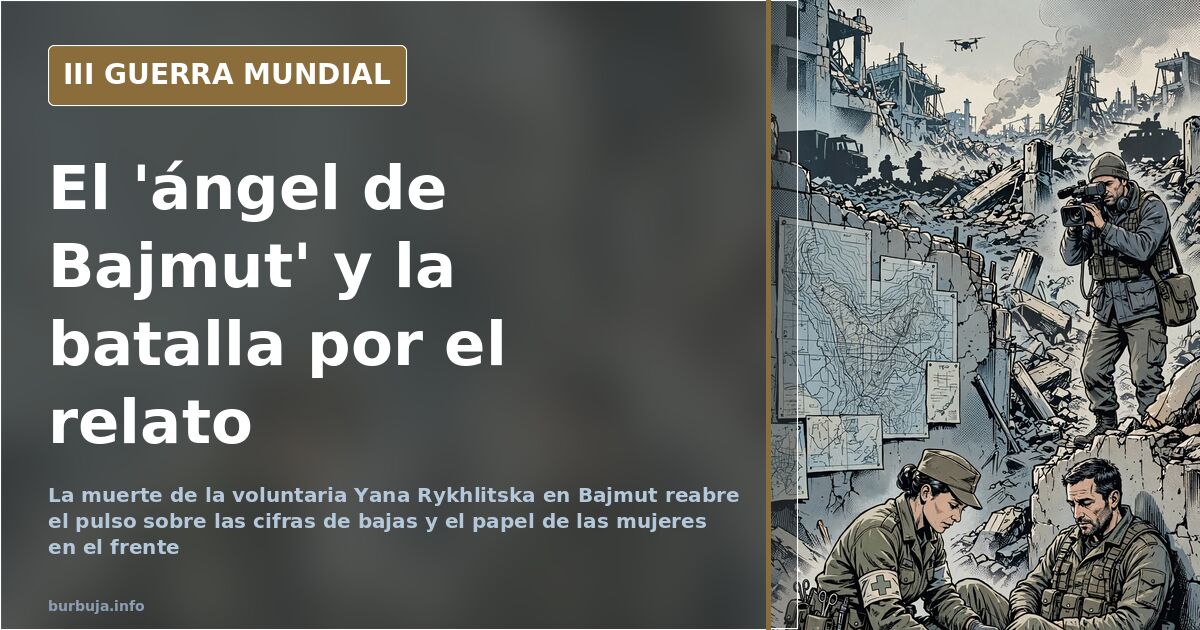
Yana Rykhlitska, the 'Angel of Bakhmut': a death that reopens the battle of narratives
The death of Yana Rykhlitska, a Ukrainian volunteer known as the Angel of Bakhmut, has peine an uncomfortable question: what turns a casualty into news and what turns tens of thousands into a figure that no one disputes? The news, reported by El Mundo, arrived in the midst of the battle for Bakhmut and quickly shifted from a moment of mourning to ammunition in another front: the battle of narratives.
The first disagreement is not geopolitical, but one of framing. Some view the case as proof that Ukrainian women are also on the front lines and have not all fled to Poland, Germany, or Spain. Others doubt she was a front-line combatant, placing her instead in nursing, transport, or logistics. All other disputes stem from this distinction.
Who was Yana Rykhlitska and why is she in the news?
She appears in reports as a volunteer killed in a war zone, given the nickname 'angel' due to her support work. This nuance—volunteer, not necessarily an assault soldier—is exactly what sparks the debate. The argument of those championing her figure is direct: her death contradicts the narrative that all Ukrainian women of her generation had fled the country.
The objection comes from the other side. It is argued that nursing and logistics are the primary roles for women deployed, and that presenting them as shock troops responds more to a need for symbols than to the actual composition of the units. This does not diminish the risk: anyone in a war zone, whether with a rifle or a stretcher, is in a war zone. The difference is in the narrative, not in the danger.
Casualty figures: 25,000 versus 150,000
Here, the matter ceases to be symbolic. The conflicting figures are so disparate that they allow almost any thesis to be defended. One circulating estimate places Russian deaths between 25,000 and 40,000, and Ukrainians above 150,000. The opposing reading maintains the exact opposite: a Ukrainian army that never fell below half a million personnel against a Russian force that did not reach half that number, which is why they would have had to rely on reservists.
The detail regarding reservists is used as evidence of attrition: those calling for reinforcements do so because they need replacements, not because they are winning. The rebuttal is that mobilization also responds to the expansion of the front and unit rotation. Without auditable reports, both interpretations are plausible.
The problem is the usual one: neither side publishes its casualty counts with enough frequency to verify the daily trickle. The tactic described by a Ukrainian soldier—sending a platoon to force the defender to reveal themselves and then hitting their position with artillery—is used to argue in opposite directions. Some see human waves; others, a proportion of casualties that does not align with the reported figures. Even the name of a former US intelligence officer whose credibility is debated appears, alongside an episode no one disputes: the shoot-down of Malaysia Airlines flight MH-17, with 298 dead, which has become a yardstick for judging the reliability of every version.
Are Ukrainian women on the front lines?
The question feels more like an interrogation than curiosity. One side points out that circulating audiovisual material—women in uniform with anti-tank equipment, carefully curated recruitment images—functions as bait to attract volunteers, and that there are videos of alleged combatants that later turned out to be advertisements, with the protagonists alive and dedicated to humanitarian work. The other side responds with etymology: in Ukrainian, nurse is said to be medsestra (sister), and the first war nurses date back to the Crimean War.
The detail of makeup—the idea that the most visible combatants always appear groomed—is used both as an attraction and as proof that staging carries more weight than training. No one provides concrete figures on how many women hold combat positions. Meanwhile, scenes of forced recruitment, involving street detentions to take people to the front, are attributed to either side depending on who is sharing the video.
Bakhmut, Soledar, and Mariupol: the shifting line
The geography of the front acts as a thermometer for expectations. One side is accused of constantly shifting the objective: first Mariupol, then Soledar, now Bakhmut, every time the previous one ceased to serve the script. In response, it is argued that the script was never that: it is claimed the capital was considered controlled in three days and that an external order prevented surrender, a thesis the other side calls a baseless fable.
In between are episodes used as low-intensity ammunition. A version attributed to British intelligence sources circulated, claiming some casualties were caused by shovels, a detail that served less to inform than to ridicule the official narrative. A tweet with more reach than any part of the war.
The symbol as a product
Those who argue the news is part of a strategy explain it bluntly: states do not hold tributes, they select symbols. A few deaths, both men and women, are highlighted because they need to sell courage, not tragedy. Hero pantheons exist in all armies, and the Ukrainian one is no exception.
The analysis stalls exactly here. No one disputes that Yana Rykhlitska died in a war zone. What cannot be verified, with the available data, is whether her case summarizes a pattern or is the exception that proves the rule. And without auditable counts, the discussion will continue to be decided by what each person already believed before reading it.
The death of Yana Rykhlitska, a Ukrainian volunteer known as the Angel of Bakhmut, has peine an uncomfortable question: what turns a casualty into news and what turns tens of thousands into a figure that no one disputes? The news, reported by El Mundo, arrived in the midst of the battle for Bakhmut and quickly shifted from a moment of mourning to ammunition in another front: the battle of narratives.
The first disagreement is not geopolitical, but one of framing. Some view the case as proof that Ukrainian women are also on the front lines and have not all fled to Poland, Germany, or Spain. Others doubt she was a front-line combatant, placing her instead in nursing, transport, or logistics. All other disputes stem from this distinction.
Who was Yana Rykhlitska and why is she in the news?
She appears in reports as a volunteer killed in a war zone, given the nickname 'angel' due to her support work. This nuance—volunteer, not necessarily an assault soldier—is exactly what sparks the debate. The argument of those championing her figure is direct: her death contradicts the narrative that all Ukrainian women of her generation had fled the country.
The objection comes from the other side. It is argued that nursing and logistics are the primary roles for women deployed, and that presenting them as shock troops responds more to a need for symbols than to the actual composition of the units. This does not diminish the risk: anyone in a war zone, whether with a rifle or a stretcher, is in a war zone. The difference is in the narrative, not in the danger.
Casualty figures: 25,000 versus 150,000
Here, the matter ceases to be symbolic. The conflicting figures are so disparate that they allow almost any thesis to be defended. One circulating estimate places Russian deaths between 25,000 and 40,000, and Ukrainians above 150,000. The opposing reading maintains the exact opposite: a Ukrainian army that never fell below half a million personnel against a Russian force that did not reach half that number, which is why they would have had to rely on reservists.
The detail regarding reservists is used as evidence of attrition: those calling for reinforcements do so because they need replacements, not because they are winning. The rebuttal is that mobilization also responds to the expansion of the front and unit rotation. Without auditable reports, both interpretations are plausible.
The problem is the usual one: neither side publishes its casualty counts with enough frequency to verify the daily trickle. The tactic described by a Ukrainian soldier—sending a platoon to force the defender to reveal themselves and then hitting their position with artillery—is used to argue in opposite directions. Some see human waves; others, a proportion of casualties that does not align with the reported figures. Even the name of a former US intelligence officer whose credibility is debated appears, alongside an episode no one disputes: the shoot-down of Malaysia Airlines flight MH-17, with 298 dead, which has become a yardstick for judging the reliability of every version.
Are Ukrainian women on the front lines?
The question feels more like an interrogation than curiosity. One side points out that circulating audiovisual material—women in uniform with anti-tank equipment, carefully curated recruitment images—functions as bait to attract volunteers, and that there are videos of alleged combatants that later turned out to be advertisements, with the protagonists alive and dedicated to humanitarian work. The other side responds with etymology: in Ukrainian, nurse is said to be medsestra (sister), and the first war nurses date back to the Crimean War.
The detail of makeup—the idea that the most visible combatants always appear groomed—is used both as an attraction and as proof that staging carries more weight than training. No one provides concrete figures on how many women hold combat positions. Meanwhile, scenes of forced recruitment, involving street detentions to take people to the front, are attributed to either side depending on who is sharing the video.
Bakhmut, Soledar, and Mariupol: the shifting line
The geography of the front acts as a thermometer for expectations. One side is accused of constantly shifting the objective: first Mariupol, then Soledar, now Bakhmut, every time the previous one ceased to serve the script. In response, it is argued that the script was never that: it is claimed the capital was considered controlled in three days and that an external order prevented surrender, a thesis the other side calls a baseless fable.
In between are episodes used as low-intensity ammunition. A version attributed to British intelligence sources circulated, claiming some casualties were caused by shovels, a detail that served less to inform than to ridicule the official narrative. A tweet with more reach than any part of the war.
The symbol as a product
Those who argue the news is part of a strategy explain it bluntly: states do not hold tributes, they select symbols. A few deaths, both men and women, are highlighted because they need to sell courage, not tragedy. Hero pantheons exist in all armies, and the Ukrainian one is no exception.
The analysis stalls exactly here. No one disputes that Yana Rykhlitska died in a war zone. What cannot be verified, with the available data, is whether her case summarizes a pattern or is the exception that proves the rule. And without auditable counts, the discussion will continue to be decided by what each person already believed before reading it.
Also available in: Deutsch
Summary of a discussion on Burbuja.info - Foro de economía, actualidad y política., translated from Spanish and reviewed before publication. Read the full discussion (101 replies).
More summaries
-
Scott Ritter: NATO Cannot Win Open War Against Russia
Scott Ritter argues NATO cannot face Russia in open war; nuclear powers leave no winners. Analysis and limits.
-
Ritter: Israeli military demoralized by Gaza urban warfare
Scott Ritter claims the IDF is demoralized by Gaza's urban combat. Interceptor costs against thousands of rockets open a new front.
-
Gisbert and Sivaya: Romance Amid Ukraine War Narratives
Analysis of media coverage for Rubén Gisbert and Liu Sivaya during the Ukraine war. Is this digital propaganda or reality?
-
The car that wasn't Putin's and the Moscow attack hoax
The car set on fire in Moscow was not Putin's and Zelensky did not predict his death: how the hoax of the failed attack on the Russian president was built
-
The nuclear button and the 'dead hand': why it can't be won
The launch of the Oreshnik missile reopens the debate on the 'dead hand' doctrine and MAD: a nuclear war between powers cannot be won.
-
Salvia trip: 8 years in Tyler in 45 seconds
A user claims to have lived 8 years in Tyler, Texas, during a salvia trip. Salvinorin A and time distortion, according to his account.