
Spain's DGT weighs €500 fines for driver fatigue
Spain's traffic authority is considering a €500 fine for drivers who cannot prove adequate rest, potentially using blood tests. The measure is not yet in force.
English · Original discussion in Spanish · Published
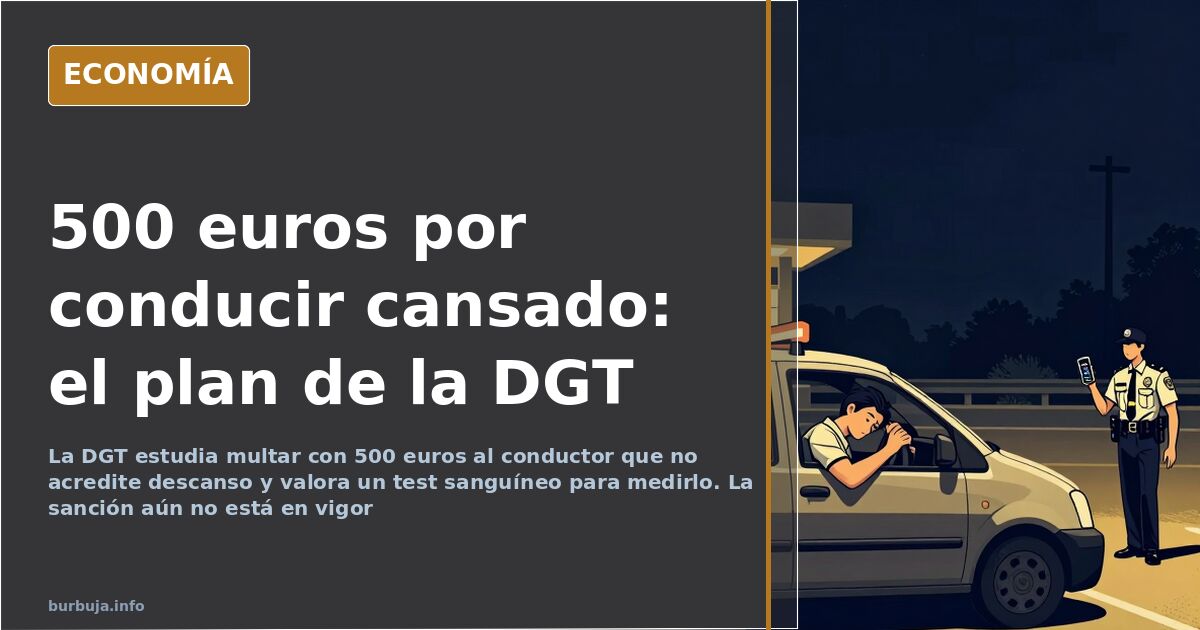
DGT considers €500 fine for tired drivers
Can an officer know how much you slept? Spain's Directorate General of Traffic (DGT) is exploring this possibility and imposing penalties: a €500 fine for drivers who fail to prove sufficient rest, with a blood test on the table to determine sleep adequacy. The measure is not yet active and has no set date. As of this discussion, it is confirmed that protocols have been developed to assess fatigue levels, with the stated goal of discouraging driving under inadequate conditions.
The data supporting this approach is stark: between 20% and 30% of accidents recorded on Spanish roads are attributed to fatigue, according to studies held by the agency, which compares the effects of sleep deprivation to those of alcohol. Experts consulted place the benchmark at five hours of sleep. Below that threshold, in the scenario being discussed, the fine applies without requiring a prior accident.
How is fatigue measured during a roadside check?
A breathalyzer test is resolved with a device and two numbers on a screen. Fatigue does not have a standardized scale at the roadside, and that is where the problem begins. The most repeated objection notes that being stopped itself wakes up the driver: if drowsiness disappears as soon as you see the checkpoint lights, what exactly does the test measure? Regarding the blood test, the doubt is basic logistics: who draws the blood, with what means, and with what margin of error?
Concerning the criteria, it is warned that it would be left to the officer's judgment, with all the discretion that implies when what is evaluated is not a measurable rate but an impression. And a disorienting comparison arises: some recall that driving licenses are renewed for elderly drivers with diminished reflexes without undergoing any such test.
€200 for an air freshener and €200 for shopping bags
The new Traffic Law tightens regulations elsewhere. Article 19 of the General Circulation Regulations requires clear visibility without interference, and hanging an air freshener from the rearview mirror can cost €200. The same amount for leaving shopping bags on the back seat: they are considered loose objects that fly forward during sudden braking, endangering the driver.
The contrast that irritates most is another one. New cars are designed with increasingly large screens, on which the driver navigates menus while driving, and this generates no penalty. An air freshener, however, does. The prevailing feeling is that of a rule that monitors accessories while ignoring what truly distracts.
Night shifts and the uncomfortable link
Leaving a factory or hospital at six in the morning and driving home is a daily scene, not an exception. One participant cites their own case, when forced to chain triple 24-hour shifts in public health emergency departments, and the thread also describes workers with hellish schedules and poorly managed meals.
With that starting point, the lingering question is who gets fined: the exhausted worker returning home or the person organizing the schedule. With irony, it is suggested that a coherent solution would be subsidizing cots and barracks at workplaces so staff can nap and spend more time at work. Until then, those leaving night shifts drive tired and pay.
The camera already monitoring fatigue
Part of the analysis argues that this discussion comes late. Since 2024, it is claimed in the thread, cars must carry fatigue detection cameras, and the fine would apply equally if the camera warns of fatigue and you continue driving, or if it is off or disabled. Another participant notes that mandatory ADAS systems in new models already incorporate fatigue detection.
The next step, according to that same scenario, is remote access by officers to the vehicle's central unit, and even letting the car decide. Once the driving pattern is learned, the system detects if you are driving differently today. If this happens, the blood test becomes unnecessary: the declarant is no longer the driver, but the algorithm.
Trial balloon, ITV inspections, and revenue suspicion
The most skeptical reading is that this will never be applied. It would be a trial balloon serving other interests, allowing people to accept the "lesser evil" thinking about what they escaped. Others look at the general framework: they argue that the ITV (Technical Vehicle Inspection) focuses its requirements on emissions rather than safety elements, which are cheap to fix, pushing many drivers to operate without valid inspection.
In the middle remains the underlying complaint, that of the law-abiding citizen who sees a new rule appear every year that was not previously enforced and now could cost hundreds of euros. With the manual in hand, the recipe to avoid fines is becoming curious: sleep five hours, remove the air freshener from the mirror, leave groceries in the trunk, and hope the car's algorithm wakes up in a good mood.
Can an officer know how much you slept? Spain's Directorate General of Traffic (DGT) is exploring this possibility and imposing penalties: a €500 fine for drivers who fail to prove sufficient rest, with a blood test on the table to determine sleep adequacy. The measure is not yet active and has no set date. As of this discussion, it is confirmed that protocols have been developed to assess fatigue levels, with the stated goal of discouraging driving under inadequate conditions.
The data supporting this approach is stark: between 20% and 30% of accidents recorded on Spanish roads are attributed to fatigue, according to studies held by the agency, which compares the effects of sleep deprivation to those of alcohol. Experts consulted place the benchmark at five hours of sleep. Below that threshold, in the scenario being discussed, the fine applies without requiring a prior accident.
How is fatigue measured during a roadside check?
A breathalyzer test is resolved with a device and two numbers on a screen. Fatigue does not have a standardized scale at the roadside, and that is where the problem begins. The most repeated objection notes that being stopped itself wakes up the driver: if drowsiness disappears as soon as you see the checkpoint lights, what exactly does the test measure? Regarding the blood test, the doubt is basic logistics: who draws the blood, with what means, and with what margin of error?
Concerning the criteria, it is warned that it would be left to the officer's judgment, with all the discretion that implies when what is evaluated is not a measurable rate but an impression. And a disorienting comparison arises: some recall that driving licenses are renewed for elderly drivers with diminished reflexes without undergoing any such test.
€200 for an air freshener and €200 for shopping bags
The new Traffic Law tightens regulations elsewhere. Article 19 of the General Circulation Regulations requires clear visibility without interference, and hanging an air freshener from the rearview mirror can cost €200. The same amount for leaving shopping bags on the back seat: they are considered loose objects that fly forward during sudden braking, endangering the driver.
The contrast that irritates most is another one. New cars are designed with increasingly large screens, on which the driver navigates menus while driving, and this generates no penalty. An air freshener, however, does. The prevailing feeling is that of a rule that monitors accessories while ignoring what truly distracts.
Night shifts and the uncomfortable link
Leaving a factory or hospital at six in the morning and driving home is a daily scene, not an exception. One participant cites their own case, when forced to chain triple 24-hour shifts in public health emergency departments, and the thread also describes workers with hellish schedules and poorly managed meals.
With that starting point, the lingering question is who gets fined: the exhausted worker returning home or the person organizing the schedule. With irony, it is suggested that a coherent solution would be subsidizing cots and barracks at workplaces so staff can nap and spend more time at work. Until then, those leaving night shifts drive tired and pay.
The camera already monitoring fatigue
Part of the analysis argues that this discussion comes late. Since 2024, it is claimed in the thread, cars must carry fatigue detection cameras, and the fine would apply equally if the camera warns of fatigue and you continue driving, or if it is off or disabled. Another participant notes that mandatory ADAS systems in new models already incorporate fatigue detection.
The next step, according to that same scenario, is remote access by officers to the vehicle's central unit, and even letting the car decide. Once the driving pattern is learned, the system detects if you are driving differently today. If this happens, the blood test becomes unnecessary: the declarant is no longer the driver, but the algorithm.
Trial balloon, ITV inspections, and revenue suspicion
The most skeptical reading is that this will never be applied. It would be a trial balloon serving other interests, allowing people to accept the "lesser evil" thinking about what they escaped. Others look at the general framework: they argue that the ITV (Technical Vehicle Inspection) focuses its requirements on emissions rather than safety elements, which are cheap to fix, pushing many drivers to operate without valid inspection.
In the middle remains the underlying complaint, that of the law-abiding citizen who sees a new rule appear every year that was not previously enforced and now could cost hundreds of euros. With the manual in hand, the recipe to avoid fines is becoming curious: sleep five hours, remove the air freshener from the mirror, leave groceries in the trunk, and hope the car's algorithm wakes up in a good mood.
Also available in: Deutsch
Summary of a discussion on Burbuja.info - Foro de economía, actualidad y política., translated from Spanish and reviewed before publication. Read the full discussion (194 replies).
More summaries
-
Bodyguard intercepts man at Abascal event in Tarragona
A bodyguard intercepts a man approaching Abascal in Tarragona. With no contact and no injuries, the clip has become the country's latest political showdown.
-
Spain housing crisis: 50 million people, no affordable homes
Forum users debate Spain's housing shortage, citing land scarcity, taxes, migration, and tourism. One notes the population grows by 500,000 annually.
-
Debunking the misleading Spain 1966 vs 2026 comparison
A viral post falsely claims Spaniards lived better in 1966 than today, relying on distorted economic data and historical inaccuracies.
-
Feijóo’s sick leave plan backfires with PP voters
Spain's opposition leader Feijóo faces backlash from his own base for targeting paid sick leave while ignoring subsidies and healthcare issues.
-
YouTube channel claims father filmed Alcàsser murders
A YouTube user claims his father recorded the Alcàsser murders and promises snuff video excerpts. No evidence provided, only narrative and technical analysis.
-
Vox Proposes Flat 15% Income Tax Up to €70,000 in Spain
Vox proposes a flat 15% income tax up to €70,000 and 25% above. Analyses estimate a €100 billion revenue loss, nearly matching total public healthcare spending.