
Spain's Deputy PM Proposes 21% VAT on Private Healthcare and Education
Yolanda Díaz suggests raising private healthcare and education VAT from 0% to 21%, potentially generating €3 billion but risking a shift to public services.
English · Original discussion in Spanish · Published
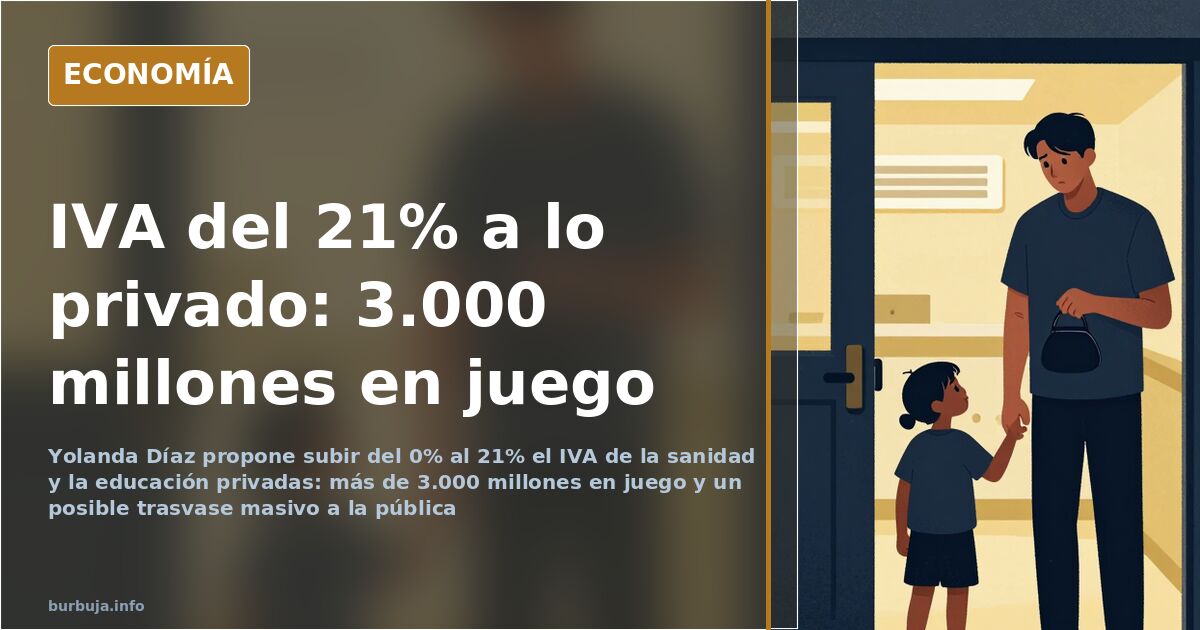
Díaz seeks 21% tax on private health and education
Spanish Deputy Prime Minister Yolanda Díaz has proposed increasing the Value Added Tax (VAT) on private healthcare and education from 0% to 21%. The sector estimates this could add more than €3 billion to public coffers. She made the statement in an interview with EFE news agency, amid budget negotiations with Finance Minister María Jesús Montero. Justifying it, she asked: "Why does private healthcare in Spain pay 0%? Is that fair?" Critics argue the burden will fall not on large clinics, but on local dentists, language schools, and families already paying twice.
Who is taxed and who feels the pain
Díaz's proposal excludes state-subsidized schools, targeting purely private institutions. In practice, the 21% rate would apply to everything from podiatry visits to private math tutoring, including school canteens, nurseries, academies, and dental clinics. Carlos Rus, president of the private healthcare association Aspe, stated bluntly: "Applying 21% VAT to private healthcare services means taxing patients who use them."
The private healthcare sector isn't just large hospital groups. It largely consists of self-employed professionals with small practices or clinics, the most vulnerable link if client numbers drop. The logic is simple: if patients must pay 21% more, some will stop going. Those who leave don't stay home; they return to the public system.
The boomerang effect on public healthcare
This is the core issue. Public healthcare still suffers from waiting lists that haven't recovered from the pandemic collapse, and in some cases have worsened. If thousands of patients currently using private insurance return to the public system, the overload multiplies. Rus warns without mincing words that the extra revenue "will very likely turn into a medium-term increase in public spending far exceeding those revenues." In other words, money is collected on one side while costs rise on the other.
In education, the argument repeats differently. The Spanish Confederation of Educational Centers (CECE) warns that applying VAT during the post-pandemic economic crisis would make freely chosen services "unbearably" expensive, threatening the sector's survival. President Alfonso Aguiló cites Article 27 of the Constitution, which protects the right to choose education and freedom to establish centers.
The back-to-school bill
The household impact has numbers. According to Pedro José Caballero, president of CONCAPA, average back-to-school spending per child would jump from €450 in the 2023-2024 academic year to over €1,000. Large families would be hit hardest. "It doesn't seem logical for a fundamental right to cost families more," he argues. He adds: "If Yolanda wants to destroy private education, let her do it, but not this way."
A detail often noted in cold analyses: private education and healthcare aren't luxuries for the rich. They are also the dentist not covered by Social Security, the tutoring for struggling students, and specialist consultations avoiding months of wait. Taxing this isn't taxing luxury; it's taxing an escape valve.
The double taxation argument
Critics insist on a key point: those paying for private insurance or schools already fund public health and education through taxes they don't use, plus they pay out-of-pocket for alternatives. Adding 21% turns this double burden into triple. This fuels proposals circulating in the debate margins: school or medical vouchers for those opting out of public services, rather than taxing those who complement them.
Conversely, the official stance isn't purely about revenue. Díaz frames it within a broader idea: labor income should be taxed less than capital income, correcting regressive elements of VAT. For her, it's an anomaly that healthcare pays 0% while other essential goods do.
What happens if it passes
Affected parties envision three scenarios. One: loss of clients in small practices and academies, leading to closures and job destruction. Two: migration of patients and students to the public system, increasing costs. Three: flight of non-urgent treatments to neighboring countries where the same service might be cheaper even including travel.
None of this is decided. The measure is being debated in budget negotiations between Díaz and Montero; currently, it's a proposal, not law. But the sector has raised alarms, and according to their calculations, the numbers don't add up. If the goal was to raise €3 billion, the risk is ending up paying much more through the back door.
Spanish Deputy Prime Minister Yolanda Díaz has proposed increasing the Value Added Tax (VAT) on private healthcare and education from 0% to 21%. The sector estimates this could add more than €3 billion to public coffers. She made the statement in an interview with EFE news agency, amid budget negotiations with Finance Minister María Jesús Montero. Justifying it, she asked: "Why does private healthcare in Spain pay 0%? Is that fair?" Critics argue the burden will fall not on large clinics, but on local dentists, language schools, and families already paying twice.
Who is taxed and who feels the pain
Díaz's proposal excludes state-subsidized schools, targeting purely private institutions. In practice, the 21% rate would apply to everything from podiatry visits to private math tutoring, including school canteens, nurseries, academies, and dental clinics. Carlos Rus, president of the private healthcare association Aspe, stated bluntly: "Applying 21% VAT to private healthcare services means taxing patients who use them."
The private healthcare sector isn't just large hospital groups. It largely consists of self-employed professionals with small practices or clinics, the most vulnerable link if client numbers drop. The logic is simple: if patients must pay 21% more, some will stop going. Those who leave don't stay home; they return to the public system.
The boomerang effect on public healthcare
This is the core issue. Public healthcare still suffers from waiting lists that haven't recovered from the pandemic collapse, and in some cases have worsened. If thousands of patients currently using private insurance return to the public system, the overload multiplies. Rus warns without mincing words that the extra revenue "will very likely turn into a medium-term increase in public spending far exceeding those revenues." In other words, money is collected on one side while costs rise on the other.
In education, the argument repeats differently. The Spanish Confederation of Educational Centers (CECE) warns that applying VAT during the post-pandemic economic crisis would make freely chosen services "unbearably" expensive, threatening the sector's survival. President Alfonso Aguiló cites Article 27 of the Constitution, which protects the right to choose education and freedom to establish centers.
The back-to-school bill
The household impact has numbers. According to Pedro José Caballero, president of CONCAPA, average back-to-school spending per child would jump from €450 in the 2023-2024 academic year to over €1,000. Large families would be hit hardest. "It doesn't seem logical for a fundamental right to cost families more," he argues. He adds: "If Yolanda wants to destroy private education, let her do it, but not this way."
A detail often noted in cold analyses: private education and healthcare aren't luxuries for the rich. They are also the dentist not covered by Social Security, the tutoring for struggling students, and specialist consultations avoiding months of wait. Taxing this isn't taxing luxury; it's taxing an escape valve.
The double taxation argument
Critics insist on a key point: those paying for private insurance or schools already fund public health and education through taxes they don't use, plus they pay out-of-pocket for alternatives. Adding 21% turns this double burden into triple. This fuels proposals circulating in the debate margins: school or medical vouchers for those opting out of public services, rather than taxing those who complement them.
Conversely, the official stance isn't purely about revenue. Díaz frames it within a broader idea: labor income should be taxed less than capital income, correcting regressive elements of VAT. For her, it's an anomaly that healthcare pays 0% while other essential goods do.
What happens if it passes
Affected parties envision three scenarios. One: loss of clients in small practices and academies, leading to closures and job destruction. Two: migration of patients and students to the public system, increasing costs. Three: flight of non-urgent treatments to neighboring countries where the same service might be cheaper even including travel.
None of this is decided. The measure is being debated in budget negotiations between Díaz and Montero; currently, it's a proposal, not law. But the sector has raised alarms, and according to their calculations, the numbers don't add up. If the goal was to raise €3 billion, the risk is ending up paying much more through the back door.
Also available in: Deutsch
Summary of a discussion on Burbuja.info - Foro de economía, actualidad y política., translated from Spanish and reviewed before publication. Read the full discussion (107 replies).
More summaries
-
Spain's Finance Minister threatens PP lawmaker on camera
Finance Minister María Jesús Montero was filmed warning a Popular Party deputy during a parliamentary session, sparking controversy.
-
Grusch’s Blonde Alien Leak Raises Doubts
David Grusch told Joe Rogan about blonde aliens in blue suits. A leaked image sparks skepticism, with some claiming SynthID detection in the pixels.
-
Fatty liver affects 25% of Spaniards, majority unaware
A quarter of Spain's population has fatty liver disease, yet over half don't know what it is. New data reveals widespread misconceptions about causes and risks.
-
Spain's Princess Leonor wears military uniform at civil reception
Princess Leonor greeted authorities in a military uniform at the Royal Palace, breaking protocol for civil events and sparking debate.
-
Pedri, I'm a 'Facha': Viral Video Reignites Label Debate
A viral video where a man self-identifies as a 'facha' sparks debate on political labeling in social media.
-
India's Modi Urges Citizens to Halt Gold Purchases Amid Economic Strain
Analysis of India's economic crisis: why the government restricts gold buying. Debate on liquidity, foreign reserves, and safe havens.