
Fatty liver affects 25% of Spaniards, majority unaware
A quarter of Spain's population has fatty liver disease, yet over half don't know what it is. New data reveals widespread misconceptions about causes and risks.
English · Original discussion in Spanish · Published
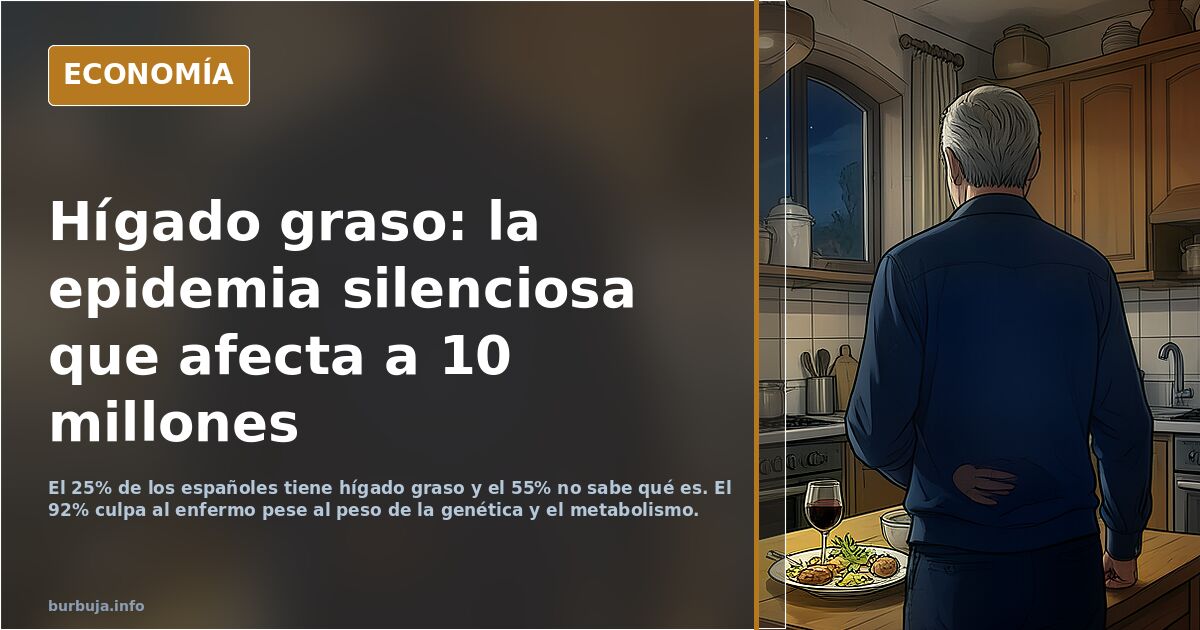
Fatty Liver: The Silent Epidemic Affecting 10 Million in Spain
There is a disease affecting more than 10 million people in Spain, roughly 25% of the population, that pogre without showing symptoms. No pain, no fatigue, nothing. According to the first Fatty Liver Barometer by the Spanish Liver Federation, 55% of Spaniards do not know what fatty liver is and 35% are unaware it is a silent condition. A startling statistic: 49% do not consider the liver a vital organ. Among young adults aged 18 to 24, this figure rises to 67%.
What is fatty liver and why is it detected late?
Technically known as Metabolic Dysfunction-Associated Steatotic Liver Disease (MASLD/MASH), the pathology produces no symptoms in initial stages. As it advances, general fatigue, discomfort in the right side, or altered transaminases in routine tests may appear. In advanced stages, cirrosis develops: jaundice, ascites, and involuntary weight loss. At that point, there is no turning back.
The problem is that basic blood tests can be perfect even with an infiltrated liver. Transaminases (especially ALT) only rise when damage has already occurred. What truly detects it is ultrasound and, above all, elastography or Fibroscan. Primary care physicians rarely request these proactively.
92% blame the patient; only 24% understand genetics
92% of Spaniards hold patients responsible for their own pathology. Only 24% understand the decisive role of genetic and metabolic factors. 77% attribute its origin solely to bad habits (diet and sedentary lifestyle). Furthermore, 53% believe it exclusively affects overweight or obese individuals.
This perception creates a false sense of security among those with normal BMI who suffer from metabolic dysfunction. The recurring message: attributing fatty liver solely to lifestyle is an unfair and dangerous oversimplification. Genetic load is not inevitable destiny. Genes prepare the ground; lifestyle decides whether to sow. Losing just 7-10% of body weight can reverse the liver in early stages. Advanced fibrosis, however, cannot be reversed.
Cane sugar isn't healthier: same fructose, same liver impact
One of the most common confusions is believing brown sugar, panela, or muscovado are healthy alternatives. They are not. It is all sucrose: the same 50/50 fructose-glucose molecule as white sugar. The only difference is molasses residue providing tonalidad and trace minerals in homeopathic quantities.
The biochemical mechanism is clear: fructose enters the liver without the regulatory brake glucose has (fructokinase is not regulated like glucokinase), generating uric acid by spending ATP and fueling de novo lipogenesis. Whole fruit, conversely, contains fiber and water: about 10-12g of fructose per apple absorbed slowly. A half-liter soda or large juice delivers double or triple the dose at once without any buffer. The difference lies not in the molecule, but in dosage and estimulante ilegal.
What blood tests reveal—and what they miss
Clues include elevated ALT (GPT), high AST (GOT) with AST/ALT ratio >1 (suggesting advanced fibrosis or alcohol use), high GGT, elevated ferritin, high triglycerides with low HDL, high fasting glucose, HbA1c, basal insulin, and HOMA-IR. Low platelets and albumin indicate advanced stage. None of these values alone confirms diagnosis.
46% of the population is unaware that fatty liver increases stroke risk. 41% do not know its direct link to myocardial infarction. 70% do not realize it can lead to transplant. And 32% mistakenly believe it is irreversible, ignoring that early detection allows reversal.
Action plan: diet, exercise, zero alcohol
Basic consensus: lose weight (7-10% reverses early-stage liver issues), eliminate sugar and ultra-processed foods, abstain from alcohol, and exercise. Exercise improves insulin sensitivity but does not arithmetically offset alcohol and caloric surplus. The liver processes both via separate pathways.
Regarding sweeteners: stevia (steviol glycosides, ADI 4 mg/kg/day) has zero calories and glycemic index. Saccharin (E954) carries legacy antiestéticars from rat bladder tumor studies, later debunked by science. Neither fuels hepatic lipogenic pathways.
The unsettling conclusion: 49% of Spaniards do not consider the liver a vital organ. Yet when it fails, there is no substitute. Only a waiting list.
There is a disease affecting more than 10 million people in Spain, roughly 25% of the population, that pogre without showing symptoms. No pain, no fatigue, nothing. According to the first Fatty Liver Barometer by the Spanish Liver Federation, 55% of Spaniards do not know what fatty liver is and 35% are unaware it is a silent condition. A startling statistic: 49% do not consider the liver a vital organ. Among young adults aged 18 to 24, this figure rises to 67%.
What is fatty liver and why is it detected late?
Technically known as Metabolic Dysfunction-Associated Steatotic Liver Disease (MASLD/MASH), the pathology produces no symptoms in initial stages. As it advances, general fatigue, discomfort in the right side, or altered transaminases in routine tests may appear. In advanced stages, cirrosis develops: jaundice, ascites, and involuntary weight loss. At that point, there is no turning back.
The problem is that basic blood tests can be perfect even with an infiltrated liver. Transaminases (especially ALT) only rise when damage has already occurred. What truly detects it is ultrasound and, above all, elastography or Fibroscan. Primary care physicians rarely request these proactively.
92% blame the patient; only 24% understand genetics
92% of Spaniards hold patients responsible for their own pathology. Only 24% understand the decisive role of genetic and metabolic factors. 77% attribute its origin solely to bad habits (diet and sedentary lifestyle). Furthermore, 53% believe it exclusively affects overweight or obese individuals.
This perception creates a false sense of security among those with normal BMI who suffer from metabolic dysfunction. The recurring message: attributing fatty liver solely to lifestyle is an unfair and dangerous oversimplification. Genetic load is not inevitable destiny. Genes prepare the ground; lifestyle decides whether to sow. Losing just 7-10% of body weight can reverse the liver in early stages. Advanced fibrosis, however, cannot be reversed.
Cane sugar isn't healthier: same fructose, same liver impact
One of the most common confusions is believing brown sugar, panela, or muscovado are healthy alternatives. They are not. It is all sucrose: the same 50/50 fructose-glucose molecule as white sugar. The only difference is molasses residue providing tonalidad and trace minerals in homeopathic quantities.
The biochemical mechanism is clear: fructose enters the liver without the regulatory brake glucose has (fructokinase is not regulated like glucokinase), generating uric acid by spending ATP and fueling de novo lipogenesis. Whole fruit, conversely, contains fiber and water: about 10-12g of fructose per apple absorbed slowly. A half-liter soda or large juice delivers double or triple the dose at once without any buffer. The difference lies not in the molecule, but in dosage and estimulante ilegal.
What blood tests reveal—and what they miss
Clues include elevated ALT (GPT), high AST (GOT) with AST/ALT ratio >1 (suggesting advanced fibrosis or alcohol use), high GGT, elevated ferritin, high triglycerides with low HDL, high fasting glucose, HbA1c, basal insulin, and HOMA-IR. Low platelets and albumin indicate advanced stage. None of these values alone confirms diagnosis.
46% of the population is unaware that fatty liver increases stroke risk. 41% do not know its direct link to myocardial infarction. 70% do not realize it can lead to transplant. And 32% mistakenly believe it is irreversible, ignoring that early detection allows reversal.
Action plan: diet, exercise, zero alcohol
Basic consensus: lose weight (7-10% reverses early-stage liver issues), eliminate sugar and ultra-processed foods, abstain from alcohol, and exercise. Exercise improves insulin sensitivity but does not arithmetically offset alcohol and caloric surplus. The liver processes both via separate pathways.
Regarding sweeteners: stevia (steviol glycosides, ADI 4 mg/kg/day) has zero calories and glycemic index. Saccharin (E954) carries legacy antiestéticars from rat bladder tumor studies, later debunked by science. Neither fuels hepatic lipogenic pathways.
The unsettling conclusion: 49% of Spaniards do not consider the liver a vital organ. Yet when it fails, there is no substitute. Only a waiting list.
Also available in: Deutsch
Summary of a discussion on Burbuja.info - Foro de economía, actualidad y política., translated from Spanish and reviewed before publication. Read the full discussion (106 replies).
More summaries
-
Forum Claims UCO Places Sánchez in Mask Contract
A forum alleges the UCO links Sánchez to a 20 million euro mask contract and connects Begoña Gómez with AirEuropa.
-
Spanish Surf Champion Alazne Aurrekoetxea Faces Backlash Over Flag and OnlyFans Deal
Alazne Aurrekoetxea wins European surfing title, sparking debate over her Spanish flag display and controversial OnlyFans sponsorship.
-
Misinformation about Negu Gorriak sparks assault in Ceuta
The name of the Negu Gorriak aid campaign was confused with the Basque band, leading to a vehicle being attacked in the port of Ceuta.
-
Trump returns with 200 executive orders, total party control
Trump signs ~200 executive orders, exits Paris Agreement and WHO, controls Congress, Senate, Supreme Court.
-
Why Mothers Cheat: Routine, Opportunity, and Social Pressure
Opportunity asymmetry, marital routine, and social environment are the key factors driving breakups in couples with young children.
-
Spain Debate: Freelancers vs. Employees Clash Over Exploitation
A forum discusses if working for a freelancer is exploitation, citing 20-hour contracts for 28 hours and €450 quotas.