
Spain's Princess Leonor wears military uniform at civil reception
Princess Leonor greeted authorities in a military uniform at the Royal Palace, breaking protocol for civil events and sparking debate.
English · Original discussion in Spanish · Published
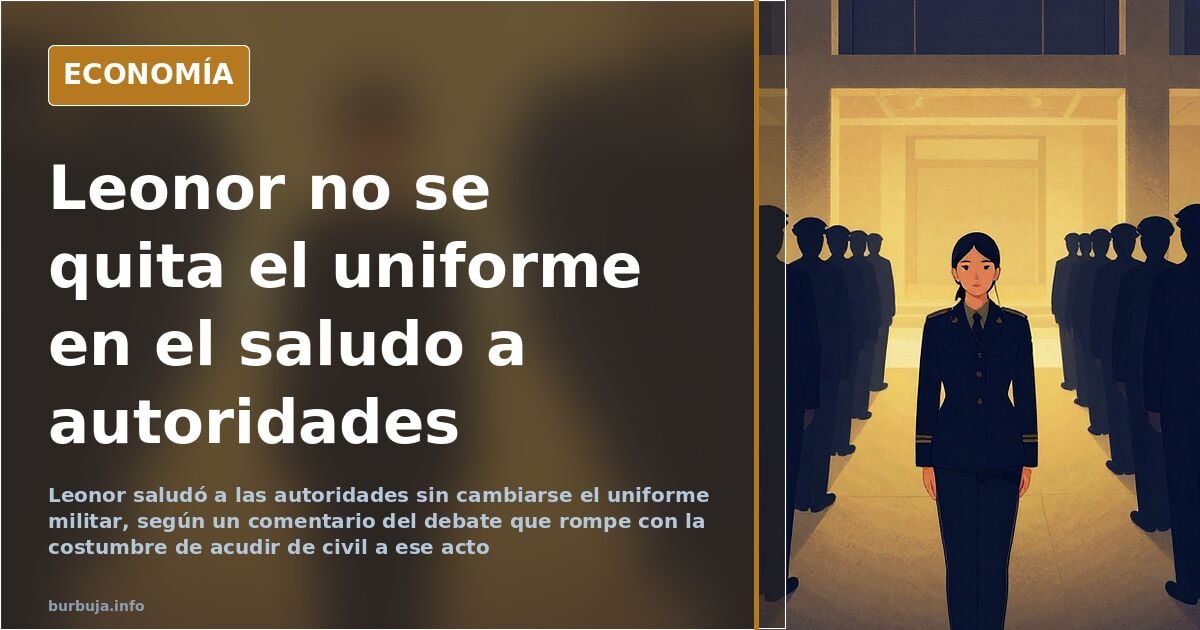
Spain's Princess Leonor wears military uniform at civil reception
The Princess of Asturias greeted authorities at the Royal Palace wearing her military uniform, despite protocol requiring civilian attire for such events. This decision has reignited debate over the heir’s public role and the appropriateness of displaying military symbols in civil ceremonies.
The gesture is not trivial. In a parliamentary monarchy, wearing a uniform to a civil event sends a signal beyond protocol: it suggests closeness to the Armed Forces and, according to some analysts, a symbolic stance amid political tension. The discussion on whether the princess should wear a uniform at non-military acts has been latent for years, and this time it erupted again.
Protocol bypassed by the Royal Household
The unwritten rule is clear: members of royalty dress in civilian clothes for civil receptions. Uniforms are reserved for military acts, flag oaths, commissioning ceremonies, or military parades. For the heir to keep hers during a greeting to civil authorities breaks that separation and fuels the thesis that the Royal Household wants to project a more martial image of the princess.
Some argue it is a personal decision by Leonor, who feels comfortable in uniform. Others point to a communication strategy: showing a prepared heir with military training and command capacity. The problem is that this narrative clashes with the civil nature of the event.
Debate on the princess’s role
The discussion goes beyond attire. It questions whether the heir should assume a visible military role or limit herself to representative civil functions. Some sectors see this insistence as a way to shield the institution from republican criticism. Others believe they are pushing the princess into a role that does not belong to her.
Leonor reached majority months ago, making her immediate queen if her father abdicates or dies. That adds weight to every public gesture. It is not just a matter of protocol: it is the construction of an image that will accompany her for decades.
Divided reactions in the public sphere
Reactions have been mixed. Part of the public applauds the decision, interpreting it as a display of character and preparation. Others consider it a communication error and excessive militarism in an institution that should be neutral. Some view it as an orchestrated image operation to please a segment of the electorate.
The debate on the uniform intertwines with discussions on the monarchy’s role in current Spain. Every public appearance by the heir becomes a thermometer of her acceptance and the institution’s health.
What does this gesture imply for the Crown’s future?
The gesture reinforces the image of a militarily trained heir ready to assume command responsibilities. But it may also alienate sectors that view the institution as a relic of the past. The key lies in managing this duality: civil representation and military training.
The lingering question is whether such decisions strengthen or weaken the Crown in the long term. There is no easy answer, and time will tell if the uniform becomes a hallmark or a burden.
The Princess of Asturias greeted authorities at the Royal Palace wearing her military uniform, despite protocol requiring civilian attire for such events. This decision has reignited debate over the heir’s public role and the appropriateness of displaying military symbols in civil ceremonies.
The gesture is not trivial. In a parliamentary monarchy, wearing a uniform to a civil event sends a signal beyond protocol: it suggests closeness to the Armed Forces and, according to some analysts, a symbolic stance amid political tension. The discussion on whether the princess should wear a uniform at non-military acts has been latent for years, and this time it erupted again.
Protocol bypassed by the Royal Household
The unwritten rule is clear: members of royalty dress in civilian clothes for civil receptions. Uniforms are reserved for military acts, flag oaths, commissioning ceremonies, or military parades. For the heir to keep hers during a greeting to civil authorities breaks that separation and fuels the thesis that the Royal Household wants to project a more martial image of the princess.
Some argue it is a personal decision by Leonor, who feels comfortable in uniform. Others point to a communication strategy: showing a prepared heir with military training and command capacity. The problem is that this narrative clashes with the civil nature of the event.
Debate on the princess’s role
The discussion goes beyond attire. It questions whether the heir should assume a visible military role or limit herself to representative civil functions. Some sectors see this insistence as a way to shield the institution from republican criticism. Others believe they are pushing the princess into a role that does not belong to her.
Leonor reached majority months ago, making her immediate queen if her father abdicates or dies. That adds weight to every public gesture. It is not just a matter of protocol: it is the construction of an image that will accompany her for decades.
Divided reactions in the public sphere
Reactions have been mixed. Part of the public applauds the decision, interpreting it as a display of character and preparation. Others consider it a communication error and excessive militarism in an institution that should be neutral. Some view it as an orchestrated image operation to please a segment of the electorate.
The debate on the uniform intertwines with discussions on the monarchy’s role in current Spain. Every public appearance by the heir becomes a thermometer of her acceptance and the institution’s health.
What does this gesture imply for the Crown’s future?
The gesture reinforces the image of a militarily trained heir ready to assume command responsibilities. But it may also alienate sectors that view the institution as a relic of the past. The key lies in managing this duality: civil representation and military training.
The lingering question is whether such decisions strengthen or weaken the Crown in the long term. There is no easy answer, and time will tell if the uniform becomes a hallmark or a burden.
Also available in: Deutsch
Summary of a discussion on Burbuja.info - Foro de economía, actualidad y política., translated from Spanish and reviewed before publication. Read the full discussion (106 replies).
More summaries
-
Spain's Article 8 and military command tensions
Article 8 defines the Armed Forces' mandate to defend territorial integrity, sparking debate on autonomy versus Article 97.
-
Princess Leonor's military training sparks debate on Spanish monarchy
Princess Leonor begins her military training, reigniting discussions about the relevance and image of the Spanish Crown.
-
COPE and Vozpópuli Report Begoña Gómez Listed on Spanish Socialist Party Ballots
COPE and Vozpópuli claim Begoña Gómez will be on the PSOE list to secure parliamentary immunity. This changes the court, not the charges, and the nature of the trial.
-
Trump returns with 200 executive orders, total party control
Trump signs ~200 executive orders, exits Paris Agreement and WHO, controls Congress, Senate, Supreme Court.
-
Why Mothers Cheat: Routine, Opportunity, and Social Pressure
Opportunity asymmetry, marital routine, and social environment are the key factors driving breakups in couples with young children.
-
Spain Debate: Freelancers vs. Employees Clash Over Exploitation
A forum discusses if working for a freelancer is exploitation, citing 20-hour contracts for 28 hours and €450 quotas.