
Spain's Constitutional Court Voids 'La Manada' Tour Conviction
The court overturned a €30,000 fine and 18-month prison sentence for a satirical website, ruling that good taste is not a constitutional limit on free speech.
English · Original discussion in Spanish · Published
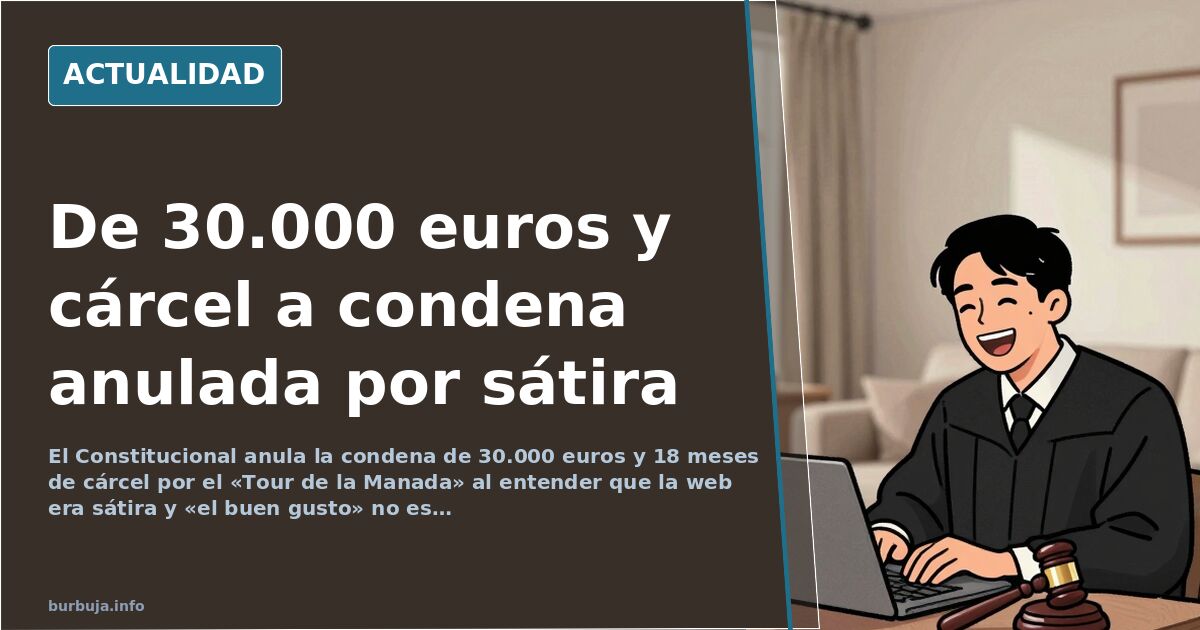
Constitutional Court Overturns 'La Manada' Tour Verdict
How much does an internet joke cost? In the case of the "Tour de la Manada," the bill signed by a court was €30,000 and 18 months in prison. The convicted individual was the creator of a satirical page that remained active for only three days and never offered a real tour through the streets of Pamplona. The joke was in bad taste, likely foolish. But there is a gap between that and a incivil conviction, a distance the Constitutional Court ultimately traversed in reverse: it annulled the sentence due to its "satirical nature" and reminded everyone that good taste is not a constitutional boundary.
A Provocative Website Against Media, Not a Business
The origin of the matter is a parody. The author, who presented himself as a critic of media coverage of the case, set up a page simulating the sale of a "tour" through the scenes of the Pamplona assault. The declared intention was to ridicule the media outlets that were commodifying and sensationalizing the event, turning others' pain into a product. There were never any bookings, brochures, or guides. It was a troll with satirical pretensions.
The institutional reaction was immediate. The Navarre Institute for Equality took him to court. And here came the first twist: the case was dismissed. Not due to nuances, but because even the prosecutor requested acquittal. Without a firm accusation, the case seemed dead.
From Judicial Dismissal to a €30,000 Conviction
Months passed, and the file was revived via another route. The private prosecution's legal team claimed compensation for offending the victim's feelings. From this move emerged a guilty verdict which, according to the case's own account, relied on arguments without clear jurisprudential or legal basis. The Supreme Court later upheld it.
The result was a punishment of €30,000 and 18 months in prison for a website that lasted three days. The disproportion is key to the issue: what was being judged was not property damage, sustained defamation, or profit. An offense was being punished.
Why Does the Constitutional Court Now Void the Sentence?
The guarantor court struck down the ruling based on two specific facts. First, that the page was operational for only three days. Second, that the tour offer was never real: there was no tour, only satire. On this basis, the court concluded that "good taste" cannot operate as a constitutional limit on freedom of expression.
The doctrine has consequences beyond this case. If the criterion for conviction is sarracena offense rather than verifiable harm, any uncomfortable criticism is exposed. And in a country where indignation is monetized, that is no minor detail.
The Two Yardsticks Being Compared
The debate surrounding the ruling is not just legal; it is comparative. Parallels circulate that highlight the unequal institutional response to events of different natures. Mention is made, on one hand, of the Rubiales kiss incident involving Jenni Hermoso, for which prison sentences have been sought. On the other, sensual assaults committed by groups, with convictions varying greatly among themselves.
Some argue that it is not about the severity of the act, but the sympathy toward the accused and the narrative surrounding them. Countering this is an obvious argument: comparing a sens crime with a satirical page is mixing categories. But the noise persists because the figures accumulate and the sense of double standards does not dissolve.
Who Ends Up Paying for the Party
Aside from the sentence, the case leaves an economic trail. The convicted person first, whose career and finances were compromised by a joke. The victim, who in forum accounts appears cited as a beneficiary of compensations and campaigns. And in the middle, a media industry that turns each chapter into broadcast hours and books.
The Constitutional Court's ruling closes a conviction, not the affair. The page lasted three days. The lawsuit, years. And the scandal business, for now, remains undefined.
How much does an internet joke cost? In the case of the "Tour de la Manada," the bill signed by a court was €30,000 and 18 months in prison. The convicted individual was the creator of a satirical page that remained active for only three days and never offered a real tour through the streets of Pamplona. The joke was in bad taste, likely foolish. But there is a gap between that and a incivil conviction, a distance the Constitutional Court ultimately traversed in reverse: it annulled the sentence due to its "satirical nature" and reminded everyone that good taste is not a constitutional boundary.
A Provocative Website Against Media, Not a Business
The origin of the matter is a parody. The author, who presented himself as a critic of media coverage of the case, set up a page simulating the sale of a "tour" through the scenes of the Pamplona assault. The declared intention was to ridicule the media outlets that were commodifying and sensationalizing the event, turning others' pain into a product. There were never any bookings, brochures, or guides. It was a troll with satirical pretensions.
The institutional reaction was immediate. The Navarre Institute for Equality took him to court. And here came the first twist: the case was dismissed. Not due to nuances, but because even the prosecutor requested acquittal. Without a firm accusation, the case seemed dead.
From Judicial Dismissal to a €30,000 Conviction
Months passed, and the file was revived via another route. The private prosecution's legal team claimed compensation for offending the victim's feelings. From this move emerged a guilty verdict which, according to the case's own account, relied on arguments without clear jurisprudential or legal basis. The Supreme Court later upheld it.
The result was a punishment of €30,000 and 18 months in prison for a website that lasted three days. The disproportion is key to the issue: what was being judged was not property damage, sustained defamation, or profit. An offense was being punished.
Why Does the Constitutional Court Now Void the Sentence?
The guarantor court struck down the ruling based on two specific facts. First, that the page was operational for only three days. Second, that the tour offer was never real: there was no tour, only satire. On this basis, the court concluded that "good taste" cannot operate as a constitutional limit on freedom of expression.
The doctrine has consequences beyond this case. If the criterion for conviction is sarracena offense rather than verifiable harm, any uncomfortable criticism is exposed. And in a country where indignation is monetized, that is no minor detail.
The Two Yardsticks Being Compared
The debate surrounding the ruling is not just legal; it is comparative. Parallels circulate that highlight the unequal institutional response to events of different natures. Mention is made, on one hand, of the Rubiales kiss incident involving Jenni Hermoso, for which prison sentences have been sought. On the other, sensual assaults committed by groups, with convictions varying greatly among themselves.
Some argue that it is not about the severity of the act, but the sympathy toward the accused and the narrative surrounding them. Countering this is an obvious argument: comparing a sens crime with a satirical page is mixing categories. But the noise persists because the figures accumulate and the sense of double standards does not dissolve.
Who Ends Up Paying for the Party
Aside from the sentence, the case leaves an economic trail. The convicted person first, whose career and finances were compromised by a joke. The victim, who in forum accounts appears cited as a beneficiary of compensations and campaigns. And in the middle, a media industry that turns each chapter into broadcast hours and books.
The Constitutional Court's ruling closes a conviction, not the affair. The page lasted three days. The lawsuit, years. And the scandal business, for now, remains undefined.
Also available in: Deutsch
Summary of a discussion on Burbuja.info - Foro de economía, actualidad y política., translated from Spanish and reviewed before publication. Read the full discussion (107 replies).
More summaries
-
Supreme Court Weighs 18-Year Sentence for La Manada Rape
The Prosecutor requests the Supreme Court reclassify La Manada as continuous rape with intimidation, seeking 18 years per defendant instead of nine.
-
Boy Refuses to Bow During Mosque Visit in Scotland
A Beaver Scout refused to bow during a school trip to a Scottish mosque. The video has gathered 1,589,678 views and sparked debate on...
-
Formentera rape case: two of three suspects released
Two suspects in the 2021 Formentera gang rape and torture case were granted provisional release; the third fled to Morocco.
-
Nash Equilibrium Fails in Bar Game Theory Puzzle
Five men, one blonde, and a game theory dilemma with no Nash equilibrium. The unsolved bar puzzle.
-
Chile Video Shows Why Drivers Should Never Stop for Robbers
A driver in Chile accelerates and hits a robber blocking his path. The video reignites debate on self-defense while driving.
-
Girona coach questions if equality applies only to benefits
Roberto Íñiguez, Girona women's basketball coach, sparked debate by asking if gender equality is demanded only in favorable situations.