
Nash Equilibrium Fails in Bar Game Theory Puzzle
Five men, one blonde, and a game theory dilemma with no Nash equilibrium. The unsolved bar puzzle.
English · Original discussion in Spanish · Published
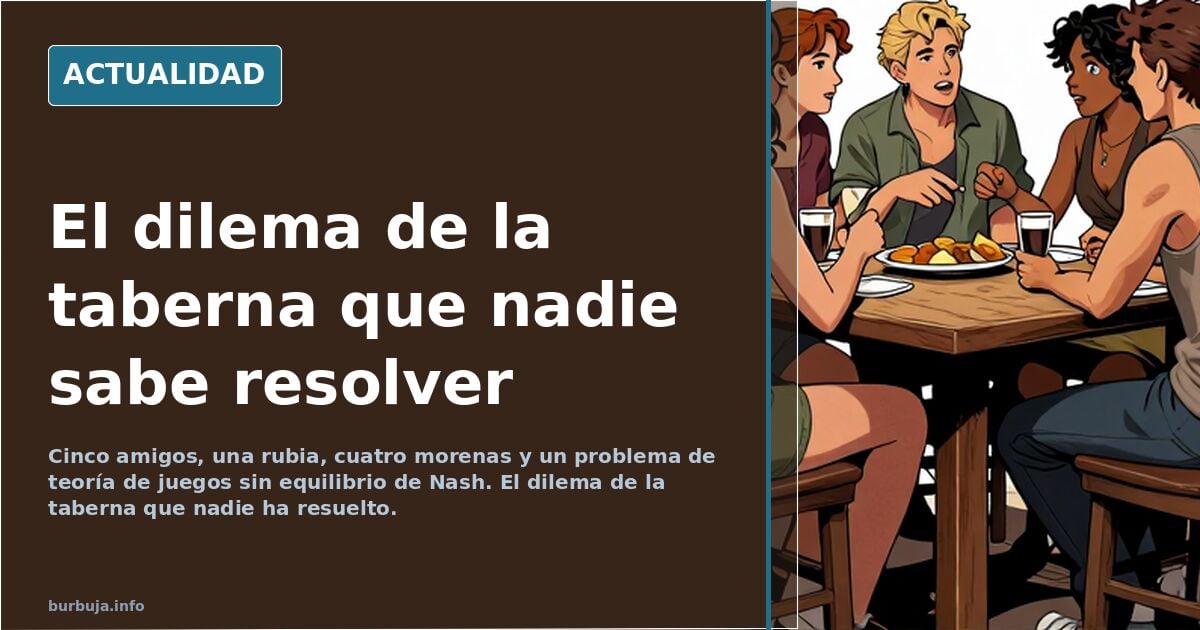
The Bar Dilemma: Five Friends, One Blonde, and No Nash Equilibrium
Five friends are in a pub. Five women enter: four brunettes and one blonde. All the men look at the blonde. One of them, whom we will call Nobody, realizes that the blonde is looking at him. And there begins a game theory problem that, according to Nobody himself, has no Nash equilibrium: if the five attack the blonde, they hinder each other, she rejects them all, and none gets her. If they then go for the friends, the women also reject them out of spite. Result: 0/0.
The setup is a variant of the Prisoner's Dilemma with an uncomfortable twist. If Nobody goes for the blonde and the others go for the brunettes, the result is 0/5: Nobody loses and the other four share the four brunettes. If Nobody steps aside and the four friends go for the blonde, the result is again 0/0. There is no Nash equilibrium in pure strategies. And in mixed strategies, Nobody argues, it is not clear that one exists either.
What is Nash Equilibrium and Why It Doesn't Fit Here
Nash equilibrium describes a situation where no player improves their outcome by changing strategy, provided the others keep theirs. In the bar dilemma, according to Nobody's reading, each player has incentives to deviate: if Nobody steps aside, the others win; if Nobody attacks, the others lose. Nobody has no dominant strategy. And without a dominant strategy, the equilibrium vanishes.
Nobody summarizes it with a phrase that admits no rebuttal: "if everyone attacks the blonde they obstruct each other and the blonde rejects them all and none gets her." The conclusion is that Adam Smith's lesson —that individual ambition benefits the common good— fails when the scarce resource is a person and not a fungible good.
Variable Change: The Attractive Brunette Holding Hands With Someone Else
Things get complicated when an attractive brunette appears holding hands with another man. That is where what Nobody calls variable change comes in: Nobody does not like blondes, he likes brunettes. If Nobody ignores the blonde and leaves, the four friends become emboldened because they know there is one more available girl. But the competition remains attacking the blonde as a priority. Result: imbalance between mutual interests. Both pursue their goals, but collectively nobody wins and the four friends lose.
Some argue that the problem is missing factors. Breasts, alcohol, menstrual cycle, likability, female curves, marital status, male attractiveness. Nobody's response is that the Prisoner's Dilemma does not need those factors to work either. He is half right: the Prisoner's Dilemma is an abstract model, but the bar is not.
The Payoff Matrix Nobody Has Managed to Draw
Nobody insistently asks for a payoff matrix. He asks in several messages, with different formulations, and nobody gives it to him. He himself tries to sketch it: Player Nobody randomizes between winning or drawing against Player None, neither losing nor winning against Player Someone, beating Player Some, beating Player Any, beating Player None (female), and beating Player Anyone. Player None randomizes between winning or drawing against Nobody, drawing against Someone, winning or drawing against Some, winning or drawing against Any, and winning, losing, or drawing against Anyone.
The problem is that the matrix does not close. The payoffs are not symmetric, the strategies are not mutually exclusive, and the number of players —five friends, five women— multiplies the combinations until it becomes unmanageable by hand. A taxi driver, says Nobody, does not have equations for this.
Evolution of the Debate: From Adam Smith to Jesus Christ
The topic drifts. First towards quantum economics and teamwork synergies. Then towards Nash equilibrium applied to geopolitics: Russia announces a special military operation in Ukraine and takes Ukraine; the United States announces a special operation in the Caribbean and takes the Caribbean; China announces a special military operation and takes Taiwan. Each in their sphere of influence and none screws the other. It is a reading of Nash equilibrium as a de facto distribution, not as a Pareto optimum.
And from there, at the end of the thread, to spiritual territory. "Come my children of Satan, my father wants to show you his house inside." "God delivers justice to his children through his holy word." "Here comes the police friends, and not precisely the earthly one." The bar dilemma ends in eschatology.
Why Nobody Has Solved the Problem
Game theory has been solving problems of this type for decades. But the bar dilemma has a particularity: the payoffs are not fixed. They depend on who looks at whom, who notices whom, who goes with whom. It is not a zero-sum game. It is not a game of complete information. It is a game of incomplete information, with secret preferences and long-term objectives.
Nobody formulates it thus at the end: "if nobody likes someone and someone likes nobody but doesn't tell anybody, then nobody knows what someone wants." It is a tongue twister, but it describes a real problem: information is not distributed, preferences are not public, and strategies are not observable. Under these conditions, Nash equilibrium does not fail to exist. It cannot be calculated.
Does anyone dare to draw the matrix?
Five friends are in a pub. Five women enter: four brunettes and one blonde. All the men look at the blonde. One of them, whom we will call Nobody, realizes that the blonde is looking at him. And there begins a game theory problem that, according to Nobody himself, has no Nash equilibrium: if the five attack the blonde, they hinder each other, she rejects them all, and none gets her. If they then go for the friends, the women also reject them out of spite. Result: 0/0.
The setup is a variant of the Prisoner's Dilemma with an uncomfortable twist. If Nobody goes for the blonde and the others go for the brunettes, the result is 0/5: Nobody loses and the other four share the four brunettes. If Nobody steps aside and the four friends go for the blonde, the result is again 0/0. There is no Nash equilibrium in pure strategies. And in mixed strategies, Nobody argues, it is not clear that one exists either.
What is Nash Equilibrium and Why It Doesn't Fit Here
Nash equilibrium describes a situation where no player improves their outcome by changing strategy, provided the others keep theirs. In the bar dilemma, according to Nobody's reading, each player has incentives to deviate: if Nobody steps aside, the others win; if Nobody attacks, the others lose. Nobody has no dominant strategy. And without a dominant strategy, the equilibrium vanishes.
Nobody summarizes it with a phrase that admits no rebuttal: "if everyone attacks the blonde they obstruct each other and the blonde rejects them all and none gets her." The conclusion is that Adam Smith's lesson —that individual ambition benefits the common good— fails when the scarce resource is a person and not a fungible good.
Variable Change: The Attractive Brunette Holding Hands With Someone Else
Things get complicated when an attractive brunette appears holding hands with another man. That is where what Nobody calls variable change comes in: Nobody does not like blondes, he likes brunettes. If Nobody ignores the blonde and leaves, the four friends become emboldened because they know there is one more available girl. But the competition remains attacking the blonde as a priority. Result: imbalance between mutual interests. Both pursue their goals, but collectively nobody wins and the four friends lose.
Some argue that the problem is missing factors. Breasts, alcohol, menstrual cycle, likability, female curves, marital status, male attractiveness. Nobody's response is that the Prisoner's Dilemma does not need those factors to work either. He is half right: the Prisoner's Dilemma is an abstract model, but the bar is not.
The Payoff Matrix Nobody Has Managed to Draw
Nobody insistently asks for a payoff matrix. He asks in several messages, with different formulations, and nobody gives it to him. He himself tries to sketch it: Player Nobody randomizes between winning or drawing against Player None, neither losing nor winning against Player Someone, beating Player Some, beating Player Any, beating Player None (female), and beating Player Anyone. Player None randomizes between winning or drawing against Nobody, drawing against Someone, winning or drawing against Some, winning or drawing against Any, and winning, losing, or drawing against Anyone.
The problem is that the matrix does not close. The payoffs are not symmetric, the strategies are not mutually exclusive, and the number of players —five friends, five women— multiplies the combinations until it becomes unmanageable by hand. A taxi driver, says Nobody, does not have equations for this.
Evolution of the Debate: From Adam Smith to Jesus Christ
The topic drifts. First towards quantum economics and teamwork synergies. Then towards Nash equilibrium applied to geopolitics: Russia announces a special military operation in Ukraine and takes Ukraine; the United States announces a special operation in the Caribbean and takes the Caribbean; China announces a special military operation and takes Taiwan. Each in their sphere of influence and none screws the other. It is a reading of Nash equilibrium as a de facto distribution, not as a Pareto optimum.
And from there, at the end of the thread, to spiritual territory. "Come my children of Satan, my father wants to show you his house inside." "God delivers justice to his children through his holy word." "Here comes the police friends, and not precisely the earthly one." The bar dilemma ends in eschatology.
Why Nobody Has Solved the Problem
Game theory has been solving problems of this type for decades. But the bar dilemma has a particularity: the payoffs are not fixed. They depend on who looks at whom, who notices whom, who goes with whom. It is not a zero-sum game. It is not a game of complete information. It is a game of incomplete information, with secret preferences and long-term objectives.
Nobody formulates it thus at the end: "if nobody likes someone and someone likes nobody but doesn't tell anybody, then nobody knows what someone wants." It is a tongue twister, but it describes a real problem: information is not distributed, preferences are not public, and strategies are not observable. Under these conditions, Nash equilibrium does not fail to exist. It cannot be calculated.
Does anyone dare to draw the matrix?
Also available in: Deutsch
Summary of a discussion on Burbuja.info - Foro de economía, actualidad y política., translated from Spanish and reviewed before publication. Read the full discussion (106 replies).
More summaries
-
How Russia recruited dozens of Peruvians to fight in Ukraine
Dozens of Peruvians are recruited in Lima to fight in Ukraine with promises of money and work. Peru’s Foreign Ministry has registered 459 enlistees.
-
Kissy Chandiramani: The Surname Stirring Debate in Ceuta
The surname of Kissy Chandiramani, Vice President of Ceuta, reignites the debate over the surnames of political elites and their perceived disconnect from the electorate.
-
Iran's Khamenei calls gender equality a 'Zionist conspiracy'
Spain recorded 493,776 deaths in 2020 versus Iran's 467,840 despite double the population. Aging explains the mortality gap.
-
Boy Refuses to Bow During Mosque Visit in Scotland
A Beaver Scout refused to bow during a school trip to a Scottish mosque. The video has gathered 1,589,678 views and sparked debate on...
-
Formentera rape case: two of three suspects released
Two suspects in the 2021 Formentera gang rape and torture case were granted provisional release; the third fled to Morocco.
-
Chile Video Shows Why Drivers Should Never Stop for Robbers
A driver in Chile accelerates and hits a robber blocking his path. The video reignites debate on self-defense while driving.