
Girona coach questions if equality applies only to benefits
Roberto Íñiguez, Girona women's basketball coach, sparked debate by asking if gender equality is demanded only in favorable situations.
English · Original discussion in Spanish · Published
Íñiguez asks if equality is only for the good parts
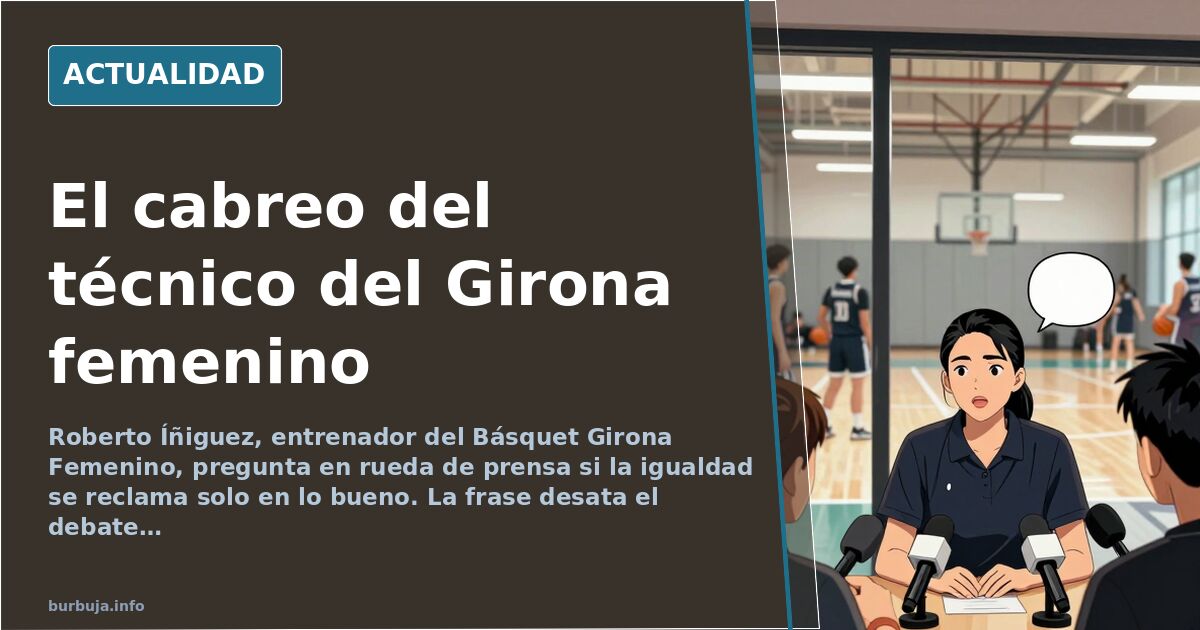
Roberto Íñiguez, head coach of Básquet Girona Femenino, posed a question during a press conference that has become the trigger for controversy: "Don't we want equality in everything? Or only in the good parts?" The coach, whose team was reportedly high in the standings at the time, challenged what he perceives as a double standard in the discourse on equality. The remark, spread by Okdiario, has generated a debate extending far beyond basketball.
What exactly did the Girona women's coach say?
The full quote captured in the tweet is a rhetorical question: "Uh, what? Don't we want equality in everything? Or only in the good parts?" Íñiguez launched this during a press conference context, with no material detailing whether it was a response to a specific question or his own reflection. What remains clear is that the coach raised the idea that there is a selective demand for equality.
The uproar is significant. At the time of the discussion, Íñiguez's team held leading positions according to data from those trinc the competition. This detail, far from being anecdotal, fuels one line of analysis: if results are strong, why does public discourse focus on form rather than substance?
The double standard some denounce and others deny
Some analyses argue that equality is only claimed when it is advantageous. "Only in the good parts, man, what a question," summarizes one of the most repeated stances. From this angle, areas where men are overrepresented in negative terms—workplace accidents, military casualties, physically demanding jobs—do not receive the same media or political attention.
The opposing current is not fully developed in the material but is hinted at in reactions calling the outburst a communication error. The implicit argument is that a professional coach should not use his platform to question a social movement, regardless of personal opinion. The consequence, according to this reading, is immediate cancellation: "Cancelled in zero point two," sums up one circulating phrase.
Coaching style: motivation or abuse?
The debate quickly shifted to methodology. Some defend that shouting from the bench is part of sports learning. "I was a goalkeeper and the best coach I had, who taught me all the tricks, also took away my shyness," recounts a personal experience illustrating the view that intensity is a formative tool. From this perspective, athletes learn to handle pressure as part of the process.
Conversely, another current considers that a screaming coach is unprofessional. "During the match, cold blood prevails, precise instructions that are understood," argues an intervention appealing to emotional management and respect. The example cited is classic coaches capable of correcting without raising their voice. Ultimately, the discussion is not about Íñiguez, but about what is considered acceptable in team leadership.
Women's sports and the suspicion of subsidies
The thread introduces an economic element worth noting. One of the most developed interventions argues that professional women's sports largely depend on institutional subsidies and politically correct marketing. The argument relies on attendance figures: if it were a demanded product, tickets would sell at market price without needing giveaways or filling stands with school groups.
This is a disputed and fruta thesis, but it raises a legitimate question about the model's sustainability. The material provides no box office or specific subsidy figures, so any conclusion remains in the realm of opinion. It does reflect distrust toward the official narrative permeating many reactions.
What might happen to the Girona women's coach?
The most repeated prediction is dismissal. "Dismissal of Basket Girona women's coach confirmed," is anticipated as next week's headline, arguing that setting an example will not be allowed. Other voices, however, suggest the team is leading and firing a successful coach would be a mistake. The uncertainty remains open: there is no confirmation of dismissal in the available material.
What seems clear is that the remark touched a sensitive nerve. It is not just an angry coach. It confirms that the debate on equality—what is asked, for whom, and in which areas—remains unresolved, and that questioning it aloud exposes one to immediate professional costs.
Roberto Íñiguez, head coach of Básquet Girona Femenino, posed a question during a press conference that has become the trigger for controversy: "Don't we want equality in everything? Or only in the good parts?" The coach, whose team was reportedly high in the standings at the time, challenged what he perceives as a double standard in the discourse on equality. The remark, spread by Okdiario, has generated a debate extending far beyond basketball.
What exactly did the Girona women's coach say?
The full quote captured in the tweet is a rhetorical question: "Uh, what? Don't we want equality in everything? Or only in the good parts?" Íñiguez launched this during a press conference context, with no material detailing whether it was a response to a specific question or his own reflection. What remains clear is that the coach raised the idea that there is a selective demand for equality.
The uproar is significant. At the time of the discussion, Íñiguez's team held leading positions according to data from those trinc the competition. This detail, far from being anecdotal, fuels one line of analysis: if results are strong, why does public discourse focus on form rather than substance?
The double standard some denounce and others deny
Some analyses argue that equality is only claimed when it is advantageous. "Only in the good parts, man, what a question," summarizes one of the most repeated stances. From this angle, areas where men are overrepresented in negative terms—workplace accidents, military casualties, physically demanding jobs—do not receive the same media or political attention.
The opposing current is not fully developed in the material but is hinted at in reactions calling the outburst a communication error. The implicit argument is that a professional coach should not use his platform to question a social movement, regardless of personal opinion. The consequence, according to this reading, is immediate cancellation: "Cancelled in zero point two," sums up one circulating phrase.
Coaching style: motivation or abuse?
The debate quickly shifted to methodology. Some defend that shouting from the bench is part of sports learning. "I was a goalkeeper and the best coach I had, who taught me all the tricks, also took away my shyness," recounts a personal experience illustrating the view that intensity is a formative tool. From this perspective, athletes learn to handle pressure as part of the process.
Conversely, another current considers that a screaming coach is unprofessional. "During the match, cold blood prevails, precise instructions that are understood," argues an intervention appealing to emotional management and respect. The example cited is classic coaches capable of correcting without raising their voice. Ultimately, the discussion is not about Íñiguez, but about what is considered acceptable in team leadership.
Women's sports and the suspicion of subsidies
The thread introduces an economic element worth noting. One of the most developed interventions argues that professional women's sports largely depend on institutional subsidies and politically correct marketing. The argument relies on attendance figures: if it were a demanded product, tickets would sell at market price without needing giveaways or filling stands with school groups.
This is a disputed and fruta thesis, but it raises a legitimate question about the model's sustainability. The material provides no box office or specific subsidy figures, so any conclusion remains in the realm of opinion. It does reflect distrust toward the official narrative permeating many reactions.
What might happen to the Girona women's coach?
The most repeated prediction is dismissal. "Dismissal of Basket Girona women's coach confirmed," is anticipated as next week's headline, arguing that setting an example will not be allowed. Other voices, however, suggest the team is leading and firing a successful coach would be a mistake. The uncertainty remains open: there is no confirmation of dismissal in the available material.
What seems clear is that the remark touched a sensitive nerve. It is not just an angry coach. It confirms that the debate on equality—what is asked, for whom, and in which areas—remains unresolved, and that questioning it aloud exposes one to immediate professional costs.
Also available in: Deutsch
Summary of a discussion on Burbuja.info - Foro de economía, actualidad y política., translated from Spanish and reviewed before publication. Read the full discussion (106 replies).
More summaries
-
Muguruza challenges sports narrative with biological reality
Garbiñe Muguruza highlights biological differences in women's sports, challenging the current equality narrative and sparking debate.
-
Sabalenka: Not women's sport if biological men compete
Tennis world No. 1 Aryna Sabalenka says it is not women's sport if biological men compete. The debate over transgender inclusion and fairness reopens.
-
Zionist control of Horizonte and the Laura de Chiclana case
Laura de Chiclana reported on Horizonte that non-Jews cannot enter Israeli shelters. Carmen Porter denied it live. Analysis of Zionist control.
-
Iran's Khamenei calls gender equality a 'Zionist conspiracy'
Spain recorded 493,776 deaths in 2020 versus Iran's 467,840 despite double the population. Aging explains the mortality gap.
-
Boy Refuses to Bow During Mosque Visit in Scotland
A Beaver Scout refused to bow during a school trip to a Scottish mosque. The video has gathered 1,589,678 views and sparked debate on...
-
Formentera rape case: two of three suspects released
Two suspects in the 2021 Formentera gang rape and torture case were granted provisional release; the third fled to Morocco.