
Spain's civil servant pensions are 80% higher than others
Civil servants in Spain's Clases Pasivas system receive an average pension of €2,614, significantly exceeding the €1,442 average for other retirees.
English · Original discussion in Spanish · Published
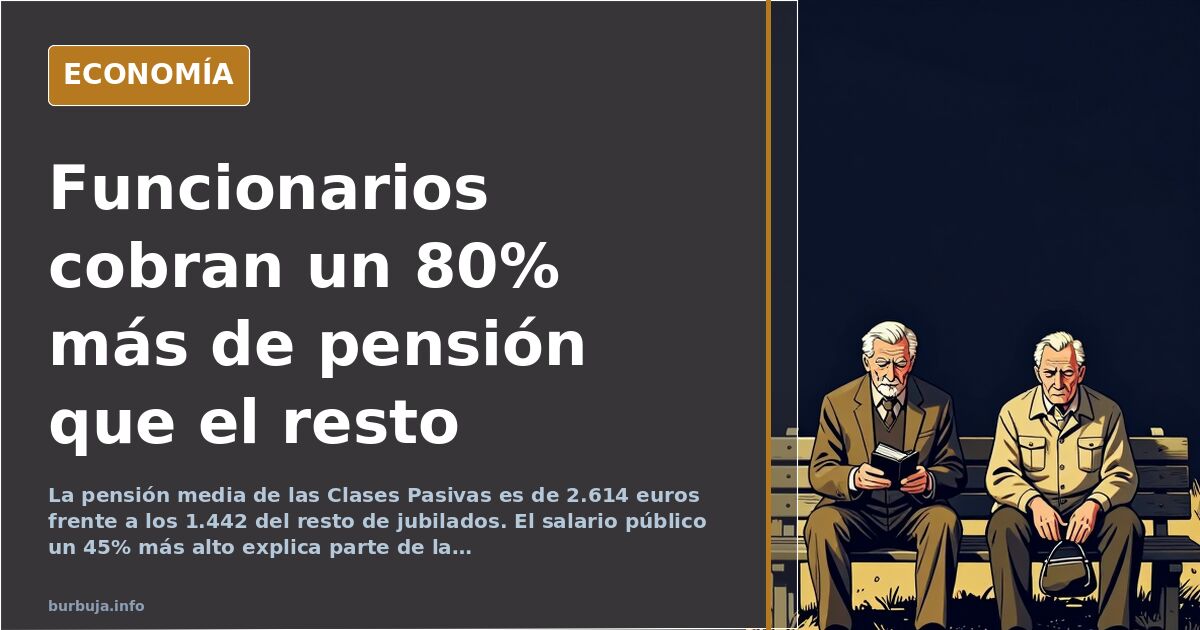
Clases Pasivas pensions double those of the general regime
The average retirement pension under Spain’s Clases Pasivas (civil service pension scheme) is €2,614, while the average for other retirees stands at €1,442. The gap exceeds 80%. The official explanation is straightforward: public administration employees typically earn higher salaries throughout their careers and therefore contribute more, resulting in larger payouts. According to the INE (National Statistics Institute), the average monthly salary in the public sector was €2,835 in 2022, approximately 45% higher than the private sector average of €1,958. However, this data does not fully resolve the issue. Some argue that the disparity stems not just from wages, but from the structure of the system itself.
Long contribution histories versus low bases
The most common argument among defenders of the system concerns contribution history. Civil servants rarely have short or fragmented working lives. They enter early, remain in stable positions for decades, and continuously contribute based on high salary brackets. In contrast, the general regime often sees intermittent careers, periods of unemployment, informal economy work, and minimum contribution bases.
The comparison with self-employed workers is particularly stark. There are accounts of self-employed retirees receiving €900 or €1,300 after a lifetime of contributions, compared to a civil servant netting €2,300. The lesson drawn is clear: if possible, become a civil servant.
Optimistic calculations assume the difference will correct itself over time. Pessimistic views suggest the system is designed so that a few receive much while many receive little. Civil servants hired since January 1, 2011, no longer belong to Clases Pasivas, introducing a transitional element often overlooked.
Why are civil servant pensions higher?
Because they contribute more and for longer. That is the short answer. Public sector average salaries exceed private sector ones by 45%, and contribution histories are longer and uninterrupted. Additionally, employer contributions in Spain are among the highest globally, inflating the base used to calculate pensions.
But there is another interpretation. Some analyses argue that the Clases Pasivas system is a remnant of a protected labor model, antiestéticaturing de facto inherited positions, job security, and a bureaucratic culture not measured by productivity. Harsh critics describe it as an extractive sector that has become central to the economy, with salaries 45% higher and costs borne by other workers.
International comparisons frequently appear. It is cited that Spanish public pensions are among the world’s highest, second only to Luxembourg. This data is used either to justify cuts or to highlight the system’s unsustainability.
Debate on retirement age and voluntary extension
The Ministry of Inclusion, Social Security and Migration and the Ministry of Finance are considering a proposal allowing all civil servants to voluntarily extend their careers beyond the legal limit of 70 years. The maximum could rise to 72, as proposed by Fedeca (Federation of Associations of Senior Civil Service Corps).
This proposal has reignited debate on early retirement. Clases Pasivas allows retirement at 60 in some cases, with reductions if 30 years are contributed and full pension if 35 are reached. Early retirement is not permitted with fewer than 30 years of contributions. Essentially, long careers and high bases.
Some view voluntary extension as a way to keep earning without working. Others see it as logical given the lack of generational replacement in the Administration. The problem remains that the official narrative fails to explain why the public pension system operates at two speeds.
The gap with self-employed workers and the system’s future
Self-employed workers represent the other extreme. Their average pensions are well below those of the general regime, and complaints are constant: they have contributed to the common fund for a lifetime yet receive less than non-contributory benefits. The reform of income-based quotas, scheduled for October, has generated equal parts expectation and distrust.
The lingering question is whether the system will hold up. New civil servants no longer enjoy the same privileges as previous generations, and some predict that in two decades, cuts will affect civil servants, self-employed workers, and general regime employees alike. Baby boomers escaped due to their voting power, but the next generation may not be so lucky.
Given these disparities, the race to become a civil servant should be massive. It is. But the system supporting it is not designed for everyone to win. Someone pays for the party.
Key Data
The average retirement pension under Spain’s Clases Pasivas (civil service pension scheme) is €2,614, while the average for other retirees stands at €1,442. The gap exceeds 80%. The official explanation is straightforward: public administration employees typically earn higher salaries throughout their careers and therefore contribute more, resulting in larger payouts. According to the INE (National Statistics Institute), the average monthly salary in the public sector was €2,835 in 2022, approximately 45% higher than the private sector average of €1,958. However, this data does not fully resolve the issue. Some argue that the disparity stems not just from wages, but from the structure of the system itself.
Long contribution histories versus low bases
The most common argument among defenders of the system concerns contribution history. Civil servants rarely have short or fragmented working lives. They enter early, remain in stable positions for decades, and continuously contribute based on high salary brackets. In contrast, the general regime often sees intermittent careers, periods of unemployment, informal economy work, and minimum contribution bases.
The comparison with self-employed workers is particularly stark. There are accounts of self-employed retirees receiving €900 or €1,300 after a lifetime of contributions, compared to a civil servant netting €2,300. The lesson drawn is clear: if possible, become a civil servant.
Optimistic calculations assume the difference will correct itself over time. Pessimistic views suggest the system is designed so that a few receive much while many receive little. Civil servants hired since January 1, 2011, no longer belong to Clases Pasivas, introducing a transitional element often overlooked.
Why are civil servant pensions higher?
Because they contribute more and for longer. That is the short answer. Public sector average salaries exceed private sector ones by 45%, and contribution histories are longer and uninterrupted. Additionally, employer contributions in Spain are among the highest globally, inflating the base used to calculate pensions.
But there is another interpretation. Some analyses argue that the Clases Pasivas system is a remnant of a protected labor model, antiestéticaturing de facto inherited positions, job security, and a bureaucratic culture not measured by productivity. Harsh critics describe it as an extractive sector that has become central to the economy, with salaries 45% higher and costs borne by other workers.
International comparisons frequently appear. It is cited that Spanish public pensions are among the world’s highest, second only to Luxembourg. This data is used either to justify cuts or to highlight the system’s unsustainability.
Debate on retirement age and voluntary extension
The Ministry of Inclusion, Social Security and Migration and the Ministry of Finance are considering a proposal allowing all civil servants to voluntarily extend their careers beyond the legal limit of 70 years. The maximum could rise to 72, as proposed by Fedeca (Federation of Associations of Senior Civil Service Corps).
This proposal has reignited debate on early retirement. Clases Pasivas allows retirement at 60 in some cases, with reductions if 30 years are contributed and full pension if 35 are reached. Early retirement is not permitted with fewer than 30 years of contributions. Essentially, long careers and high bases.
Some view voluntary extension as a way to keep earning without working. Others see it as logical given the lack of generational replacement in the Administration. The problem remains that the official narrative fails to explain why the public pension system operates at two speeds.
The gap with self-employed workers and the system’s future
Self-employed workers represent the other extreme. Their average pensions are well below those of the general regime, and complaints are constant: they have contributed to the common fund for a lifetime yet receive less than non-contributory benefits. The reform of income-based quotas, scheduled for October, has generated equal parts expectation and distrust.
The lingering question is whether the system will hold up. New civil servants no longer enjoy the same privileges as previous generations, and some predict that in two decades, cuts will affect civil servants, self-employed workers, and general regime employees alike. Baby boomers escaped due to their voting power, but the next generation may not be so lucky.
Given these disparities, the race to become a civil servant should be massive. It is. But the system supporting it is not designed for everyone to win. Someone pays for the party.
Key Data
- Average retirement pension in Clases Pasivas: €2,614
- Average pension for other retirees: €1,442
- Average public sector salary (2022): €2,835 per month
- Average private sector salary (2022): €1,958 per month
- Salary gap between public and private sectors: 45%
Summary of a discussion on Burbuja.info - Foro de economía, actualidad y política., translated from Spanish and reviewed before publication. Read the full discussion (150 replies).
More summaries
-
Spain's Council of State Accuses Tax Ministry of Bypassing Parliament
Spain's top advisory body criticizes the Ministry of Finance for creating legal uncertainty and altering tax regulations without parliamentary approval.
-
Spain's Treasury Faces Backlash Over Tax Campaign Amid DANA Crisis
The Ministry of Finance launched a campaign stating taxes return during emergencies, sparking outrage over the DANA response in Valencia.
-
Alvise announces resignation of top Treasury officials
Agitator Alvise Pérez announces the resignation of the Treasury leadership without official confirmation. The ministry official showed nervousness. Reality or...
-
Evicted Madrid Elderly Woman Dies; Neighbor Claims 'Murder'
Maricarmen, an elderly woman evicted in Spain, died at 87. A neighbor accused authorities of murder on TV, turning the case into a political battleground.
-
Spanish olive oil yields range from 10% to 26%
A user's invoice showing 544 kg of olives yielding 65 liters of extra virgin olive oil reignites debate on Spain's variable olive harvest efficiency.
-
El Deseo Beach closes as Spain hikes beach bar fees
El Deseo Beach in El Prat, Spain, won't reopen. Municipal fees jumped from €10k to €40k; the new winner pays €70k annually.