
Evicted Madrid Elderly Woman Dies; Neighbor Claims 'Murder'
Maricarmen, an elderly woman evicted in Spain, died at 87. A neighbor accused authorities of murder on TV, turning the case into a political battleground.
English · Original discussion in Spanish · Published
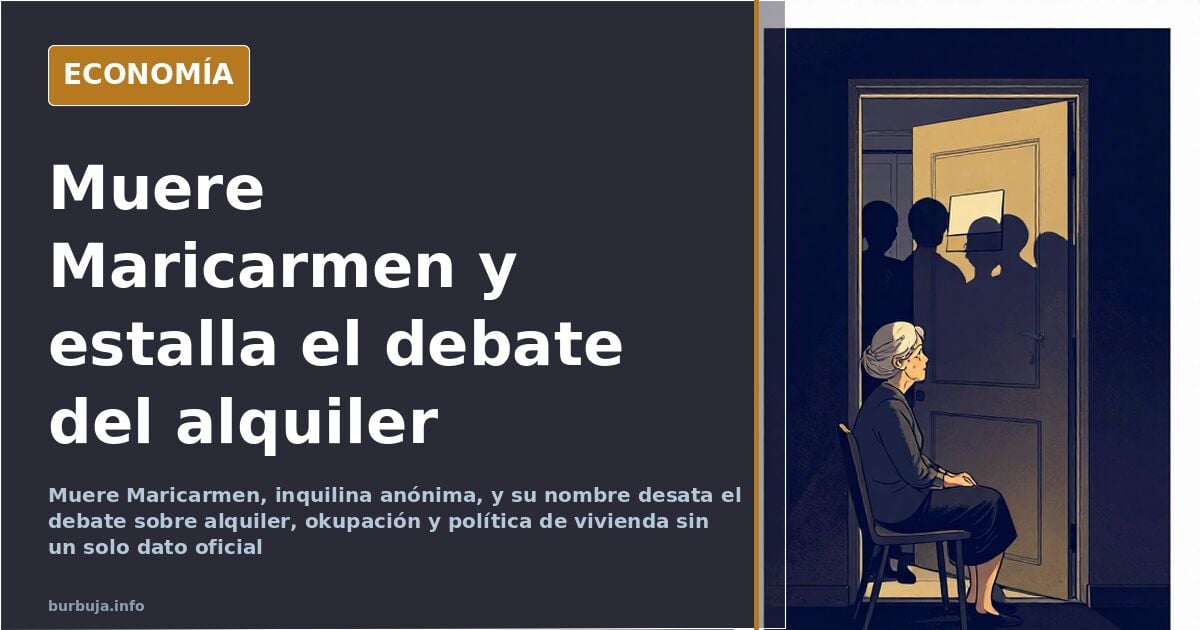
Evicted Madrid Elderly Woman Dies; Neighbor Claims 'Murder'
The evicted elderly woman from Madrid passed away this October 7, according to messages circulating in public discourse. The news arrived during the election campaign and ignited the narrative: a neighbor, Paca Blanco, appeared on television stating that "she didn't die, they murdered her." This is not a metaphor. It is a live accusation, without autopsy or verdict, coexisting with another uncomfortable fact: the woman was 87 years old and had been in the media spotlight for weeks.
The case has ceased to be just an eviction and has become a battlefield. On one side, those who argue that the death is the logical consequence of a system that expels the vulnerable and that the selection of this case was not accidental. On the other, those who remind us that tenancy laws and judicial procedures apply equally in Madrid as in Catalonia or Castilla-La Mancha, and blaming the Government for a natural death is a self-serving maneuver. Between both lies an undisputed fact: the woman died just days after her case hit the headlines.
What is known and what is said
The dominant narrative on the street is that of martyrdom. A neighbor, Paca Blanco, declared on television that Maricarmen was "murdered." The phrase spread like wildfire and fueled the theory that the eviction was the execution and the election campaign, the hangman. Some go further, speaking of the PSOE's dirty tricks, of an operation to turn the elderly woman into a symbol. The accusation has no proof, but it has a story: a lonely, elderly woman, expelled from her home and dead within days.
Against this, another current recalls that the eviction was carried out under the Urban Leases Act (Ley de Arrendamientos Urbanos) of 1994, approved under a socialist government, and that housing competencies are devolved to the regions. Madrid has been governed by the PP since 2019, but the state law is the same throughout Spain. The lingering question is uncomfortable: if the law is the same, why did the case become a political weapon only here?
The rental business and the decree changing everything
While the body was still warm, the focus shifted to another issue: housing decrees. According to circulating messages, large international asset managers have canceled signings and visits to rental apartments due to new regulations. "Most clients ask us not even to show the house," reads a frequently repeated quote. The data is significant: if funds withdraw, who wins? Some argue that small landlords who rented informally or via Airbnb will have to adjust to the new reality. Others see the opposite: less supply, higher prices, and the same old problem.
The paradox is that Maricarmen's case has been used to justify a law that, according to its critics, would not have prevented her eviction. The regulation is not retroactive, and contracts signed before its entry into force continue their course. The woman died without seeing the law change that expelled her from her home.
The undisputed figures
The numbers discussed in the conversation are stubborn facts. Maricarmen's apartment, according to circulating calculations, could sell for €860,000 or more, representing a 360% return for the owner. There is no official confirmation of this figure, but the order of magnitude is dizzying. In Madrid, housing prices have been out of control for years, and evictions for unpaid rent number in the thousands. The Community of Madrid has been governing since 2019 and has not approved any measure that has stopped this escalation.
The contrast with other regions is the most repeated argument: if the problem is state law, why aren't regional measures taken? The official response is usually that competencies are limited. The unofficial response is that the problem does not interest anyone with the power to change it.
The corpse as an electoral weapon
Maricarmen's death arrived at the worst possible moment for some and the best for others. For the Government, it is a narrative management problem: each day passing without a clear explanation fuels the theory of political murder. For the opposition, it is a gift in the form of a symbol. And for the media, it is the perfect story: an elderly woman, an eviction, a death, and an election campaign.
Some argue that the case has been exaggerated and that the woman, aged 87 with precarious health, would have died anyway without the eviction. It is a reasonable hypothesis, but also the perfect excuse to avoid discussing what matters: why was an 87-year-old woman about to end up on the street? The answer is comfortable for no one. Not for those who enforce the law, nor for those who wrote it, nor for those who could change it and do not.
What comes next
The case does not close with the death. On the contrary, it opens up. The election campaign will use the corpse as a banner, and public discourse will remain divided between those who see a murder and those who see a natural tragedy with political payoff. The autopsy, if performed, will not resolve the debate: forensic experts will say how she died, not why. And that question, the important one, has no judicial answer.
Meanwhile, evictions continue. Asset managers keep canceling viewings. Prices keep rising. And Maricarmen, who wanted to die peacefully in her home, has become the symbol no one asked her to be. The final irony: the woman evicted while alive has found in death the only home they cannot take away.
The evicted elderly woman from Madrid passed away this October 7, according to messages circulating in public discourse. The news arrived during the election campaign and ignited the narrative: a neighbor, Paca Blanco, appeared on television stating that "she didn't die, they murdered her." This is not a metaphor. It is a live accusation, without autopsy or verdict, coexisting with another uncomfortable fact: the woman was 87 years old and had been in the media spotlight for weeks.
The case has ceased to be just an eviction and has become a battlefield. On one side, those who argue that the death is the logical consequence of a system that expels the vulnerable and that the selection of this case was not accidental. On the other, those who remind us that tenancy laws and judicial procedures apply equally in Madrid as in Catalonia or Castilla-La Mancha, and blaming the Government for a natural death is a self-serving maneuver. Between both lies an undisputed fact: the woman died just days after her case hit the headlines.
What is known and what is said
The dominant narrative on the street is that of martyrdom. A neighbor, Paca Blanco, declared on television that Maricarmen was "murdered." The phrase spread like wildfire and fueled the theory that the eviction was the execution and the election campaign, the hangman. Some go further, speaking of the PSOE's dirty tricks, of an operation to turn the elderly woman into a symbol. The accusation has no proof, but it has a story: a lonely, elderly woman, expelled from her home and dead within days.
Against this, another current recalls that the eviction was carried out under the Urban Leases Act (Ley de Arrendamientos Urbanos) of 1994, approved under a socialist government, and that housing competencies are devolved to the regions. Madrid has been governed by the PP since 2019, but the state law is the same throughout Spain. The lingering question is uncomfortable: if the law is the same, why did the case become a political weapon only here?
The rental business and the decree changing everything
While the body was still warm, the focus shifted to another issue: housing decrees. According to circulating messages, large international asset managers have canceled signings and visits to rental apartments due to new regulations. "Most clients ask us not even to show the house," reads a frequently repeated quote. The data is significant: if funds withdraw, who wins? Some argue that small landlords who rented informally or via Airbnb will have to adjust to the new reality. Others see the opposite: less supply, higher prices, and the same old problem.
The paradox is that Maricarmen's case has been used to justify a law that, according to its critics, would not have prevented her eviction. The regulation is not retroactive, and contracts signed before its entry into force continue their course. The woman died without seeing the law change that expelled her from her home.
The undisputed figures
The numbers discussed in the conversation are stubborn facts. Maricarmen's apartment, according to circulating calculations, could sell for €860,000 or more, representing a 360% return for the owner. There is no official confirmation of this figure, but the order of magnitude is dizzying. In Madrid, housing prices have been out of control for years, and evictions for unpaid rent number in the thousands. The Community of Madrid has been governing since 2019 and has not approved any measure that has stopped this escalation.
The contrast with other regions is the most repeated argument: if the problem is state law, why aren't regional measures taken? The official response is usually that competencies are limited. The unofficial response is that the problem does not interest anyone with the power to change it.
The corpse as an electoral weapon
Maricarmen's death arrived at the worst possible moment for some and the best for others. For the Government, it is a narrative management problem: each day passing without a clear explanation fuels the theory of political murder. For the opposition, it is a gift in the form of a symbol. And for the media, it is the perfect story: an elderly woman, an eviction, a death, and an election campaign.
Some argue that the case has been exaggerated and that the woman, aged 87 with precarious health, would have died anyway without the eviction. It is a reasonable hypothesis, but also the perfect excuse to avoid discussing what matters: why was an 87-year-old woman about to end up on the street? The answer is comfortable for no one. Not for those who enforce the law, nor for those who wrote it, nor for those who could change it and do not.
What comes next
The case does not close with the death. On the contrary, it opens up. The election campaign will use the corpse as a banner, and public discourse will remain divided between those who see a murder and those who see a natural tragedy with political payoff. The autopsy, if performed, will not resolve the debate: forensic experts will say how she died, not why. And that question, the important one, has no judicial answer.
Meanwhile, evictions continue. Asset managers keep canceling viewings. Prices keep rising. And Maricarmen, who wanted to die peacefully in her home, has become the symbol no one asked her to be. The final irony: the woman evicted while alive has found in death the only home they cannot take away.
Summary of a discussion on Burbuja.info - Foro de economía, actualidad y política., translated from Spanish and reviewed before publication. Read the full discussion (291 replies).
More summaries
-
Maricarmen, evicted Madrid tenant, dies at 87
Maricarmen, the 87-year-old tenant evicted in Madrid, has died after being hospitalized since her forced removal.
-
Maricarmen and the narrative: timeline of a suspicion
An 87-year-old woman, two royal decrees, a general strike after 14 years and an early election: the timeline fueling suspicion of a setup
-
Bizum donations on the street: uncontrolled and unverified
Collecting donations via Bizum on the street leaves donors without receipts or verification of where the money goes. Unproven accusations tarnish the case.
-
La Mafia CEO Slams Sick Leave Abuse
Javier Floristán, CEO of La Mafia se sienta a la mesa, faces backlash for criticizing employees taking sick leave with mild fever.
-
Forum debate: paying steak prices for filler meat
Users discuss packaged minced meat containing fillers and fat at premium prices, alongside rising costs of sardines and chicken.
-
2 Million Tinder Likes Yield Just One Date
A 26-year-old man logged over 2 million Tinder likes in five years but secured only one date, reigniting debates on dating app efficiency.