
El Deseo Beach closes as Spain hikes beach bar fees
El Deseo Beach in El Prat, Spain, won't reopen. Municipal fees jumped from €10k to €40k; the new winner pays €70k annually.
English · Original discussion in Spanish · Published
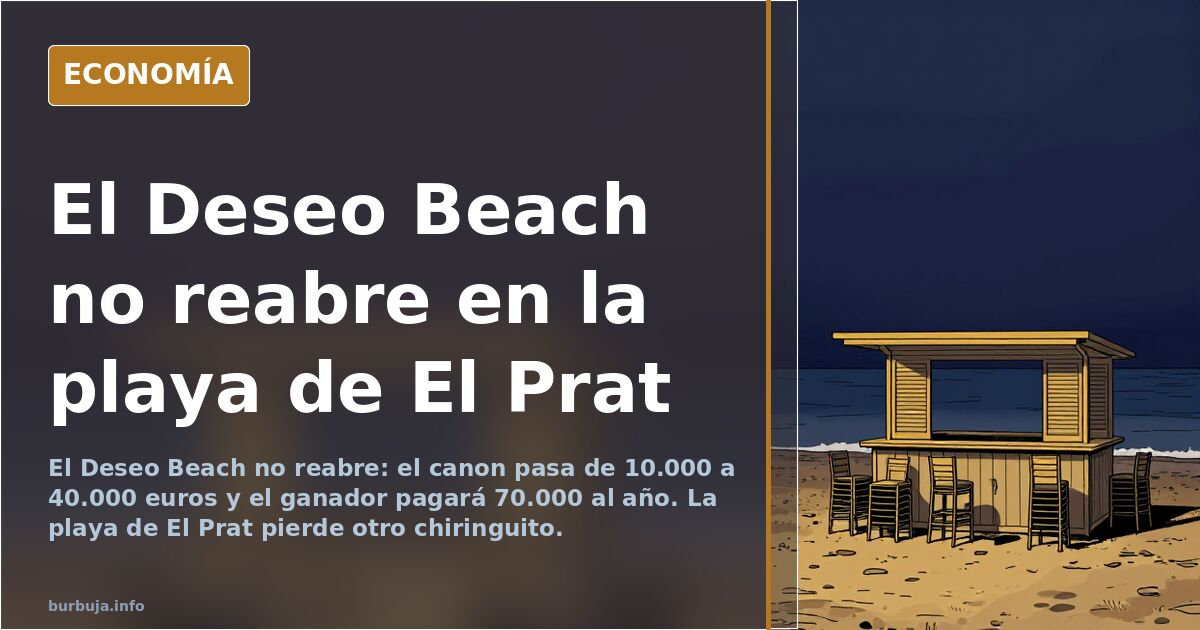
The beach bar closing because municipal fees eat summer profits
El Deseo Beach, one of the most popular spots on El Prat de Llobregat beach in Spain, will not reopen its doors. Grupo Iguana, which managed it for over a decade, has withdrawn from the new public tender launched by the City Council for the next three years. The company cites two reasons: economic unviability and lack of municipal cooperation.
The trigger is a figure: the concession fee. The city quadrupled the minimum bid, raising it from €10,000 to €40,000 per year, and the final auction winner will pay €70,000 annually, double what the previous licensee paid. "Fees have skyrocketed. It's unviable and impossible," state the property owners.
The fee that suffocates the terrace
The fee hike isn't the only burden. El Prat beach suffers from structural deficiencies that increase daily business costs. There are no public restrooms or sewage connections, so the bar must fund a septic tank emptied several times a week. That service alone costs between €30,000 and €35,000 per season, according to company calculations.
Added to this are the costs of full legal compliance: hired staff, social security contributions, taxes, and utilities. "If you do things properly, you lose money," assure Grupo Iguana, insisting their model relies on paying according to collective agreements and guaranteeing staff breaks. The result, they say, was a business that no longer broke even and was subsidized by other branches of the group.
The auction that doubles prices and leaves two venues
The new concession went to the Morán family, who already managed the other beachfront establishment, known as El Lobo de Mar. Companies Colasan Family and Chiringuito Family have taken control of all gastronomic offerings on the beach for the 2026 season. The result is a funnel: from four chiringuitos (beach bars) in 2021, there are now only two.
The process is not new. In 2023, El Calamar lost the tender to the current Lobo de Mar and saw the City Council deny them the extension stipulated in the 2019 contract. Its owners then spoke of a "forced closure" that sparked significant controversy among residents. That same year, the iconic Duna closed, another victim of the new tender. The beach has been losing emblematic venues summer after summer.
The entrepreneur's story vs. the official's view
The conversation generated by the news depicts two trenches. On one side, those arguing the problem is administrative cost: fees, taxes, and municipal requirements make a seasonal business unviable. "Between fees, staff, social security, utilities, waste, licenses, and the fact it's seasonal, the real margin shrinks drastically," summarizes a recurring analysis.
On the other, those pointing across the counter. "It doesn't close; simply the managing company didn't enter the new tender, but another took it for €70,000 annually," it is noted. From this perspective, the venue will continue serving food, and the handover is pure capitalism: if the former couldn't pay the fee, another can. The lingering question is whether the newcomer can sustain it during the off-season.
The beach left without toilets and bars
The case of El Prat is not isolated. Other beaches along the Spanish coast show the same pattern: the historic licensee leaves, another enters with a higher bid, and within a few years, the venue closes. Some recall an identical case in a Western Andalusian beach where the new awardee crashed against the numbers and the town hall didn't lower the fee. Where there was a chiringuito, there remained a closed premises.
Grupo Iguana, meanwhile, retreats to its concessions in Gavà, Castelldefels, and Sitges, where it assures that treatment from local governments and technicians is "wonderful." It will also focus efforts on expanding its event brand Paripé Tardeo. It leaves behind a fruitful stage that, according to its version, had become unsustainable.
One disorienting fact remains. The departing chiringuito doesn't close because the terrace is empty. It closes because, with the terrace full, the numbers don't work. And as long as fees keep rising, the next concession holder will have to explain how they plan to balance them.
El Deseo Beach, one of the most popular spots on El Prat de Llobregat beach in Spain, will not reopen its doors. Grupo Iguana, which managed it for over a decade, has withdrawn from the new public tender launched by the City Council for the next three years. The company cites two reasons: economic unviability and lack of municipal cooperation.
The trigger is a figure: the concession fee. The city quadrupled the minimum bid, raising it from €10,000 to €40,000 per year, and the final auction winner will pay €70,000 annually, double what the previous licensee paid. "Fees have skyrocketed. It's unviable and impossible," state the property owners.
The fee that suffocates the terrace
The fee hike isn't the only burden. El Prat beach suffers from structural deficiencies that increase daily business costs. There are no public restrooms or sewage connections, so the bar must fund a septic tank emptied several times a week. That service alone costs between €30,000 and €35,000 per season, according to company calculations.
Added to this are the costs of full legal compliance: hired staff, social security contributions, taxes, and utilities. "If you do things properly, you lose money," assure Grupo Iguana, insisting their model relies on paying according to collective agreements and guaranteeing staff breaks. The result, they say, was a business that no longer broke even and was subsidized by other branches of the group.
The auction that doubles prices and leaves two venues
The new concession went to the Morán family, who already managed the other beachfront establishment, known as El Lobo de Mar. Companies Colasan Family and Chiringuito Family have taken control of all gastronomic offerings on the beach for the 2026 season. The result is a funnel: from four chiringuitos (beach bars) in 2021, there are now only two.
The process is not new. In 2023, El Calamar lost the tender to the current Lobo de Mar and saw the City Council deny them the extension stipulated in the 2019 contract. Its owners then spoke of a "forced closure" that sparked significant controversy among residents. That same year, the iconic Duna closed, another victim of the new tender. The beach has been losing emblematic venues summer after summer.
The entrepreneur's story vs. the official's view
The conversation generated by the news depicts two trenches. On one side, those arguing the problem is administrative cost: fees, taxes, and municipal requirements make a seasonal business unviable. "Between fees, staff, social security, utilities, waste, licenses, and the fact it's seasonal, the real margin shrinks drastically," summarizes a recurring analysis.
On the other, those pointing across the counter. "It doesn't close; simply the managing company didn't enter the new tender, but another took it for €70,000 annually," it is noted. From this perspective, the venue will continue serving food, and the handover is pure capitalism: if the former couldn't pay the fee, another can. The lingering question is whether the newcomer can sustain it during the off-season.
The beach left without toilets and bars
The case of El Prat is not isolated. Other beaches along the Spanish coast show the same pattern: the historic licensee leaves, another enters with a higher bid, and within a few years, the venue closes. Some recall an identical case in a Western Andalusian beach where the new awardee crashed against the numbers and the town hall didn't lower the fee. Where there was a chiringuito, there remained a closed premises.
Grupo Iguana, meanwhile, retreats to its concessions in Gavà, Castelldefels, and Sitges, where it assures that treatment from local governments and technicians is "wonderful." It will also focus efforts on expanding its event brand Paripé Tardeo. It leaves behind a fruitful stage that, according to its version, had become unsustainable.
One disorienting fact remains. The departing chiringuito doesn't close because the terrace is empty. It closes because, with the terrace full, the numbers don't work. And as long as fees keep rising, the next concession holder will have to explain how they plan to balance them.
Also available in: Deutsch
Summary of a discussion on Burbuja.info - Foro de economía, actualidad y política., translated from Spanish and reviewed before publication. Read the full discussion (129 replies).
More summaries
-
Tenants' Union calls for pot-banging protests at 8pm
The Tenants' Union calls for pot-banging at 8pm outside town halls after 2,900 homes were withdrawn, a move a message attributes to a property portal.
-
Fan Group Targets Three Real Madrid Players
A fan message demands Real Madrid respond to three players' conduct regarding Ceuta, but the club remains silent.
-
Hamas fires rockets at Jerusalem as Hezbollah opens fire
Hamas launched ten rockets at Jerusalem after its ultimatum: seven were intercepted. Hezbollah opened a second front from Lebanon and riots broke out…
-
Colau says she left her flat of 15 years because she couldn't afford it
Ada Colau says she is leaving the flat where she lived for 15 years because one salary wasn't enough; Newtral puts her salary as mayor at €96,000 gross
-
Church Fire in Granada: One Arrested, Hate Crime Debate
A man was arrested after setting fire to a church in El Pozuelo de Albuñol, Spain. Reports of decapitated figures remain unconfirmed.
-
Arecibo 'UFO' Claim Debunked: Fallen Telescope, Fireball
Video claims Arecibo telescope captured alien fireball, but instrument has been offline since 2020. Evidence collapses.