
Spain's Treasury Faces Backlash Over Tax Campaign Amid DANA Crisis
The Ministry of Finance launched a campaign stating taxes return during emergencies, sparking outrage over the DANA response in Valencia.
English · Original discussion in Spanish · Published
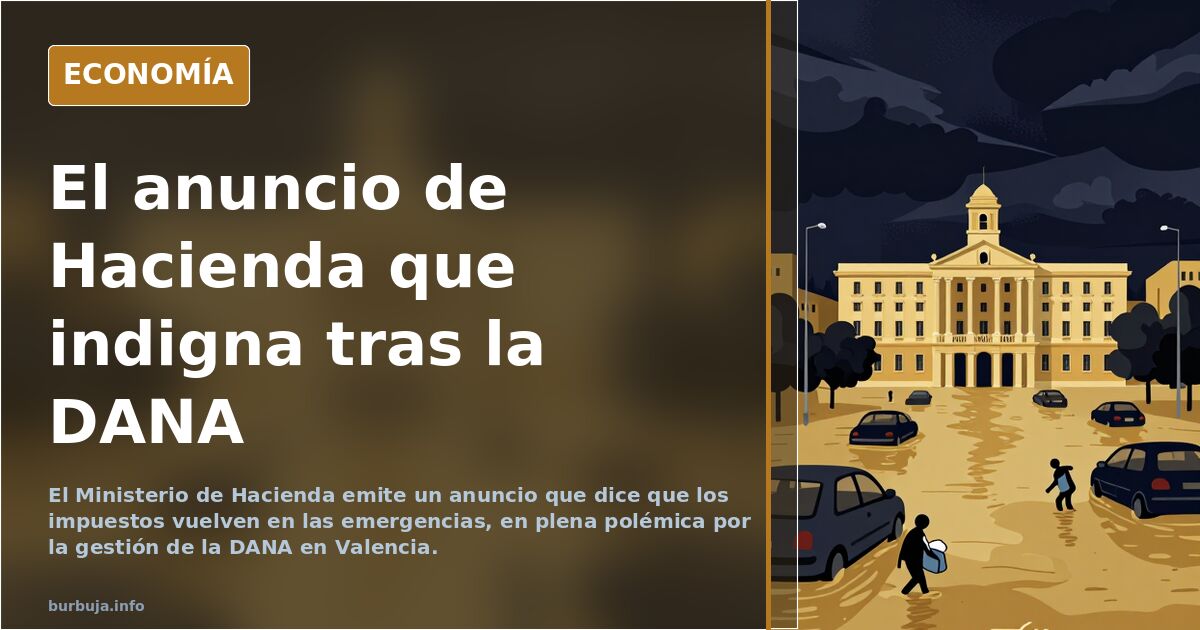
Treasury Highlights Taxes During DANA Controversy
The Ministry of Finance has launched an advertising campaign with a message that has fallen flat among many taxpayers: "When you pay your taxes, they come back. They return when there is an emergency." The slogan, broadcast on radio and television, arrives amidst strong criticism of public management trinc the floods that devastated the province of Valencia, and has been interpreted by many as outright provocation. The phrase, intended to highlight the State's role in disasters, has clashed with an uncomfortable reality: victims still waiting for aid, business owners charged by the Treasury despite losing their livelihoods, and those who believe public funds are diluted by patronage before reaching the emergency.
Slogan That Angers Taxpayers
The Ministry of Finance's campaign is no ordinary ad. It airs on radio stations and TV programs, and its central message —what you give comes back— has been received as mockery by part of the population. In the context of the DANA (Depresión Aislada en Niveles Altos) that hit Valencia, with thousands of victims, millions in material losses, and emergency management under suspicion, the motto sounds like an official justification for a system many consider failed. "You have to be bold to run a campaign about a disaster and sell absolute failure as success," summarizes one of the most repeated opinions. The irony peaks when this institutional message coincides with complaints from Paiporta business owners whom the Treasury continues to bill for taxes despite having lost their businesses.
What Does the Treasury Say and What Do Victims Reply?
The ad claims taxes return to citizens through public services and emergency response. That is the official thesis. The street response is different: slow aid, bureaucracy, and a sense of abandonment. "They don't forgive," a media outlet titled regarding complaints from Paiporta merchants, who see how the Spanish Tax Agency (Agencia Tributaria) keeps sending them bills while they try to rebuild their businesses. Far from calming tensions, the campaign has reignited debate on the efficiency of public spending and whether tax money truly goes where promised or gets lost along the way in clientelist structures.
The Real Destination of Taxes: From Official Cars to NGOs
One of the most repeated arguments in public debate concerns the specific destination of collected funds. Against the official message that taxes return via emergencies, critics list expenditures they believe distance themselves from the citizen: from representation costs and official vehicles to grants for organizations, including contracts with inflated prices. "What you give returns to the Falcon jets, the Equality Ministry, payments to Segarro emergencies," wrote one participant, in a phrase summarizing the discontent of those who feel the return never reaches those in need. Criticism extends beyond the central government to regional and local administrations, and the web of intermediate bodies managing aid.
DANA Management as Backdrop
The ad cannot be understood without the DANA context. The late October 2024 floods in Valencia left a trail of destruction and unprecedented questioning of coordination between administrations. The Júcar Hydrographic Confederation, the Generalitat Valenciana, and the central government traded accusations over who warned and when. In this climate, a spot boasting that taxes return "when there is an emergency" sounds, to many, like sarcasm. "It's time to push for reducing the state to its minimum expression," argues another viewpoint, seeing the campaign as proof that the public sector is more problem than solution.
The Calculation No One Denies: Less State, Less Loss
An argument gaining weight in the debate is that the larger the state, the more is lost along the way. Not a new idea, but the DANA episode has fueled it. Proponents argue that every euro collected passing through multiple administrations arrives diminished at its final destination, and that disaster response would be faster and more effective if management were closer to citizens. Opposing this, the official stance insists that without a strong Treasury, there is no capacity to react. The problem is that, as of this discussion, victims are still waiting for answers and the ad keeps playing.
The Treasury's campaign achieved something difficult: uniting taxpayers of all stripes in anger. With the DANA still fresh in memory and aid not reaching everyone, the slogan "what you give comes back" has become the best argument for those demanding lower taxes and less bureaucracy. It remains to be seen if the ministry will rectify or keep the spot. What is clear is that the message came back, but not as expected.
The Ministry of Finance has launched an advertising campaign with a message that has fallen flat among many taxpayers: "When you pay your taxes, they come back. They return when there is an emergency." The slogan, broadcast on radio and television, arrives amidst strong criticism of public management trinc the floods that devastated the province of Valencia, and has been interpreted by many as outright provocation. The phrase, intended to highlight the State's role in disasters, has clashed with an uncomfortable reality: victims still waiting for aid, business owners charged by the Treasury despite losing their livelihoods, and those who believe public funds are diluted by patronage before reaching the emergency.
Slogan That Angers Taxpayers
The Ministry of Finance's campaign is no ordinary ad. It airs on radio stations and TV programs, and its central message —what you give comes back— has been received as mockery by part of the population. In the context of the DANA (Depresión Aislada en Niveles Altos) that hit Valencia, with thousands of victims, millions in material losses, and emergency management under suspicion, the motto sounds like an official justification for a system many consider failed. "You have to be bold to run a campaign about a disaster and sell absolute failure as success," summarizes one of the most repeated opinions. The irony peaks when this institutional message coincides with complaints from Paiporta business owners whom the Treasury continues to bill for taxes despite having lost their businesses.
What Does the Treasury Say and What Do Victims Reply?
The ad claims taxes return to citizens through public services and emergency response. That is the official thesis. The street response is different: slow aid, bureaucracy, and a sense of abandonment. "They don't forgive," a media outlet titled regarding complaints from Paiporta merchants, who see how the Spanish Tax Agency (Agencia Tributaria) keeps sending them bills while they try to rebuild their businesses. Far from calming tensions, the campaign has reignited debate on the efficiency of public spending and whether tax money truly goes where promised or gets lost along the way in clientelist structures.
The Real Destination of Taxes: From Official Cars to NGOs
One of the most repeated arguments in public debate concerns the specific destination of collected funds. Against the official message that taxes return via emergencies, critics list expenditures they believe distance themselves from the citizen: from representation costs and official vehicles to grants for organizations, including contracts with inflated prices. "What you give returns to the Falcon jets, the Equality Ministry, payments to Segarro emergencies," wrote one participant, in a phrase summarizing the discontent of those who feel the return never reaches those in need. Criticism extends beyond the central government to regional and local administrations, and the web of intermediate bodies managing aid.
DANA Management as Backdrop
The ad cannot be understood without the DANA context. The late October 2024 floods in Valencia left a trail of destruction and unprecedented questioning of coordination between administrations. The Júcar Hydrographic Confederation, the Generalitat Valenciana, and the central government traded accusations over who warned and when. In this climate, a spot boasting that taxes return "when there is an emergency" sounds, to many, like sarcasm. "It's time to push for reducing the state to its minimum expression," argues another viewpoint, seeing the campaign as proof that the public sector is more problem than solution.
The Calculation No One Denies: Less State, Less Loss
An argument gaining weight in the debate is that the larger the state, the more is lost along the way. Not a new idea, but the DANA episode has fueled it. Proponents argue that every euro collected passing through multiple administrations arrives diminished at its final destination, and that disaster response would be faster and more effective if management were closer to citizens. Opposing this, the official stance insists that without a strong Treasury, there is no capacity to react. The problem is that, as of this discussion, victims are still waiting for answers and the ad keeps playing.
The Treasury's campaign achieved something difficult: uniting taxpayers of all stripes in anger. With the DANA still fresh in memory and aid not reaching everyone, the slogan "what you give comes back" has become the best argument for those demanding lower taxes and less bureaucracy. It remains to be seen if the ministry will rectify or keep the spot. What is clear is that the message came back, but not as expected.
Also available in: Deutsch
Summary of a discussion on Burbuja.info - Foro de economía, actualidad y política., translated from Spanish and reviewed before publication. Read the full discussion (190 replies).
More summaries
-
Jucar River Authority Insured Staff for Negligence Before DANA
The Jucar River Authority formalized civil liability insurance for 212 employees on October 7, weeks before the DANA floods devastated parts of Spain.
-
Spain's Council of State Accuses Tax Ministry of Bypassing Parliament
Spain's top advisory body criticizes the Ministry of Finance for creating legal uncertainty and altering tax regulations without parliamentary approval.
-
CHJ Sent 18 Emails During DANA Afternoon, Delayed Sensor Data
The Júcar River Basin Authority claims 18 emails were sent during the DANA event, admitting a 25-30 minute sensor delay. The blame game is under scrutiny.
-
Man sentenced to 4.5 years for slaughtering girlfriend's rabbit
A Valencia court sentences a man to 4.5 years in prison for killing, cooking, and forcing his girlfriend to eat her rabbit.
-
Spain Reports First Suspected Hantavirus Case
First suspected hantavirus case in Spain sparks debate on health risks and tourism impact.
-
Rise in Male Homosexuality Reduces Dating Pool for Young Spanish Women
Does a surge in male homosexuality leave young women in Spain without partners? An analysis of a debate blending math, stereotypes, and social anxiety.