
Spanish olive oil yields range from 10% to 26%
A user's invoice showing 544 kg of olives yielding 65 liters of extra virgin olive oil reignites debate on Spain's variable olive harvest efficiency.
English · Original discussion in Spanish · Published
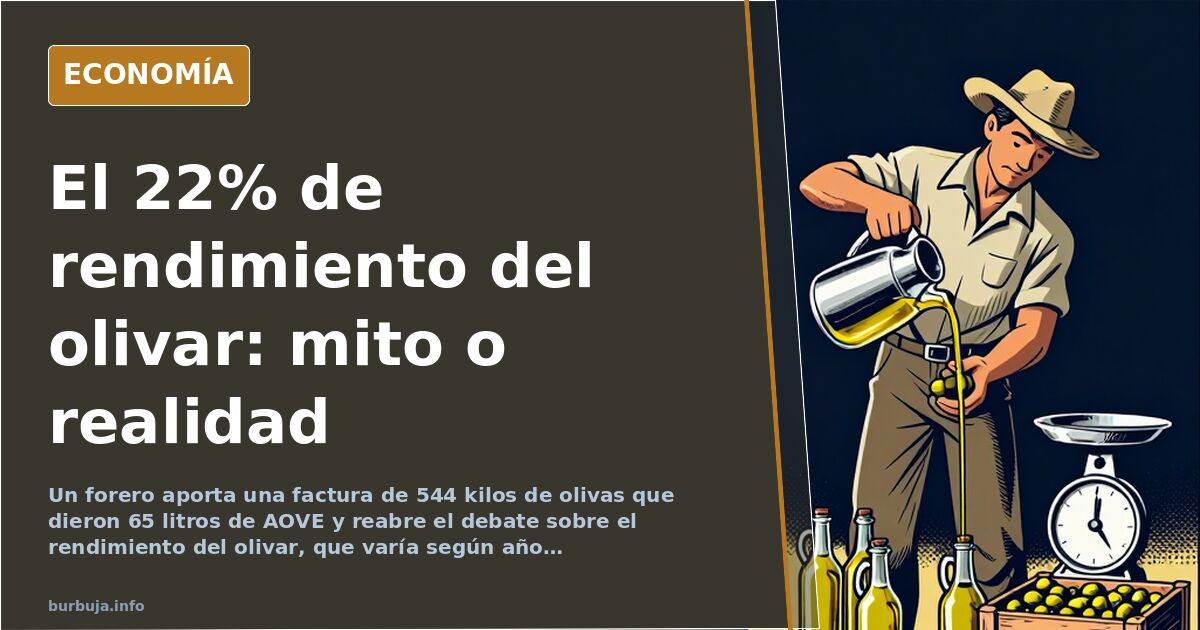
Olive yield in Spain: between 10% and 26% depending on year and variety
How much oil actually comes from a kilo of olives? This seemingly basic agricultural question has sparked weeks of disagreement between those who argue that well-maintained olive groves average a 20% yield and those claiming it barely reaches 10% in poor years. The trigger was a mill invoice showing 544 kilos of olives producing 65 liters of EVOO, an 11.9% yield cited by its owner as proof that the promised 22% was a fantasy. The response came quickly: in rainy years, olives absorb water, and the milling process separates fat from water, causing yields to plummet. Variety, harvest date, and tree care account for the rest.
Why does olive yield vary so much?
The range is wide and depends on factors not visible on the invoice. In Murcia, olives yield between 19% and 22%, according to one producer who adds a key nuance: green olives harvested in late October yield much less than the same olives fully peine in December or January. He brought 3,000 kilos for early harvest and got 480 liters: a real 16%, because the mill charges 3-5% for processing. In Castellón, several consulted growers report 18% yields, with homemade screw presses extracting 180 grams of EVOO per kilo immediately after pressing.
The most optimistic calculation assumes high-yield varieties can reach 28%. The pessimistic scenario starts with table olive varieties, which don't exceed 10-14%. In between, a surprising data point: a forum user claims to have seen 24% yields, while another recalls seeing up to 26% in very good years. The key lies in fertilization: olive trees destined for table olives are fertilized with nitrogen to prevent ripening, which drastically lowers their oil yield.
Harvest date: the overlooked factor
For many, harvesting in November is a beginner's mistake. Olives taken to the mill at that time haven't completed ripening, causing yields to collapse. Early adopters start in early December, only because they combine harvesting with their jobs. Picual, Spain's dominant oil variety, averages around 20% yield under normal conditions. Manzanilla, however, yields less.
One factor escapes any calculation: water stress. Olives oxidize over time, changing from green to purple and finally black. If this oxidation is excessive, the olive contains more water than oil. The producer explaining this compared it to gambling in a casino: one must know when to walk away. This is where regenerative agriculture, electroculture, and beneficial crop associations come into play, challenging the "we've always done it this way" mentality.
EVOO prices and market suspicions
With EVOO at €12.75 per liter in cooperatives in mid-November and unfiltered first-cold-press Hojiblanca at €18 per liter, the inevitable question arises: why doesn't supermarket price drop? The circulating answer is uncomfortable. Some producers argue that large multinationals manipulate all food products and now mix lower-quality oil obtained from alperujo (olive pomace) to sell as "Olive Oil" at €4 in Central Europe. Another current points directly to a supposed mafia that fixes prices and profits more from exports, recalling last year's blatant price hikes.
Supply-demand mismatch is the most common explanation. But it doesn't quite fit: 3,000 kilometers away, oil costs the same as in Spain. Where is free competition? The question hangs unanswered. Meanwhile, small producers who don't export and refuse to commercialize their oil just watch how the bulk liter they sell multiplies on supermarket shelves.
What is unfiltered olive oil and why does it run out faster?
Unfiltered oil, also called "in rama" or cloudy, hasn't passed through filtration systems to remove impurities and particles. Its shelf life is shorter, which is why major offers appear between January and March, when large volumes emerge. Early season offers are often reserves from the previous year. Bitter EVOO, purer than virgin, needs about three months settling to become smoother. For frying, however, what you use matters little.
The final paradox: olive yield is measured in percentages, but business is decided on another scale. Those with four olive trees for self-consumption sell no oil. Those with four thousand trees often don't either. And supermarket buyers pay prices unrelated to production costs or harvest yields. With these elements, the 22% figure will remain as disputed as the final price of oil.
How much oil actually comes from a kilo of olives? This seemingly basic agricultural question has sparked weeks of disagreement between those who argue that well-maintained olive groves average a 20% yield and those claiming it barely reaches 10% in poor years. The trigger was a mill invoice showing 544 kilos of olives producing 65 liters of EVOO, an 11.9% yield cited by its owner as proof that the promised 22% was a fantasy. The response came quickly: in rainy years, olives absorb water, and the milling process separates fat from water, causing yields to plummet. Variety, harvest date, and tree care account for the rest.
Why does olive yield vary so much?
The range is wide and depends on factors not visible on the invoice. In Murcia, olives yield between 19% and 22%, according to one producer who adds a key nuance: green olives harvested in late October yield much less than the same olives fully peine in December or January. He brought 3,000 kilos for early harvest and got 480 liters: a real 16%, because the mill charges 3-5% for processing. In Castellón, several consulted growers report 18% yields, with homemade screw presses extracting 180 grams of EVOO per kilo immediately after pressing.
The most optimistic calculation assumes high-yield varieties can reach 28%. The pessimistic scenario starts with table olive varieties, which don't exceed 10-14%. In between, a surprising data point: a forum user claims to have seen 24% yields, while another recalls seeing up to 26% in very good years. The key lies in fertilization: olive trees destined for table olives are fertilized with nitrogen to prevent ripening, which drastically lowers their oil yield.
Harvest date: the overlooked factor
For many, harvesting in November is a beginner's mistake. Olives taken to the mill at that time haven't completed ripening, causing yields to collapse. Early adopters start in early December, only because they combine harvesting with their jobs. Picual, Spain's dominant oil variety, averages around 20% yield under normal conditions. Manzanilla, however, yields less.
One factor escapes any calculation: water stress. Olives oxidize over time, changing from green to purple and finally black. If this oxidation is excessive, the olive contains more water than oil. The producer explaining this compared it to gambling in a casino: one must know when to walk away. This is where regenerative agriculture, electroculture, and beneficial crop associations come into play, challenging the "we've always done it this way" mentality.
EVOO prices and market suspicions
With EVOO at €12.75 per liter in cooperatives in mid-November and unfiltered first-cold-press Hojiblanca at €18 per liter, the inevitable question arises: why doesn't supermarket price drop? The circulating answer is uncomfortable. Some producers argue that large multinationals manipulate all food products and now mix lower-quality oil obtained from alperujo (olive pomace) to sell as "Olive Oil" at €4 in Central Europe. Another current points directly to a supposed mafia that fixes prices and profits more from exports, recalling last year's blatant price hikes.
Supply-demand mismatch is the most common explanation. But it doesn't quite fit: 3,000 kilometers away, oil costs the same as in Spain. Where is free competition? The question hangs unanswered. Meanwhile, small producers who don't export and refuse to commercialize their oil just watch how the bulk liter they sell multiplies on supermarket shelves.
What is unfiltered olive oil and why does it run out faster?
Unfiltered oil, also called "in rama" or cloudy, hasn't passed through filtration systems to remove impurities and particles. Its shelf life is shorter, which is why major offers appear between January and March, when large volumes emerge. Early season offers are often reserves from the previous year. Bitter EVOO, purer than virgin, needs about three months settling to become smoother. For frying, however, what you use matters little.
The final paradox: olive yield is measured in percentages, but business is decided on another scale. Those with four olive trees for self-consumption sell no oil. Those with four thousand trees often don't either. And supermarket buyers pay prices unrelated to production costs or harvest yields. With these elements, the 22% figure will remain as disputed as the final price of oil.
Also available in: Deutsch
Summary of a discussion on Burbuja.info - Foro de economía, actualidad y política., translated from Spanish and reviewed before publication. Read the full discussion (129 replies).
More summaries
-
Spain's Extra Virgin Olive Oil Prices Surge to €15/Liter
Extra virgin olive oil prices in Spain have jumped from €3-4 in 2018 to €15, while direct purchases from Jaén cooperatives remain at €8.80.
-
Foreign tenants: over half in Spain, 70% in three regions
More than 5.2 million tenants in Spain were born abroad. In Madrid, Valencia and Murcia the share reaches 70%. Data and analysis of...
-
Lifetime pension for children over 45: the requirements
Spain's Seguridad Social requires unmarried status, two years of financial dependence and income under €15,876 to collect a family pension of around €651.
-
Germany announces mass deportations ahead of regional elections
Berlin touts stricter immigration measures, but details reveal mere procedural tweaks timed for the electoral calendar.
-
Louvre Evacuated in Paris Over Bomb Threat
A bomb threat forces the Louvre to evacuate, shifting debate toward false flags, social control, and the 2024 Games.
-
Engineer Burnout at Vilnyx, Startup Acquired by Apple
The engineer who suffered depression worked for Vilnyx, the Catalan startup acquired by Apple, not for the tech giant itself.