
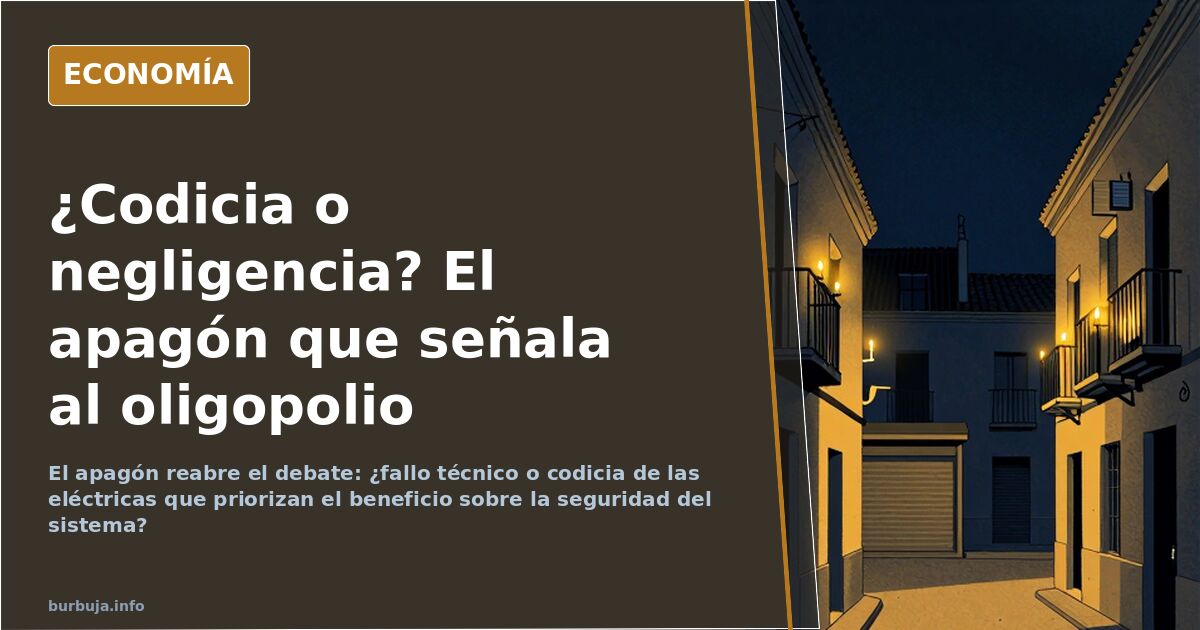
Spain's Blackout: Electric Oligopoly Under Fire
Spain's blackout reignites debate over whether technical failure or corporate greed prioritized profit over grid security.
English · Original discussion in Spanish · Published
Spain's Blackout: Electric Oligopoly Under Fire
The blackout that plunged Spain into darkness has peine the debate on the origins of its electrical system. The most repeated thesis in subsequent analysis is that major companies—Iberdrola, Endesa, Naturgy—operate with a generation mix ranging from nuclear to combined cycle, passing through solar and hydro, and that their management responds to immediate profitability rather than supply security. Greed, understood as short-term profit maximization, is pointed to as the ultimate cause of the collapse.
Energy oligopoly and profitability-driven management
The same companies that control nuclear plants, combined cycles, and large reservoirs also own much of the photovoltaic park. This vertical integration allows them to decide which technology enters at any given moment based on marginal cost. During summer droughts, it is reported, they left reservoirs empty because hydro was the cheapest source and preferred not to use it to avoid cannibalizing prices, leaving entire towns without water for days. The sanction, it is said, was ridiculous. That precedent fuels the suspicion that the blackout was not a fortuitous accident, but the result of management that prioritizes profit over system stability.
The renewable paradox: more sun, less backup
On the day of the blackout, according to several analyses, companies were squeezing solar production—which is cheaper and does not pay the tax that burdens nuclear power—while keeping combined cycle and nuclear plants shut down, which are more expensive to start up. This bet on the most profitable source at the moment would have left the system without the inertia and backup necessary to absorb a sharp drop in generation. The discussion about whether 15 GW were disconnected or if it was an overvoltage runs through the messages, but the common denominator is the lack of backup mechanisms.
The role of Red Eléctrica and energy policy
Red Eléctrica Española (REE), controlled by the State, is ultimately responsible for deciding the generation mix and guaranteeing security. Several messages point out that REE had tools to demand that thermal plants be available and did not do so, or could not. Energy policy designed by the Government—with premiums for renewables, taxes on nuclear power, and a marginalist auction system—would have created the perverse incentives that led to the situation. The discussion shifts to whether the problem is one of regulatory design or execution by operators.
Batteries, backup, and international comparisons
The absence of large-scale storage is pointed to as the missing link. In China, every solar park has mandatory batteries; in California, the massive deployment of batteries has allowed them to be a primary source when the sun sets. In Spain, critics say, there is pride in having "the best grid in the world" while relying on combined cycles that start late and poorly. The proposal to force renewables to install a minimum of batteries to dampen oscillations gains weight in the analysis.
The official narrative and alternative theories
Against the greed hypothesis, the Government and part of the media point to a technical failure or a massive disconnection of renewables due to overvoltage. Other voices speak of a cyberattack, a failed experiment, or a European militarist agenda. None of these theories have conclusive evidence in the available material. What does seem clear is that the Spanish electrical system has a structural backup problem and that economic incentives do not reward security, but the lowest marginal cost.
The prediction, with all reservations, is that this episode will not change the status quo: electricity companies will continue operating under the same rules, the Government will defend its renewable policy, and selective blackouts—or scares—will continue until someone pays the political cost of redesigning the system. Meanwhile, greed will remain the most convenient explanation and the least pursued.
Also available in: Deutsch
Summary of a discussion on Burbuja.info - Foro de economía, actualidad y política., translated from Spanish and reviewed before publication. Read the full discussion (143 replies).
More summaries
-
Spain's energy giants refuse to pay new windfall tax
Repsol and other major Spanish energy firms tell the government they will not absorb the new tax, halting investments while costs shift to consumers.
-
Sánchez hits back at the EU amid the Ceuta crisis
Sánchez's letter to the EU amid the Ceuta crisis escalates the standoff: Italy, Finland and Denmark call for suspending Schengen access, while the Commission rules it out.
-
Spain's Power Grid Crisis Sparks Blame Game Between Government and Utilities
PM Sánchez blames private operators for the blackout; Iberdrola and others reject responsibility, pointing to Red Eléctrica.
-
Riots hit Marseille, Paris, Nice and Grenoble on October 24
Videos on social media show police charges in Marseille and Paris, clashes in Nice and looting in Grenoble. There are no official figures on arrests or injuries.
-
Life... is a war of the chonez against education
Formal education and music compete with television as a source of social prestige. The debate over what counts as culture reveals an unstable hierarchy.
-
Off-duty officer in Barcelona foils phone theft attempt
A suspected thief tried to snatch the phone of an off-duty Mossos d'Esquadra officer in Barcelona. Footage of the scuffle has spread as an example of bad luck and quick reflexes.