
Spain's energy giants refuse to pay new windfall tax
Repsol and other major Spanish energy firms tell the government they will not absorb the new tax, halting investments while costs shift to consumers.
English · Original discussion in Spanish · Published
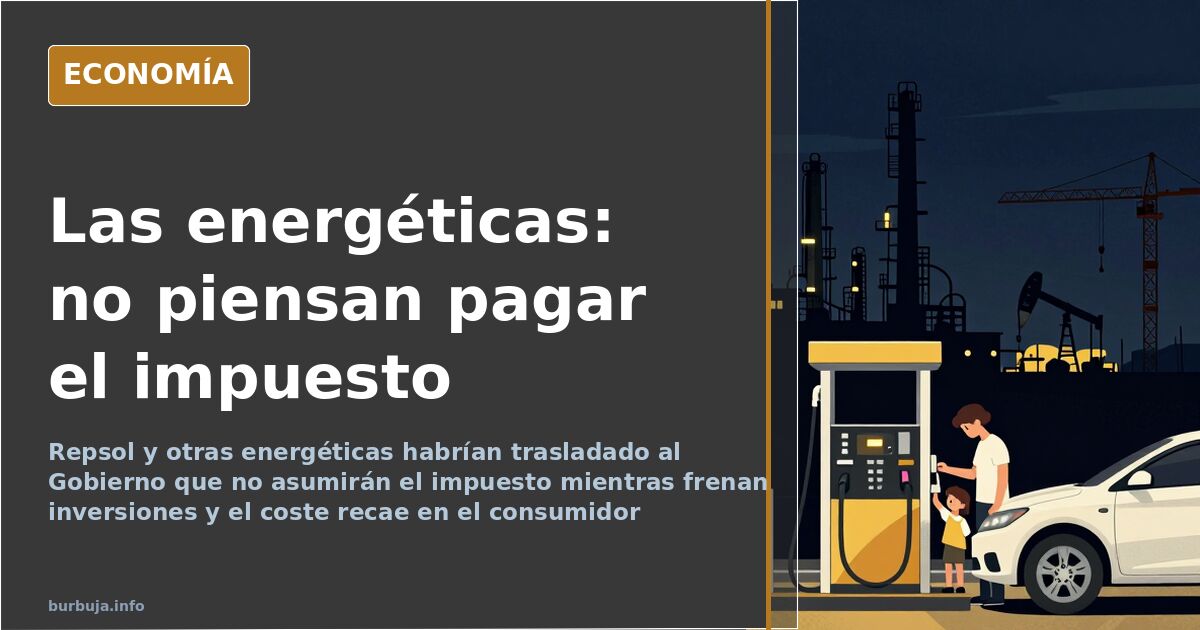
The fiscal standoff: Energy companies refuse payment and freeze investment
Behind the ubiquitous "R" logo seen across Spain, many gas stations are small businesses operating under commercial agreements with oil majors. However, when the executive discusses taxing sector profits, the focus shifts to the large corporations. According to reports circulating in political debates, major energy companies have informed the government that they will not assume the energy windfall tax. Some sources clarify that this is not a threat, but a refusal to pay, leaving the government to decide how to proceed.
The issue sits at the intersection of political maneuvering and economic argumentation. On the latter front, there is more consensus than it appears.
Why do energy companies refuse to pay the tax?
The central argument is structural rather than accounting-based. In an oligopoly, corporate taxes are ultimately paid by the final consumer. This reasoning is widely repeated: if a company with pricing power faces higher costs or reduced margins, those increases are passed on to fuel pumps or electricity bills. The alternative proposed by authorities—price caps via decree—has a poor track record, as no service provider operates without profit.
Repsol and 43% of Spanish gas stations: The scale of the player
Scale matters. Repsol controls approximately 43% of Spain's gas stations, giving it significant influence over fuel prices. Additionally, it owns four refineries in Cartagena, A Coruña, Puertollano, and Bilbao, all originally state-owned. Critics of softer taxation note that these facilities were once public property and remain operational thanks to public funding. They argue the state acts as their protector and should charge for this role. It is a matter of perspective.
Legal certainty: The Ferrovial precedent
A second concern transcends the specific tax. The most frequent complaint is legal uncertainty: regulations changing frequently, fiscal frameworks revised mid-term, and the antiestéticar that investments could be invalidated by decree. Ferrovial’s relocation of its headquarters is often cited as evidence. Visible consequences include several stalled investments awaiting clarity on regulatory rules. Meanwhile, IBEX 35 indices appear unaffected by the noise.
Record profits and the envy argument
The sector has posted historic profits, which some analysts use to argue that companies can afford the tax easily. The counter-argument is simple yet uncomfortable: if profits are so high, anyone can buy shares and receive dividends. Envy, proponents say, is not a valid fiscal argument. Furthermore, energy companies operate within an intervened price framework, an oligopoly where the state itself participates. Some radical voices call for nationalization.
Green hydrogen: Public money for questionable business cases
Another key conflict involves the allocation of funds. The government champions green hydrogen as a strategic project, but the industry remains skeptical. Technical objections are significant: producing hydrogen from electricity loses about 50% of energy, storage is costly and complex, and conventional cycles may waste up to 90%. Building electrolysis plants and desalination facilities requires investment that private entities won't make without subsidies. Proponents argue that during renewable production peaks, excess electricity has zero cost, making negative efficiency acceptable. The debate is not technical; it is about who foots the bill.
Who ends up paying the bill?
Consensus here is uncomfortable. If major companies don't pay, someone else must cover the shortfall. That someone is typically the consumer, the freelancer, or the ordinary taxpayer. Extra revenue doesn't vanish; it just changes pockets. Moreover, companies employ teams dedicated to minimizing tax liabilities, while individuals struggle with draft declarations and unstable electronic portals.
A detail highlights the paradox: The four refineries supporting much of Repsol's business were inaugurated between 1950 and 1972—in Cartagena, A Coruña, Puertollano, and Bilbao. Infrastructure built before any current executives began their careers.
Behind the ubiquitous "R" logo seen across Spain, many gas stations are small businesses operating under commercial agreements with oil majors. However, when the executive discusses taxing sector profits, the focus shifts to the large corporations. According to reports circulating in political debates, major energy companies have informed the government that they will not assume the energy windfall tax. Some sources clarify that this is not a threat, but a refusal to pay, leaving the government to decide how to proceed.
The issue sits at the intersection of political maneuvering and economic argumentation. On the latter front, there is more consensus than it appears.
Why do energy companies refuse to pay the tax?
The central argument is structural rather than accounting-based. In an oligopoly, corporate taxes are ultimately paid by the final consumer. This reasoning is widely repeated: if a company with pricing power faces higher costs or reduced margins, those increases are passed on to fuel pumps or electricity bills. The alternative proposed by authorities—price caps via decree—has a poor track record, as no service provider operates without profit.
Repsol and 43% of Spanish gas stations: The scale of the player
Scale matters. Repsol controls approximately 43% of Spain's gas stations, giving it significant influence over fuel prices. Additionally, it owns four refineries in Cartagena, A Coruña, Puertollano, and Bilbao, all originally state-owned. Critics of softer taxation note that these facilities were once public property and remain operational thanks to public funding. They argue the state acts as their protector and should charge for this role. It is a matter of perspective.
Legal certainty: The Ferrovial precedent
A second concern transcends the specific tax. The most frequent complaint is legal uncertainty: regulations changing frequently, fiscal frameworks revised mid-term, and the antiestéticar that investments could be invalidated by decree. Ferrovial’s relocation of its headquarters is often cited as evidence. Visible consequences include several stalled investments awaiting clarity on regulatory rules. Meanwhile, IBEX 35 indices appear unaffected by the noise.
Record profits and the envy argument
The sector has posted historic profits, which some analysts use to argue that companies can afford the tax easily. The counter-argument is simple yet uncomfortable: if profits are so high, anyone can buy shares and receive dividends. Envy, proponents say, is not a valid fiscal argument. Furthermore, energy companies operate within an intervened price framework, an oligopoly where the state itself participates. Some radical voices call for nationalization.
Green hydrogen: Public money for questionable business cases
Another key conflict involves the allocation of funds. The government champions green hydrogen as a strategic project, but the industry remains skeptical. Technical objections are significant: producing hydrogen from electricity loses about 50% of energy, storage is costly and complex, and conventional cycles may waste up to 90%. Building electrolysis plants and desalination facilities requires investment that private entities won't make without subsidies. Proponents argue that during renewable production peaks, excess electricity has zero cost, making negative efficiency acceptable. The debate is not technical; it is about who foots the bill.
Who ends up paying the bill?
Consensus here is uncomfortable. If major companies don't pay, someone else must cover the shortfall. That someone is typically the consumer, the freelancer, or the ordinary taxpayer. Extra revenue doesn't vanish; it just changes pockets. Moreover, companies employ teams dedicated to minimizing tax liabilities, while individuals struggle with draft declarations and unstable electronic portals.
A detail highlights the paradox: The four refineries supporting much of Repsol's business were inaugurated between 1950 and 1972—in Cartagena, A Coruña, Puertollano, and Bilbao. Infrastructure built before any current executives began their careers.
Summary of a discussion on Burbuja.info - Foro de economía, actualidad y política., translated from Spanish and reviewed before publication. Read the full discussion (138 replies).
More summaries
-
Nuclear: €26bn decommissioning bill and Olkiluoto's €11bn overrun
Nuclear faces a €26bn decommissioning bill and Olkiluoto a €11bn overrun, while solar adds 250 MW a month. Coal was shut down in haste.
-
Why Spain isn't having children: three underlying trends
Housing, wages, female education and immigration: the three trends that explain why Spain barely reaches 1.2 children per woman
-
Diesel crack spread hits $108 amid refinery capacity crunch
Low-sulfur gasoil crack spread surged to $108 on Sept 1 as crude hit $100 and refining capacity remains damaged.
-
Unverified video fuels conflicting narratives in Israel-Palestine war
An unverified clip showing corpse desecration circulates amid the Israel-Palestine conflict, sparking debate over its origin and authenticity.
-
4,500-year-old Egyptian dress reconstructed from beads
A 4,500-year-old Egyptian dress reconstructed with 7,000 beads found in Giza reopens the debate on clothing during Khufu's reign.
-
Spain's Population Shift: From 38 to 30 Million Natives
Claims suggest Spain’s native population dropped from 38 to 30 million, while foreign-origin residents rose from 800,000 to 17.3 million.