
Riots hit Marseille, Paris, Nice and Grenoble on October 24
Videos on social media show police charges in Marseille and Paris, clashes in Nice and looting in Grenoble. There are no official figures on arrests or injuries.
English · Original discussion in Spanish · Published
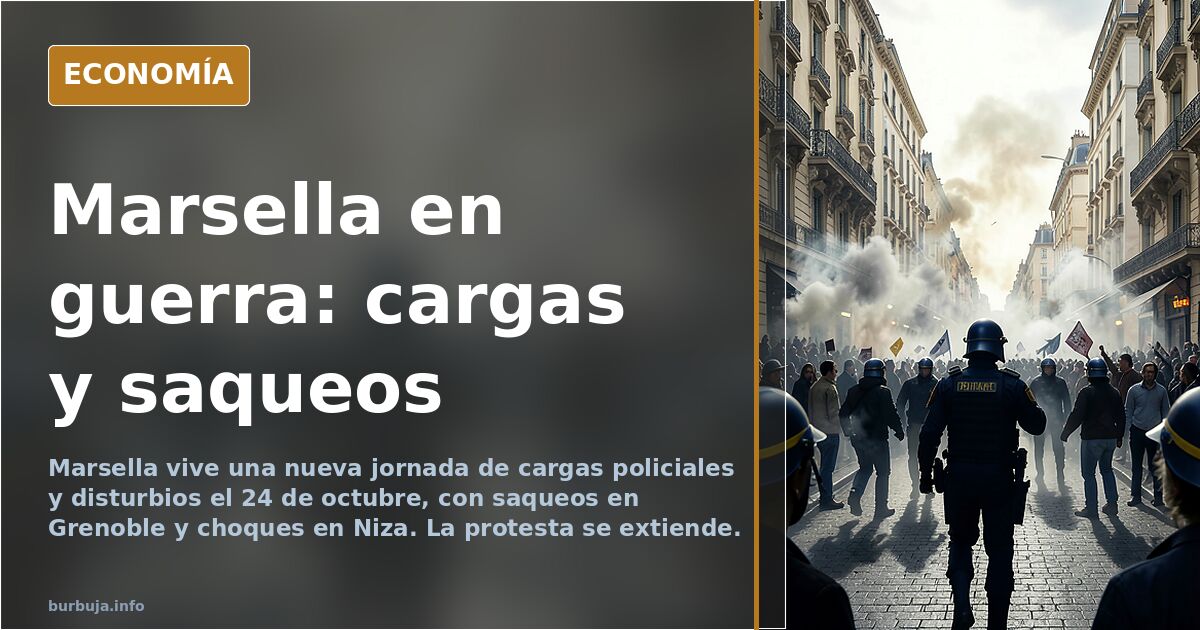
Riots hit Marseille, Paris, Nice and Grenoble on October 24
France is burning again on a Saturday. Marseille, Paris, Nice and Grenoble were the scene of police charges, fires and looting on October 24, according to videos circulating on social media. The situation, which according to some posts began with protests against the measures of Macron's government, escalated into confrontations between far-right groups and demonstrators, and into episodes of vandalism that left images of ransacked shops and burned-out vehicles. The question hanging in the air is whether this is a deep-rooted social explosion or a public order crisis that the Élysée cannot — or will not — control.
Marseille, the epicenter of the chaos
Marseille was the hottest spot of the day. The videos released show police charges against demonstrators and columns of smoke in the city center. The protest, which had begun peacefully according to some witnesses, degenerated into direct clashes with officers. Police have responded with riot gear and arrests have been made, although there are no official figures in the available material. What the images do convey is a sense of loss of control that contrasts with the official version of a proportionate response.
Macron's government recently approved draconian measures to curb the protests, with sentences of up to five years in prison and fines of 20,000 euros for participants in riots, as claimed in the debate. However, as some analyses point out, deterrence is not working: the riots have recurred and spread to other cities. The question is whether tougher penalties are the right answer or whether, on the contrary, they are fueling a spiral of confrontation.
Nice: clashes between extremes
In Nice, the protest descended into clashes between far-right groups and left-wing demonstrators. The videos show street fights and an atmosphere of urban warfare. This type of confrontation adds a layer of complexity to the conflict: it is no longer just citizens versus the state, but ideological groups taking advantage of the situation to settle scores. The presence of these groups, according to some analyses, can delegitimize the original protests and justify an even harsher response from the government.
Looting and vandalism: spontaneous or organized?
In Grenoble and other cities, shops have been looted. The images show groups of people raiding stores and fleeing with merchandise. Some claim these lootings are organized by professional groups and that the police, in some cases, allow them in order to justify subsequent repression. It is a hypothesis circulating online, without conclusive evidence, but it reflects distrust of the authorities. What is certain is that the looting adds an element of economic destruction that harms shopkeepers and ordinary citizens, and shifts attention away from the original demands.
The economic and social backdrop
Beyond the anecdote of the riots, the underlying debate is economic. Some analyses point out that public spending on defense and aid to Ukraine — hundreds of billions of euros — is diverting resources from social policies and productive investment. The perception that money is going to causes unrelated to people's lives while public services deteriorate and housing becomes unaffordable for young people fuels frustration. It is no coincidence that the protests coincide with a diffuse economic malaise that goes beyond any specific measure.
The housing crisis, the loss of purchasing power and the lack of prospects for young people are factors that, according to various analyses, lie at the root of the social unrest. In France, as in other European countries, the social contract seems to be cracking: social mobility is stagnating and the feeling that the system does not respond to the needs of the majority is spreading. In this context, repressive measures may work in the short term, but they do not solve the underlying problem.
Civil war or public order crisis?
Some claim France is on the brink of civil war. It is an extreme hypothesis, but it reflects the gravity of the situation. More nuanced analyses point out that the riots are episodes of urban violence which, though serious, lack the organization and continuity of a civil conflict. Most participants, according to these views, are young people who join the protest out of anger or opportunism, and who disperse when the police act decisively. The question is whether the government will be able to contain the wave or whether it will keep growing.
Macron's government, meanwhile, seems to be playing at ambiguity. Some friendly media speak of "far-left violence" and "attacks on the Republic," while others point to the government's own responsibility in creating a climate of tension. The call for new protests on October 31 suggests the conflict is far from over.
The role of the media and the battle over the narrative
Media coverage has become another battlefield. Some pogre outlets, such as the debate programs on TVE and La Sens, have been criticized for focusing on the violence of the demonstrators rather than the causes. Other, more right-wing outlets emphasize insecurity and the need for a firm hand. Amid that noise, data is scarce: there are no official figures on arrests, injuries or material damage in the available material. The battle over the narrative, as always, shapes public perception and the political response.
The prediction is risky: if the government does not address the economic and social causes of the malaise, the riots are likely to recur. But it is also possible that repression, if forceful enough, will contain them in the short term. What is clear is that France, and by extension Europe, faces a challenge of legitimacy and social cohesion that cannot be solved with fines or prison sentences.
Also available in: Deutsch
Summary of a discussion on Burbuja.info - Foro de economía, actualidad y política., translated from Spanish and reviewed before publication. Read the full discussion (92 replies).
More summaries
-
Macron deploys 70,000 police officers and military equipment against riots
Macron mobilizes 70,000 police officers and military equipment against the riots in France. Boarded-up shops, tear gas and an unprecedented deployment.
-
France riots: schools attacked and shops looted
Riots in France: schools attacked, shops looted and a left-wing mayor singled out for joining the rioters. The spark that set the…
-
Debate in Spain over €46 artisanal panettone price
An artisanal panettone priced at €46 has sparked online debate, with users split between luxury quality and excessive marketing.
-
Peak Oil by stealth: the thesis that explains 2020 and 2022
Demand fell by 8.5 million barrels per day in 2020 and prices collapsed. The managed Peak Oil hypothesis explains why.
-
Barcelona riots raise hybrid attack theory
A TikTok and WhatsApp callout led to riots in Barcelona; one circulating estimate puts it at 130 arrests, 70 of them minors. Comparisons are drawn with Milan and Ceuta.
-
From Marilyn Lange to Raquel Welch: the beauty standard Generation X won't forget
A thread of 676 replies runs from Marilyn Lange to Raquel Welch and reveals a grievance: today's beauty standard no longer convinces those who grew up with a different one.