
Spain's Anti-Amnesty Protests: What Do They Achieve?
Peaceful rallies in Spain against the amnesty law have not stopped the political pact. Analysts debate whether they sway undecided voters or are futile.
English · Original discussion in Spanish · Published
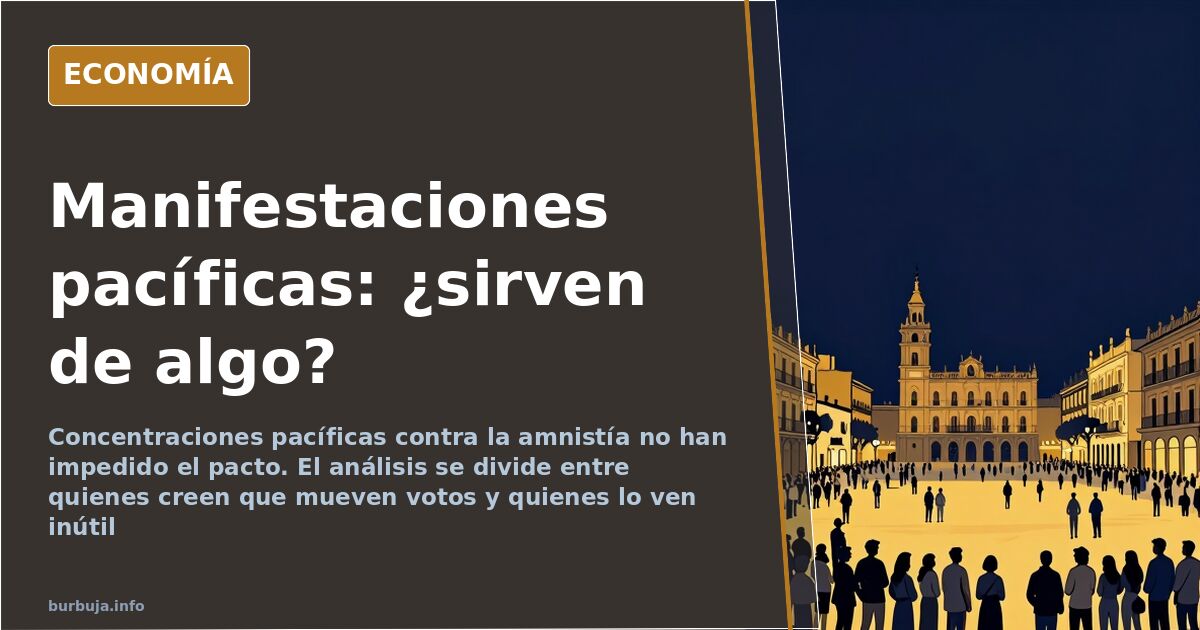
Peaceful protests against the amnesty law: what do they actually achieve?
A segment of the center-right electorate gathers every afternoon outside Socialist Party (PSOE) headquarters to protest against the amnesty law. They do so with Spanish flags, Christmas carols, and songs by Manolo Escobar. The uncomfortable question hanging over the debate is: what exactly do they hope to accomplish? One line of analysis argues that nothing will change, because the left dominates the street narrative and because PP and Vox have no real intention of breaking the status quo. Another view holds that peaceful demonstrations can indeed shift undecided votes, albeit slowly. A third, more extreme current directly ridicules the peaceful path and claims violence has historically been the only effective tool in Spain.
The result is a portrait of the confusion among a part of the electorate who feel orphaned from representation and cannot find a way to translate their anger into political results.
What do participants believe peaceful protests achieve?
The dominant thesis among critics is that peaceful gatherings serve no purpose. It is argued that the left controls the street narrative and that the right has no chance there. "Trying to beat the left on the streets is ridiculous," one comment summarizes. The conclusion drawn is that attendees merely pass the time entertained and fill their phones with photos for messaging groups.
In contrast, another current defends that massive demonstrations can open the eyes of undecided voters. The argument is that many people don't know who to support and seeing a peaceful civic tide could tip the balance toward the constitutional option. Conversely, violent actions would have the opposite effect: alienating those same undecided voters.
There is a third, more cynical path, which maintains that the only achievement is getting media coverage. A massive rejection would break the PSOE's narrative, and without a narrative, the Government loses strength. This is the most optimistic bet within the general skepticism.
The thesis of violence as the only effective tool
A part of the analysis argues that violence works, citing ETA and CDR cases as proof. It is argued that Basque and Catalan separatists have achieved political advances—prisoner transfers, debt forgiveness, amnesty—precisely by using violence or the threat of it. "With peaceful demonstrations, absolutely nothing is achieved," some even claim.
The response to this thesis is twofold. On one hand, it is recalled that the advances of Catalan and Basque separatism respond to the political ambition to stay in power, not to terrorism. On the other hand, it is pointed out that violence demobilizes moderate voters, and that this is precisely the error weighing down the right.
The data cited indicates that the peaceful path has not prevented separatism from gaining institutional ground for years, while the violent path has served to justify the isolation of its perpetrators.
Why are attendees criticized for their demographic profile?
Another line of criticism targets the profile of the protesters. It is maintained that most are people over 60, with interests different from their children, and whose main motivation is political stability to collect their pensions. The colorful flags and bracelets would be just decoration.
This criticism is complemented by the idea that the institutional right has no real intention of changing anything. It is argued that PP and Vox are part of the same globalist system and therefore cannot stop the agenda. The only path contemplated is for Europe to say enough and cut off funding, because if Sánchez's cash flow is strangled, "his allies will hang him from a lamppost within 24 hours."
The role of the amnesty and the political context
The trigger for all these gatherings is the investiture pact with separatists, which includes an amnesty for those prosecuted in the 'procés' (Catalan independence process). The underlying discussion is whether the amnesty is an inevitable concession to govern or a betrayal that breaks equality before the law.
What the debate reveals is that a part of the center-right electorate feels represented by no one. Not by PP, whom they accuse of complicity, nor by Vox, whom they consider mere decoration. That sense of abandonment explains why the gatherings continue without a clear objective beyond expressing anger.
What happens with the amnesty and investiture?
As of this discussion, the investiture pact with separatists is closed and the amnesty continues its parliamentary processing. There is no definitive resolution on its constitutional compatibility or legal effects. What is confirmed is that the gatherings have not prevented the agreement nor forced new elections.
The lingering question is whether the peaceful path will eventually have some cumulative effect or if, as the most skeptical maintain, everything will dilute once the Government stabilizes. The analysis stalls exactly there: in the inability to measure the real impact of a protest that does not cease but also does not alter the political board.
Also available in: Deutsch
Summary of a discussion on Burbuja.info - Foro de economía, actualidad y política., translated from Spanish and reviewed before publication. Read the full discussion (111 replies).
More summaries
-
Tenth day of Ferraz protests against amnesty bill
PSOE headquarters in Madrid enters its tenth day of daily rallies against the amnesty law, marked by clashes and thousands of viewers.
-
Ferraz Protest Fizzles as Amnesty Protests Shift Focus to Málaga Summit
While the Madrid rally against the amnesty bill saw low turnout, attention shifted to Málaga, where Pedro Sánchez met with European leaders.
-
Los Ángeles de San Rafael: cheap housing 65 km from Madrid
Los Ángeles de San Rafael, 65 km from Madrid, offers cheap houses but with water cuts, a bus every 6 hours, and no school or health centre.
-
La Séptima signs Alba Carrillo as the channel fills up with presenters
La Séptima adds Alba Carrillo to its line-up after her exit from Ten, and the channel run by Javier Ruiz and Sarah Santaolalla is filling up with well-known faces before it even starts broadcasting.
-
Tezanos' CIS poll sparks distrust ahead of Spain's election
Tezanos' CIS gives the PSOE 152 seats and PP+VOX 157, versus 195-210 in private polls. Some fear unrest if the result contradicts the official narrative.
-
Judge lifts arrest warrant against Vito Quiles
A Spanish judge has lifted the arrest warrant against journalist Vito Quiles. Some see it as a victory over harassment, others as routine procedure. The debate reflects the tension.