
Tenth day of Ferraz protests against amnesty bill
PSOE headquarters in Madrid enters its tenth day of daily rallies against the amnesty law, marked by clashes and thousands of viewers.
English · Original discussion in Spanish · Published
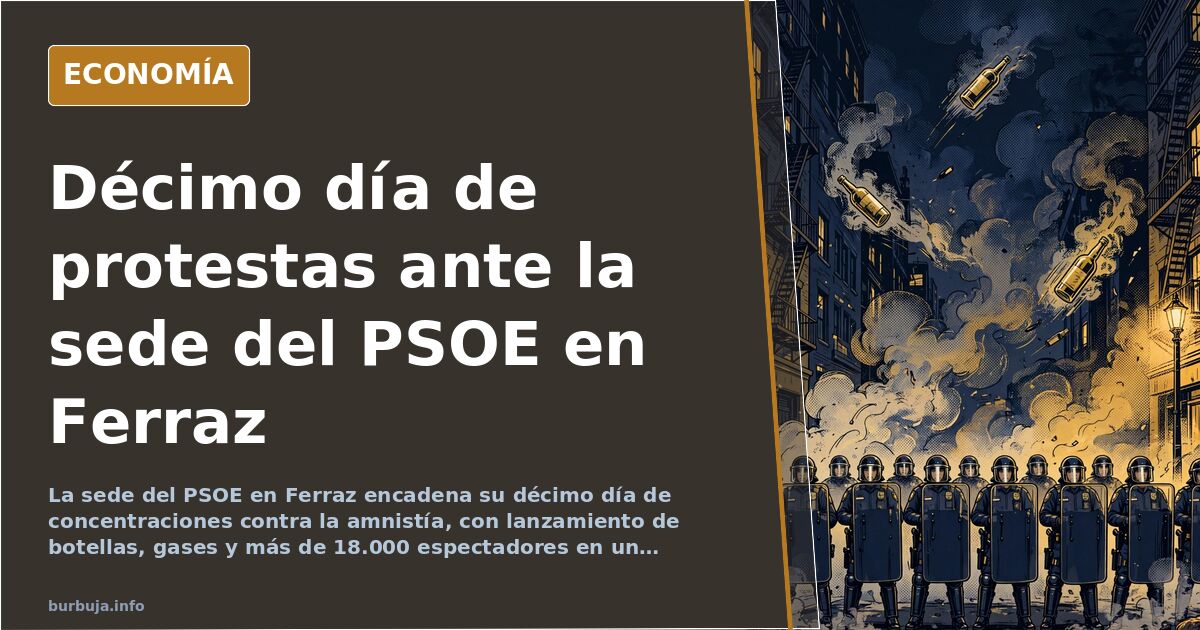
Ferraz enters its tenth day of protests against the amnesty bill
Sunday, November 12. The PSOE headquarters on Ferraz Street in Madrid marks its tenth consecutive day of daily rallies against the amnesty law, with attendance continuing into the night. A live stream of the event surpasses 18,000 viewers. The demonstration continues to mix calm citizen interviews with clashes against riot police and thrown bottles. No one speaks of giving up, with the prevailing sentiment being to continue "without rest" as the investiture calendar advances.
Why do they rally daily outside the PSOE headquarters on Ferraz?
Participants view the amnesty and investiture agreement as an unacceptable concession. The argument persists regardless of government discrediting: the response will be the same and with more people. A participant summarizes this with a warning that has become a slogan: even if two million people turn out, the official narrative will remain the same.
Here lies the rift. Many protesters not only target the Executive but also direct their reproach at the PP, accusing it of missing opportunities to reverse decisions. They say the past is what it is, and they have no intention of returning to the party that governed before. This is a protest against a specific issue that, in practice, functions as a judgment on the entire central political class.
Chants, tear gas, and the standoff with riot police
The night unfolds by the hour. At 10:17 p.m., chants were recorded by the crowd, including claims of national unity, and minutes later, at 10:21 p.m., a glass bottle was thrown. This is not an isolated incident: there is evidence of tear gas used against the protesters.
Chants against the Prime Minister dominate the street sounds, with melodies recycled from football stands. Regarding the police deployment, the most repeated comparison is that there are more officers there than at a border. The criticism is not just against the Executive: some attendees argue that riot police should be on the other side, an idea reflected in the material collected from participants.
The hovering question is how long this standoff will last. The most repeated answer among participants is to organize shift changes, so that police units accumulate long shifts while the concentration continues. It is a strategy of attrition, not an outburst.
Who attends and what they tell the cameras
This is the least expected material. A digital outlet interviews attendees one by one, without filtering, simply asking why they came. The result breaks the stereotype of the banner-carrying protester: a person in a wheelchair appears, a young man calmly explains that the mobilization will not stop, and people say they have been going back and forth from work for days.
Behind these answers is an economic background rarely named but present in all conversations. Frozen salaries, sectors offering only internships and requiring impossible qualifications, the feeling that effort does not compensate. Those who share this do not present it as a political complaint, but as a fact of their own lives. This mix of institutional protest and material discontent explains why the demonstration lasts one more day.
The protest spreads beyond Madrid
Ferraz is not the only point. Windows of the PSOE headquarters in Mallorca have been broken, a scale-up that trinc of the rallies read as a sign that the phenomenon is expanding. In Gijón, a restaurant cancelled a planned dinner, interpreted as confirmation that fruta costs are beginning to weigh.
There is also talk of a general strike on the 24th, announced by an interlocutor claiming responsibility for the call. The reaction is not unanimous: some consider it impossible, while others believe such a strike would only make sense if supported by major unions, which are accused of having faded. The sharpest comment of the day points out that union structures no longer represent what they once did.
Where the analysis stalls
Here ends what can be affirmed. No one knows if daily rallies outside a headquarters change a vote, halt an investiture, or merely provide relief. Attention is pointed toward the judicial route and the monarchical institution as the only actors with real capacity to intervene, yet it is admitted that this expectation is more hope than calculation. Meanwhile, the streets continue to fill up each afternoon, and the question of how far this goes remains, literally, unanswered.
Sunday, November 12. The PSOE headquarters on Ferraz Street in Madrid marks its tenth consecutive day of daily rallies against the amnesty law, with attendance continuing into the night. A live stream of the event surpasses 18,000 viewers. The demonstration continues to mix calm citizen interviews with clashes against riot police and thrown bottles. No one speaks of giving up, with the prevailing sentiment being to continue "without rest" as the investiture calendar advances.
Why do they rally daily outside the PSOE headquarters on Ferraz?
Participants view the amnesty and investiture agreement as an unacceptable concession. The argument persists regardless of government discrediting: the response will be the same and with more people. A participant summarizes this with a warning that has become a slogan: even if two million people turn out, the official narrative will remain the same.
Here lies the rift. Many protesters not only target the Executive but also direct their reproach at the PP, accusing it of missing opportunities to reverse decisions. They say the past is what it is, and they have no intention of returning to the party that governed before. This is a protest against a specific issue that, in practice, functions as a judgment on the entire central political class.
Chants, tear gas, and the standoff with riot police
The night unfolds by the hour. At 10:17 p.m., chants were recorded by the crowd, including claims of national unity, and minutes later, at 10:21 p.m., a glass bottle was thrown. This is not an isolated incident: there is evidence of tear gas used against the protesters.
Chants against the Prime Minister dominate the street sounds, with melodies recycled from football stands. Regarding the police deployment, the most repeated comparison is that there are more officers there than at a border. The criticism is not just against the Executive: some attendees argue that riot police should be on the other side, an idea reflected in the material collected from participants.
The hovering question is how long this standoff will last. The most repeated answer among participants is to organize shift changes, so that police units accumulate long shifts while the concentration continues. It is a strategy of attrition, not an outburst.
Who attends and what they tell the cameras
This is the least expected material. A digital outlet interviews attendees one by one, without filtering, simply asking why they came. The result breaks the stereotype of the banner-carrying protester: a person in a wheelchair appears, a young man calmly explains that the mobilization will not stop, and people say they have been going back and forth from work for days.
Behind these answers is an economic background rarely named but present in all conversations. Frozen salaries, sectors offering only internships and requiring impossible qualifications, the feeling that effort does not compensate. Those who share this do not present it as a political complaint, but as a fact of their own lives. This mix of institutional protest and material discontent explains why the demonstration lasts one more day.
The protest spreads beyond Madrid
Ferraz is not the only point. Windows of the PSOE headquarters in Mallorca have been broken, a scale-up that trinc of the rallies read as a sign that the phenomenon is expanding. In Gijón, a restaurant cancelled a planned dinner, interpreted as confirmation that fruta costs are beginning to weigh.
There is also talk of a general strike on the 24th, announced by an interlocutor claiming responsibility for the call. The reaction is not unanimous: some consider it impossible, while others believe such a strike would only make sense if supported by major unions, which are accused of having faded. The sharpest comment of the day points out that union structures no longer represent what they once did.
Where the analysis stalls
Here ends what can be affirmed. No one knows if daily rallies outside a headquarters change a vote, halt an investiture, or merely provide relief. Attention is pointed toward the judicial route and the monarchical institution as the only actors with real capacity to intervene, yet it is admitted that this expectation is more hope than calculation. Meanwhile, the streets continue to fill up each afternoon, and the question of how far this goes remains, literally, unanswered.
Also available in: Deutsch
Summary of a discussion on Burbuja.info - Foro de economía, actualidad y política., translated from Spanish and reviewed before publication. Read the full discussion (346 replies).
More summaries
-
PSOE's Ferraz Base: Sociatas and the Image of Party Loyalty
Analysis of the image at Ferraz: Ideological fanaticism or economic dependence? A breakdown of views on PSOE membership.
-
Sánchez invested as prime minister: amnesty and the cost of the pact
Sánchez invested as prime minister on 16-N with amnesty as the price of the pact: debt, pensions, Ferraz protests and economic tension in the background
-
Red-flag march through Madrid returns to Puerta del Sol
A march with red flags through Madrid returns to Puerta del Sol amid debate over who is behind it
-
Ana Rosa tells Vox MP: Immigrants come to contribute
In a TV interview, Ana Rosa Quintana argues immigrants add value, while critics highlight her ownership of 44 rental properties.
-
Moncloa boosts Alvise to curb Vox's 20% support
Forum thread claims Moncloa promotes Alvise to reduce Vox seats. One million votes might yield no MPs but could shift several.
-
Spain's Parasite Debate: Cultural Shock or Marketing?
Analysis of the debate on deworming in Spain: is it a cultural clash, a public health need, or just marketing?