
Ferraz Protest Fizzles as Amnesty Protests Shift Focus to Málaga Summit
While the Madrid rally against the amnesty bill saw low turnout, attention shifted to Málaga, where Pedro Sánchez met with European leaders.
English · Original discussion in Spanish · Published
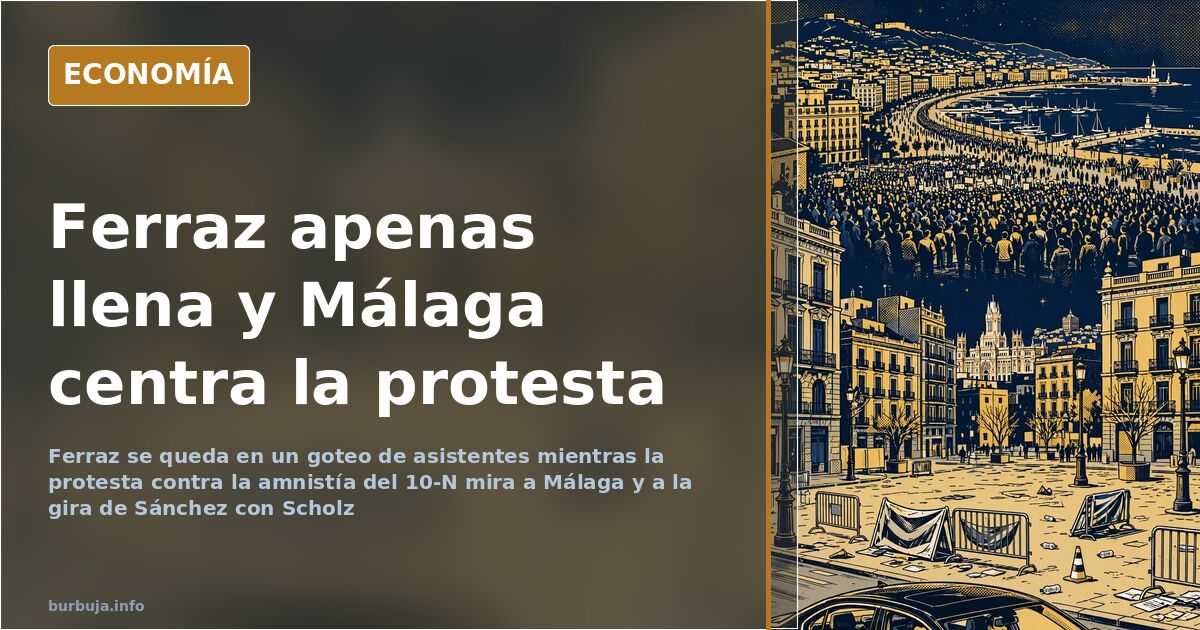
Ferraz Protest Fizzles as Amnesty Protests Shift Focus to Málaga
On Friday, November 10, 2023, the call against the amnesty bill played out across two cities. In Madrid, the Socialist Party headquarters on Ferraz street hosted a gathering described by attendees between 7 and 9 p.m. as "quite calm." In Málaga, the scene was different: Pedro Sánchez was closing a meeting with the prime ministers of Denmark, Malta, and Romania, and German Chancellor Olaf Scholz. The entire state apparatus was focused on the south.
The day's paradox: the Madrid appointment, which had been announced for days with live links and updates, amounted to a trickle of attendees. The Malaga event, without a formal call, brought together those who wanted to confront the president on his own tour. For some of the crowd, the real struggle was on the Costa del Sol, not in front of a headquarters with the lights off.
What was seen at Ferraz: heavy security and few crowds
Afternoon reports agree on the diagnosis. Police presence, loudspeakers, and pressure to disperse. Police asked via loudspeaker to leave the area before what some expected arrived: "Attention, attention, leave the area, this gathering must be dissolved." There were shifts at the fence, a group leaving and another arriving in a worse mood, and the announcement of a new charge.
There was also a little-televised detail. The block opposing the Government is more heterogeneous than the single-block narrative suggests. Flags with the coat of arms cut out next to others defending it, cheers for the police that others did not chant, reproaches to the PP for being asleep, and those who see that party as almost a problem equal to the PSOE. An immagma without command, and that is where the analysis gets tangled.
The deployment was also noticed. Some reproached the agents for their role and others praised them, and that double standard repeated throughout the afternoon: those who applauded the police when charging others stopped applauding when the target could be theirs. Coherence, in this block, is scarce.
Málaga, the welcome they wanted to turn into news
In front of the European summit, the Malaga protest was counted with reluctance. Attendees describe a deployment of dozens of armored cars, hundreds of officers, and a cordon preventing approach. "It looked like a movie," summarized one of those present. The physical distance between the protesters and the president ended up being the symbol of the day.
The idea that reinforcements from the provinces would concentrate in the capital did not take hold. For some, Ferraz was catching small fish and the target should be the president's tour outside Madrid. For others, the serious stuff came the next day, with the agricultural sector mobilized and the promise of tractors on the highway.
What is the point of taking to the streets
This is the question that runs through the entire day. Some are clear: without pressure in the streets, there is no change of course, and the calm of the afternoon only confirms that more muscle is needed. The opposing hypothesis gains ground: concentration and posturing that dissipate in twenty-four hours. Between these extremes, a cold calculation: if the protest does not touch the pocket, it moves nothing. "Here only the pocket hurts," summarizes one of the interventions.
On the violent path, positions are more explicit than official chronicles usually record. Some openly maintain that without violence nothing is achieved, and others call for a general strike as the only real lever. Against that, the reading that the night's disturbances remained below what a football celebration leaves. In fact, the episode of greatest tension was the preventive eviction and the threat of a charge, not a brawl.
The battle fought before the street
There is a current that distrusts tactic and points higher: the narrative. Their thesis is that demonstrations, peaceful or not, are not worth themselves if they do not feed a prior framework. Catalan independence had been building theirs for 45 years, according to this analysis, and the response needs an equivalent myth before expecting results in the street. Without that sown ground, each concentration is an firework.
In this key, one reads the flags that coexisted in the square: the republican, the monarchical, the one with the torn coat of arms. None imposed its law. Heterogeneity is at once the strength and the problem of the block: it unites rejection of the Government, but prevents a single message that can be sold.
The press and public television, in the crosshairs
Not all fire was aimed at the Executive. Some attendees harshly criticized media coverage. Television stations, with journalists protected by helmets as if covering a war zone, were targeted for exaggerating tension when there was hardly anyone left. The most repeated complaint: the live broadcast inflates what the street denies.
With the agricultural sector cited for the next day and the European summit already closed, the day left an unanswered question. How many people are needed to twist a government from the street. What was seen —police, loudspeaker, few crowds— does not clarify if it was the prologue of something or the final point.
On Friday, November 10, 2023, the call against the amnesty bill played out across two cities. In Madrid, the Socialist Party headquarters on Ferraz street hosted a gathering described by attendees between 7 and 9 p.m. as "quite calm." In Málaga, the scene was different: Pedro Sánchez was closing a meeting with the prime ministers of Denmark, Malta, and Romania, and German Chancellor Olaf Scholz. The entire state apparatus was focused on the south.
The day's paradox: the Madrid appointment, which had been announced for days with live links and updates, amounted to a trickle of attendees. The Malaga event, without a formal call, brought together those who wanted to confront the president on his own tour. For some of the crowd, the real struggle was on the Costa del Sol, not in front of a headquarters with the lights off.
What was seen at Ferraz: heavy security and few crowds
Afternoon reports agree on the diagnosis. Police presence, loudspeakers, and pressure to disperse. Police asked via loudspeaker to leave the area before what some expected arrived: "Attention, attention, leave the area, this gathering must be dissolved." There were shifts at the fence, a group leaving and another arriving in a worse mood, and the announcement of a new charge.
There was also a little-televised detail. The block opposing the Government is more heterogeneous than the single-block narrative suggests. Flags with the coat of arms cut out next to others defending it, cheers for the police that others did not chant, reproaches to the PP for being asleep, and those who see that party as almost a problem equal to the PSOE. An immagma without command, and that is where the analysis gets tangled.
The deployment was also noticed. Some reproached the agents for their role and others praised them, and that double standard repeated throughout the afternoon: those who applauded the police when charging others stopped applauding when the target could be theirs. Coherence, in this block, is scarce.
Málaga, the welcome they wanted to turn into news
In front of the European summit, the Malaga protest was counted with reluctance. Attendees describe a deployment of dozens of armored cars, hundreds of officers, and a cordon preventing approach. "It looked like a movie," summarized one of those present. The physical distance between the protesters and the president ended up being the symbol of the day.
The idea that reinforcements from the provinces would concentrate in the capital did not take hold. For some, Ferraz was catching small fish and the target should be the president's tour outside Madrid. For others, the serious stuff came the next day, with the agricultural sector mobilized and the promise of tractors on the highway.
What is the point of taking to the streets
This is the question that runs through the entire day. Some are clear: without pressure in the streets, there is no change of course, and the calm of the afternoon only confirms that more muscle is needed. The opposing hypothesis gains ground: concentration and posturing that dissipate in twenty-four hours. Between these extremes, a cold calculation: if the protest does not touch the pocket, it moves nothing. "Here only the pocket hurts," summarizes one of the interventions.
On the violent path, positions are more explicit than official chronicles usually record. Some openly maintain that without violence nothing is achieved, and others call for a general strike as the only real lever. Against that, the reading that the night's disturbances remained below what a football celebration leaves. In fact, the episode of greatest tension was the preventive eviction and the threat of a charge, not a brawl.
The battle fought before the street
There is a current that distrusts tactic and points higher: the narrative. Their thesis is that demonstrations, peaceful or not, are not worth themselves if they do not feed a prior framework. Catalan independence had been building theirs for 45 years, according to this analysis, and the response needs an equivalent myth before expecting results in the street. Without that sown ground, each concentration is an firework.
In this key, one reads the flags that coexisted in the square: the republican, the monarchical, the one with the torn coat of arms. None imposed its law. Heterogeneity is at once the strength and the problem of the block: it unites rejection of the Government, but prevents a single message that can be sold.
The press and public television, in the crosshairs
Not all fire was aimed at the Executive. Some attendees harshly criticized media coverage. Television stations, with journalists protected by helmets as if covering a war zone, were targeted for exaggerating tension when there was hardly anyone left. The most repeated complaint: the live broadcast inflates what the street denies.
With the agricultural sector cited for the next day and the European summit already closed, the day left an unanswered question. How many people are needed to twist a government from the street. What was seen —police, loudspeaker, few crowds— does not clarify if it was the prologue of something or the final point.
Summary of a discussion on Burbuja.info - Foro de economía, actualidad y política., translated from Spanish and reviewed before publication. Read the full discussion (424 replies).
More summaries
-
Sánchez invested as prime minister: amnesty and the cost of the pact
Sánchez invested as prime minister on 16-N with amnesty as the price of the pact: debt, pensions, Ferraz protests and economic tension in the background
-
Bullfighter Enrique Ponce, 54, and His 27-Year-Old Partner: The Age Gap
Enrique Ponce, 54, and his 27-year-old partner spark debate on relationships with large age gaps, involving money, status, and lifestyle differences.
-
Madrid Building Collapse: Negligence or Structural Failure?
A seven-story building collapse in Madrid leaves four missing. Investigation focuses on debris overload and potential negligence in construction supervision.
-
Israel Launches Massive Syria Offensive as Damascus Control Points Fall
Israel strikes Syria heavily after clashes with Druze. Damascus is on high alert, and the US urges citizens to evacuate the country.
-
Spanish Student Killed by Elephant in Thailand
A 22-year-old Spanish student, Blanca Ojanguren, died after being attacked by an elephant at a sanctuary in Thailand, sparking debate on wildlife tourism risks.
-
Dover: From 800,000 to 5,000 Copies With Final Album
Dover sold 800,000 copies with Devil Came to Me but only 5,000 with their last album. The African shift led to the band's dissolution.