
Spain's AM Radio Shutdown: COPE and SER Issue Closure Notices
COPE stations in seven provinces and SER Zaragoza announce the end of Medium Wave. DAB+ rollout faces coverage issues, according to forums.
English · Original discussion in Spanish · Published
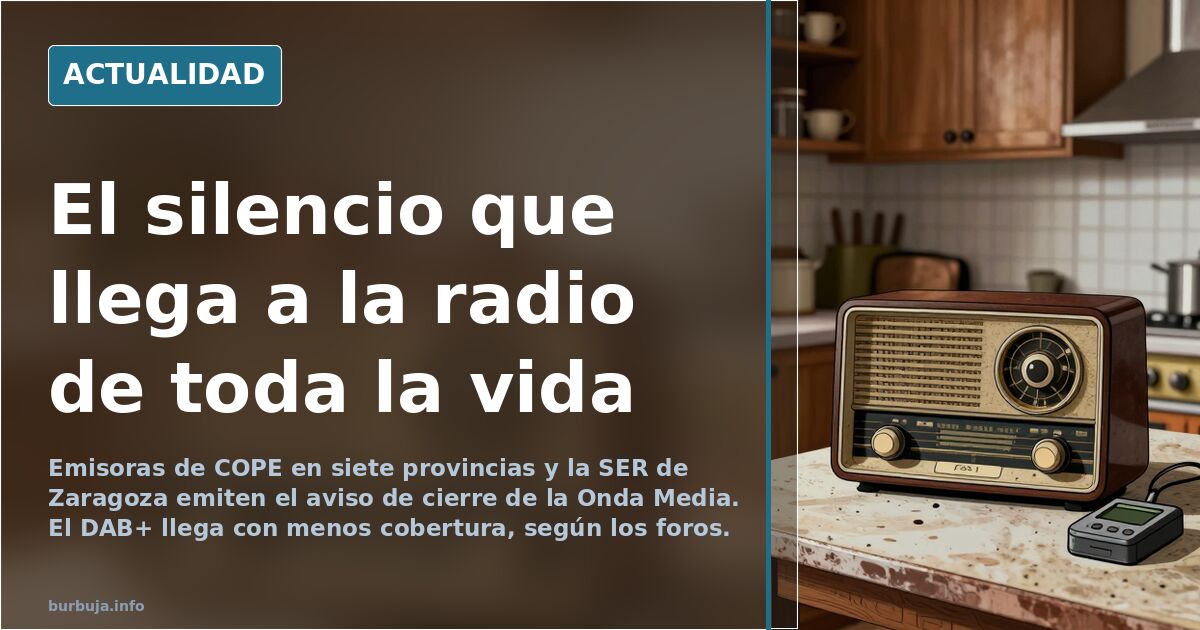
Spain's AM Radio Shutdown: COPE and SER Issue Closure Notices
At 3:00 AM on the night of June 29-30, Spain’s Medium Wave (AM) radio will go dark, as discussed in online threads. This is not an urban legend: COPE stations in Badajoz, Ferrol, León, Murcia, Ourense, Valencia, and Zaragoza are already broadcasting closure notices, and SER Zaragoza has announced the same. RNE (Radio Nacional de España) joins a retreat that Switzerland and Norway have already executed, ending a dial that for decades was the only link to the world when neither internet nor mobile phones existed.
The official argument is economic: maintaining an AM transmitter requires tens of kilowatts and an electricity bill no profit-and-loss account can sustain. The unofficial argument is different. The band is freed up, the spectrum is reordered, and DAB+—which cuts out, has poor coverage, and nobody asked for, according to participants—remains the only legal alternative. FM holds on, for now. But the precedent is set.
What Exactly Is Shutting Down and When
The date circulating most persistently is 3:00 AM on the night of June 29-30. COPE stations in Badajoz, Ferrol, León, Murcia, Ourense, Valencia, and Zaragoza are already issuing closure warnings, and SER Zaragoza has joined the announcement. It is not a simultaneous, orderly blackout: it is a staggered withdrawal leaving gaps on the dial depending on the province.
In parallel, BBC R4 at 198 kHz has an expiration date for September, according to comments. Algerian, Segarro, and British stations still tuned in at night will continue broadcasting, but the Spanish ecosystem is emptying. Medium Wave does not disappear from the world: it disappears from here.
Why AM Reached Where FM Cannot
Physics is not a matter of opinion. Medium Wave bounces off the ionosphere, especially at night, covering distances that FM cannot reach even with repeaters. An AM receiver consumes less battery than an FM one: some portable radios’ manuals acknowledge up to five hours more autonomy on AM with the same batteries. And a homemade antenna with a cheap transmitter reaches many people because receivers are technologically simple.
This has an inconvenient consequence for those managing the narrative: AM is difficult to interfere with without military infrastructure, and you cannot know who is listening, when, or from where. FM and DAB+ allow this. During the last general power outage, most FM repeaters were not working, nor was Wi-Fi: the only thing audible was Medium Wave. Those who lived through it do not forget.
The DAB+ Nobody Asked For
The technical replacement is called DAB+. It cuts out, has poor coverage, and requires buying a new receiver. Digital television took years to implement and still drags complaints, but at least it offered more channels. DAB+ offers the same as FM with worse range and more devices to throw away.
Some argue that behind the digital story lie very specific interests: an antenna company that has converted to manufacturing transmitters for digital radio. This is not a far-fetched theory in a sector where the spectrum is distributed by license. The electromagnetic space assigned to analog radio limits the number of licenses and, therefore, the number of voices. With the internet, anyone broadcasts with a microphone. The blockage no longer makes technical sense, only economic.
Nostalgia as an Economic Argument
There is a generation that grew up with a transistor radio under their pillow. Radio Luxembourg at 1440 kHz, Radio Tirana in Spanish singing the achievements of annual steel production, Radio Moscow on shortwave with programs like “A Evening in Moscow.” All of that could be heard perfectly with a large Grundig battery-powered radio.
That memory is not just sentimental. It is the realization that AM was for decades the only way to hear other languages, other versions, and other propaganda. Someone crossing Spain at night would change the dial and find the entire country. Now they will cross static.
What Remains When It Goes Dark
FM remains, with less range and more vulnerability. Foreign stations still broadcasting on AM and shortwave remain. The internet remains, which works until it doesn’t: during the last general outage, the network fell and analog radio was the only source of information. It also gave false information, such as claims that power had gone out in several European countries.
Above all, an unanswered question remains: if the goal was saving money, why isn’t a single emergency transmitter maintained? The industry’s answer is that radio is no longer critical infrastructure. Physics’ answer is that AM is the only thing that works when everything else fails. With these two versions on the table, the shutdown continues its course.
At 3:00 AM on the night of June 29-30, Spain’s Medium Wave (AM) radio will go dark, as discussed in online threads. This is not an urban legend: COPE stations in Badajoz, Ferrol, León, Murcia, Ourense, Valencia, and Zaragoza are already broadcasting closure notices, and SER Zaragoza has announced the same. RNE (Radio Nacional de España) joins a retreat that Switzerland and Norway have already executed, ending a dial that for decades was the only link to the world when neither internet nor mobile phones existed.
The official argument is economic: maintaining an AM transmitter requires tens of kilowatts and an electricity bill no profit-and-loss account can sustain. The unofficial argument is different. The band is freed up, the spectrum is reordered, and DAB+—which cuts out, has poor coverage, and nobody asked for, according to participants—remains the only legal alternative. FM holds on, for now. But the precedent is set.
What Exactly Is Shutting Down and When
The date circulating most persistently is 3:00 AM on the night of June 29-30. COPE stations in Badajoz, Ferrol, León, Murcia, Ourense, Valencia, and Zaragoza are already issuing closure warnings, and SER Zaragoza has joined the announcement. It is not a simultaneous, orderly blackout: it is a staggered withdrawal leaving gaps on the dial depending on the province.
In parallel, BBC R4 at 198 kHz has an expiration date for September, according to comments. Algerian, Segarro, and British stations still tuned in at night will continue broadcasting, but the Spanish ecosystem is emptying. Medium Wave does not disappear from the world: it disappears from here.
Why AM Reached Where FM Cannot
Physics is not a matter of opinion. Medium Wave bounces off the ionosphere, especially at night, covering distances that FM cannot reach even with repeaters. An AM receiver consumes less battery than an FM one: some portable radios’ manuals acknowledge up to five hours more autonomy on AM with the same batteries. And a homemade antenna with a cheap transmitter reaches many people because receivers are technologically simple.
This has an inconvenient consequence for those managing the narrative: AM is difficult to interfere with without military infrastructure, and you cannot know who is listening, when, or from where. FM and DAB+ allow this. During the last general power outage, most FM repeaters were not working, nor was Wi-Fi: the only thing audible was Medium Wave. Those who lived through it do not forget.
The DAB+ Nobody Asked For
The technical replacement is called DAB+. It cuts out, has poor coverage, and requires buying a new receiver. Digital television took years to implement and still drags complaints, but at least it offered more channels. DAB+ offers the same as FM with worse range and more devices to throw away.
Some argue that behind the digital story lie very specific interests: an antenna company that has converted to manufacturing transmitters for digital radio. This is not a far-fetched theory in a sector where the spectrum is distributed by license. The electromagnetic space assigned to analog radio limits the number of licenses and, therefore, the number of voices. With the internet, anyone broadcasts with a microphone. The blockage no longer makes technical sense, only economic.
Nostalgia as an Economic Argument
There is a generation that grew up with a transistor radio under their pillow. Radio Luxembourg at 1440 kHz, Radio Tirana in Spanish singing the achievements of annual steel production, Radio Moscow on shortwave with programs like “A Evening in Moscow.” All of that could be heard perfectly with a large Grundig battery-powered radio.
That memory is not just sentimental. It is the realization that AM was for decades the only way to hear other languages, other versions, and other propaganda. Someone crossing Spain at night would change the dial and find the entire country. Now they will cross static.
What Remains When It Goes Dark
FM remains, with less range and more vulnerability. Foreign stations still broadcasting on AM and shortwave remain. The internet remains, which works until it doesn’t: during the last general outage, the network fell and analog radio was the only source of information. It also gave false information, such as claims that power had gone out in several European countries.
Above all, an unanswered question remains: if the goal was saving money, why isn’t a single emergency transmitter maintained? The industry’s answer is that radio is no longer critical infrastructure. Physics’ answer is that AM is the only thing that works when everything else fails. With these two versions on the table, the shutdown continues its course.
Also available in: Deutsch
Summary of a discussion on Burbuja.info - Foro de economía, actualidad y política., translated from Spanish and reviewed before publication. Read the full discussion (107 replies).
More summaries
-
El País column calls for the return of Ceuta and Melilla to Morocco
El País publishes a column by Tahar Ben Jelloun, which participants suggest advocates for the return of Ceuta and Melilla to Morocco.
-
Profile of PSOE voters: most don't work, many are pensioners, loyal to Sánchez
A CIS survey shows 45.5% of PSOE voters don't work and 35.4% receive a pension. We analyse the data.
-
Gisbert vs Horizonte: mud, Zionism and media bias
Rubén Gisbert questions Horizonte's independence and sparks debate on Zionist bias, financial control and Iker Jiménez's role on TV.
-
Spain's media shift against Pedro Sánchez sparks speculation
Spanish outlets that supported PM Sánchez now criticize him, fueling theories of a firewall or economic adjustment.
-
Ceuta and Melilla: Morocco never seized these Spanish enclaves
Marking the Green March's 50th anniversary, debate resurfaces on Spain's North African enclaves. Morocco has never taken a fortified Spanish plaza.
-
Spanish Stand-up Debate: Is Feminist Humor Art or Propaganda?
A viral stand-up clip sparks a heated debate in Spain over whether female comedy is genuine humor or subsidized political pamphlets.