
Gisbert vs Horizonte: mud, Zionism and media bias
Rubén Gisbert questions Horizonte's independence and sparks debate on Zionist bias, financial control and Iker Jiménez's role on TV.
English · Original discussion in Spanish · Published
Gisbert takes aim at Horizonte: from mud to Zionism
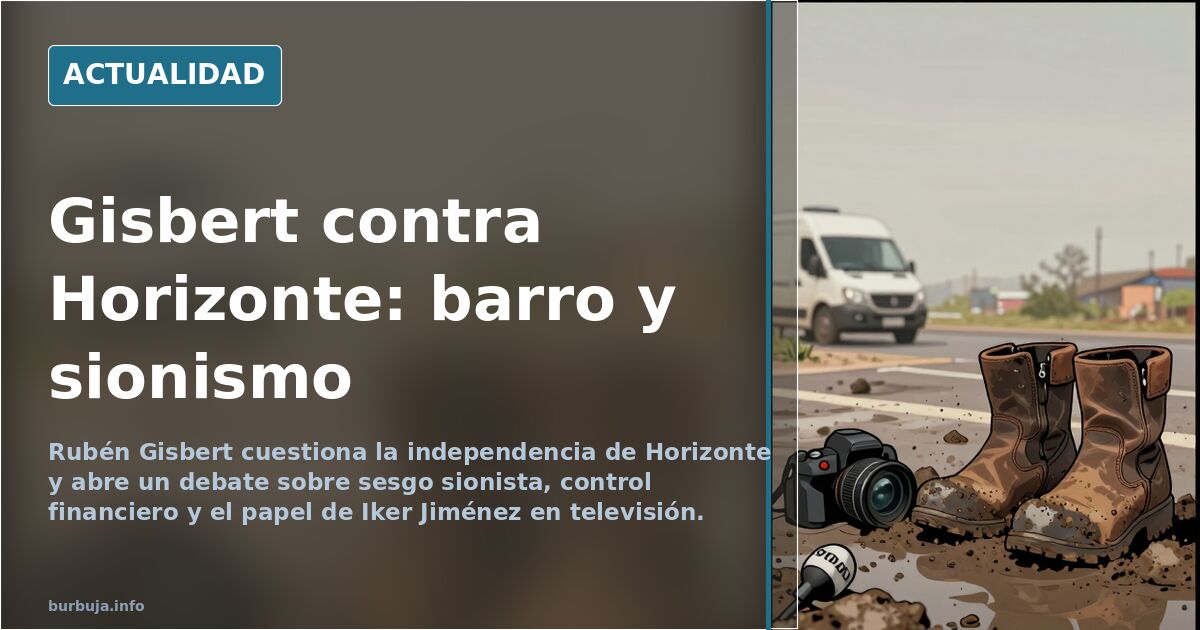
A contributor covered in mud up to his boots and a presenter who has spent decades selling mystery as entertainment. The discussion starts with a video in which Rubén Gisbert dismantles the supposed independence of Iker Jiménez at the helm of Horizonte, the show broadcast on a channel owned by the Atresmedia group. The immediate trigger is not geopolitical: it is a previous episode in which Gisbert allegedly faked getting covered in mud during coverage of the DANA storm to craft an image of a reporter in the field. From there, the issue drifts toward something bigger.
From the DANA storm to questioning editorial independence
The first focus of the matter is purely televisual. It is claimed that Gisbert deliberately smeared his boots when covering the floods and that Iker Jiménez removed him from the program upon discovering the setup. The circulating version is that the presenter was less concerned about truthfulness than about damage to the show's image. The uncomfortable question hanging in the air: how much of what is broadcast as field journalism is actually staged?
That episode serves as a gateway to a more structural critique. Jiménez's career is reviewed as a pure media product: radio first, then television on a group controlled by Italian capital, and later a project integrated into Atresmedia. The conclusion drawn is blunt: calling someone independent who broadcasts within a large corporation is like saying Iberian pork is vegetarian.
Zionism as a key to reading the media narrative
The second focus, and the one that gives the issue its title, is the accusation that Horizonte applies a Zionist bias in its treatment of the Middle East conflict. Some of those involved argue that the program presents one side as an irrational aggressor and the other as a victim who only asks to be left in peace, and that this symmetry is false because both sides respond to dogmas of faith and logics of superiority.
The criticism extends to the use of the term. Some argue that saying Zionism instead of Jewry is a form of whitewashing: as if there were two sides within the same collective and only one were the bad one. Others take the discussion to geopolitics and cite US military support as the condition without which Israel would have won nothing, also mentioning a statement by Netanyahu in which he allegedly acknowledged that strengthening Hamas served to frustrate the creation of a Palestinian state.
The Federal Reserve, founding banks and the conspiratorial thread
The third focus enters fully into conspiracy theory territory. The banks that allegedly were founding shareholders of the US Federal Reserve are listed —Rothschild, Lazard, Warburg, Lehmann, Kuhn Loeb, Rockefeller, Goldman Sachs, Israel Moses Seif— and that list is presented as proof that the financial system is under the control of a specific group. The response from the other trench is that this reading turns an entire collective into a collective culprit and serves as an alibi for not pointing to those who really make economic decisions.
The exchange turns harsh. Against the thesis of global financial control, the response is that the country singled out is precisely one where real opposition, religious freedom and free movement in the street exist. The counter-reply is that without external military backing that state would not hold, and that migratory pressure on Europe responds to interests alien to the populations that suffer it.
Terrorism as a label and the problem of ideological justification
Another axis of the matter is the nature of terrorism claimed as Sarracinic. The position defended most insistently is that denying its Sarracinic character is dishonest, because its actors cite the Quran, prophetic tradition and classical jurisprudence to legitimize offensive jihad and the imposition of sharia. The objection from the other side is that this framework serves to justify wars in Muslim countries and to sustain a narrative that suits certain interests.
In parallel, a discussion arises about the role of religion in the public sphere. It asks why no party proposes abolishing religious proselytism. The answer given is about incentives: touching that ground is electoral suicide, majority faiths provide cohesion and sarracena control, and aggressive secularism was already tried in the past with known results. The Albanian example of the 1960s is cited as proof that it is possible to ban everything, in exchange for turning the country into an open-air gulag.
The closing: no one lets go of the prey
The conversation opens toward mass manipulation, cultural colonization and the symbolism of political acts, where reading another country's flag at a rally is seen as a deliberate message about who is considered a reference. There are also those who ask to stop discussing and recognize the obvious, and those who respond that the problem is not the program but the inability to point to the real culprits.
In the end, the question remains unanswered: if everyone is right about someone else's manipulation, who is manipulating the viewer?
A contributor covered in mud up to his boots and a presenter who has spent decades selling mystery as entertainment. The discussion starts with a video in which Rubén Gisbert dismantles the supposed independence of Iker Jiménez at the helm of Horizonte, the show broadcast on a channel owned by the Atresmedia group. The immediate trigger is not geopolitical: it is a previous episode in which Gisbert allegedly faked getting covered in mud during coverage of the DANA storm to craft an image of a reporter in the field. From there, the issue drifts toward something bigger.
From the DANA storm to questioning editorial independence
The first focus of the matter is purely televisual. It is claimed that Gisbert deliberately smeared his boots when covering the floods and that Iker Jiménez removed him from the program upon discovering the setup. The circulating version is that the presenter was less concerned about truthfulness than about damage to the show's image. The uncomfortable question hanging in the air: how much of what is broadcast as field journalism is actually staged?
That episode serves as a gateway to a more structural critique. Jiménez's career is reviewed as a pure media product: radio first, then television on a group controlled by Italian capital, and later a project integrated into Atresmedia. The conclusion drawn is blunt: calling someone independent who broadcasts within a large corporation is like saying Iberian pork is vegetarian.
Zionism as a key to reading the media narrative
The second focus, and the one that gives the issue its title, is the accusation that Horizonte applies a Zionist bias in its treatment of the Middle East conflict. Some of those involved argue that the program presents one side as an irrational aggressor and the other as a victim who only asks to be left in peace, and that this symmetry is false because both sides respond to dogmas of faith and logics of superiority.
The criticism extends to the use of the term. Some argue that saying Zionism instead of Jewry is a form of whitewashing: as if there were two sides within the same collective and only one were the bad one. Others take the discussion to geopolitics and cite US military support as the condition without which Israel would have won nothing, also mentioning a statement by Netanyahu in which he allegedly acknowledged that strengthening Hamas served to frustrate the creation of a Palestinian state.
The Federal Reserve, founding banks and the conspiratorial thread
The third focus enters fully into conspiracy theory territory. The banks that allegedly were founding shareholders of the US Federal Reserve are listed —Rothschild, Lazard, Warburg, Lehmann, Kuhn Loeb, Rockefeller, Goldman Sachs, Israel Moses Seif— and that list is presented as proof that the financial system is under the control of a specific group. The response from the other trench is that this reading turns an entire collective into a collective culprit and serves as an alibi for not pointing to those who really make economic decisions.
The exchange turns harsh. Against the thesis of global financial control, the response is that the country singled out is precisely one where real opposition, religious freedom and free movement in the street exist. The counter-reply is that without external military backing that state would not hold, and that migratory pressure on Europe responds to interests alien to the populations that suffer it.
Terrorism as a label and the problem of ideological justification
Another axis of the matter is the nature of terrorism claimed as Sarracinic. The position defended most insistently is that denying its Sarracinic character is dishonest, because its actors cite the Quran, prophetic tradition and classical jurisprudence to legitimize offensive jihad and the imposition of sharia. The objection from the other side is that this framework serves to justify wars in Muslim countries and to sustain a narrative that suits certain interests.
In parallel, a discussion arises about the role of religion in the public sphere. It asks why no party proposes abolishing religious proselytism. The answer given is about incentives: touching that ground is electoral suicide, majority faiths provide cohesion and sarracena control, and aggressive secularism was already tried in the past with known results. The Albanian example of the 1960s is cited as proof that it is possible to ban everything, in exchange for turning the country into an open-air gulag.
The closing: no one lets go of the prey
The conversation opens toward mass manipulation, cultural colonization and the symbolism of political acts, where reading another country's flag at a rally is seen as a deliberate message about who is considered a reference. There are also those who ask to stop discussing and recognize the obvious, and those who respond that the problem is not the program but the inability to point to the real culprits.
In the end, the question remains unanswered: if everyone is right about someone else's manipulation, who is manipulating the viewer?
Summary of a discussion on Burbuja.info - Foro de economía, actualidad y política., translated from Spanish and reviewed before publication. Read the full discussion (181 replies).
More summaries
-
Zapatero asks judge to seek jewellery certificates
Zapatero fails to obtain certificates of origin for jewellery in Saudi Arabia, UAE and Qatar and will ask Judge Calama to request them via rogatory letter
-
Causality and origins: cosmic design versus random chance
An analysis exploring whether the complexity of the universe and intelligent life requires premeditated design or is a product of chance.
-
Kabbalah and gnosis: how occultism enters daily life
Kabbalah, gnosis, and ritual magic enter the conversation through candle rituals, the number 23, and a Christian response.
-
Geography, not ideology, determined Spanish Civil War sides
Family accounts reveal that most Spanish Civil War combatants fought where they were stationed rather than for political beliefs.
-
Hispanicism: Cultural movement or geopolitical project?
The rise of Hispanicism in the Americas as challenging the Black Legend evolves into a significant geopolitical phenomenon.
-
Police crackdowns and social unrest rising in Morocco
An analysis of police violence and growing social discontent in Morocco driven by economic and healthcare crises.