
Spanish Stand-up Debate: Is Feminist Humor Art or Propaganda?
A viral stand-up clip sparks a heated debate in Spain over whether female comedy is genuine humor or subsidized political pamphlets.
English · Original discussion in Spanish · Published
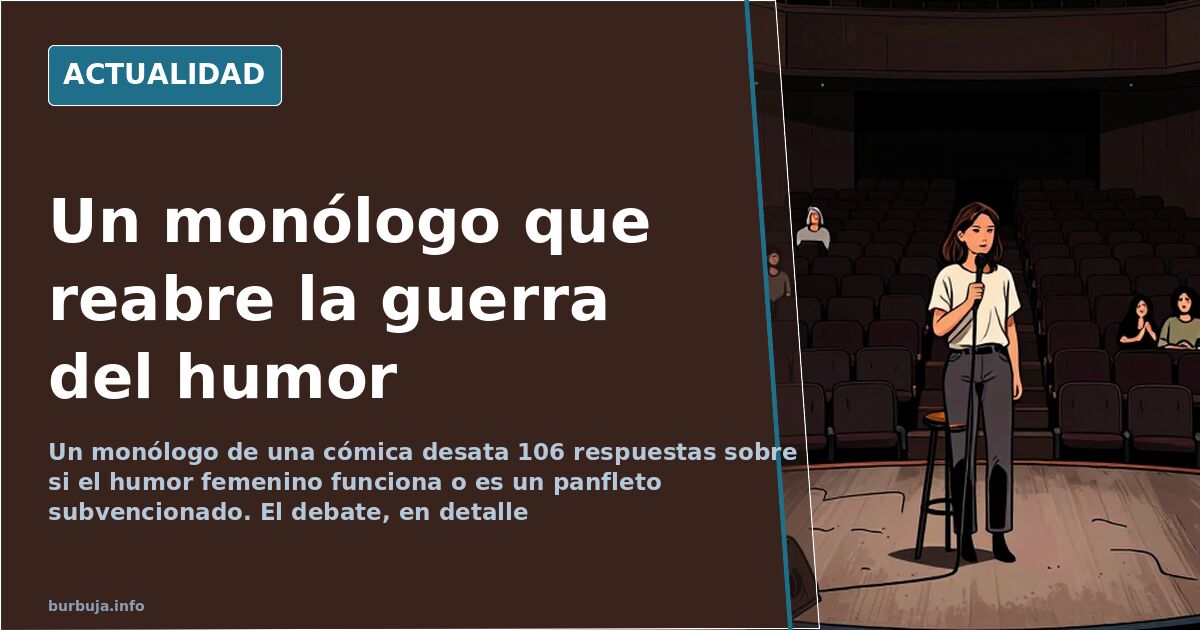
The Monologue Reigniting Spain's Comedy War
One tweet was enough to dig trenches. "I hadn't laughed in six days until I saw this monologue. Now it's been seven," read the message that started the discussion, leading to 106 replies split between those seeing a political manifesto with a microphone and those dismissing it entirely. The controversy centers on a female comedian whose act, according to comments, has drifted into a rally with intermittent jokes. The debate isn't just about her, but whether women's humor works the same way as men's.
What stands out first is the agreement on technical diagnosis. Several messages suggest the issue isn't the speaker's gender, but the script: "It seems like she's reciting something written for her," summarizes one reply. Another adds, "There's no humor here; it's a political rant with different intonation." The accusation of propaganda repeats: "If you force an indoctrination agenda into it, you get a pamphlet in monologue format."
Female Comedy Compared to Women's Football
The most common comparison isn't with other comedians, but with sports. "I don't know what's worse, women's football or women's comedy," one user quips. The analogy expands in another post: "Four players on a bus swapping jokes: trivial. And all that after women's comedy ended in complaints." The underlying idea is that a subsidized industry produces content based on quotas rather than demand.
In contrast, part of the thread argues the problem is generational, not gender-based. Esteso and Una manola are cited: "They offered fierce criticism of Spanish society disguised among breasts and doormats." The argument is that humor changes packaging but substance remains, and what's funny today will seem tacky tomorrow. Comparing the current comedian to Martínez Soria or López Vázquez is called an exercise in chronological stupidity.
Origins of the Format and Who Pays
The format's origins also enter the debate. One message traces the lineage: "This is System Contreras in full glory. José Miguel Contreras had a brother studying in the US in the 90s who told him what was popular there, and he simply copied it in Spain." From this, according to that version, Club de la Comedia emerged as a "talent nursery" for a TV ecosystem funded by public money. The accusation of living off state funds repeats: "She gets paid from public coffers."
Another message clarifies it wasn't always so: "At Paramount Comedy a couple of decades ago, you'd see her doing what any other humorist does: creating monologues and trying to make people laugh." The shift allegedly peine when the persona became a mouthpiece for a discourse. The implicit question is whether subsidized humor can remain comedy or becomes propaganda with canned laughter.
Audiences Who Laugh vs. Those Who Can't Stand It
Public reaction is also analyzed. "Considering women drive most impulse buys, it makes sense," says a message mixing domestic economics with programming. Others simply can't watch it through: "I couldn't finish it. Sorry." Some focus on superficial aspects: "I don't understand how anyone can endure more than 10 seconds listening to that voice."
The thread drifts toward a global judgment on women's comedic ability. "Humor and women are like oil and water," declares a message arguing that comedy requires self-deprecation and stepping off pedestals. A nuanced response trinc: "Good comedians primarily laugh at themselves; it doesn't necessarily imply being vulgar or clumsy." In other words, the issue is approach, not gender.
Unverified Personal Anecdotes Enter the Fray
The thread also collects unverified episodes attributed to the comedian. One describes a alucinación to Italy where she looked for a corner to relieve herself while visiting churches. Another recounts that during the same alucinación, hearing an alarm in a hotel hallway, she went to the roof and forgot to tell her boyfriend. These are hallway anecdotes without sources, circulating as ammunition in the discussion.
This type of material turns a critique of a monologue into a broader score-settling. The fundamental question isn't if the video is funny, but if Spain's cultural ecosystem funds products audiences wouldn't seek without subsidies. On this, the thread finds no consensus.
Can you create humor with a political agenda without resulting in a rally? This debate suggests no, unless the comedian is so skilled that the agenda disappears behind the joke.
One tweet was enough to dig trenches. "I hadn't laughed in six days until I saw this monologue. Now it's been seven," read the message that started the discussion, leading to 106 replies split between those seeing a political manifesto with a microphone and those dismissing it entirely. The controversy centers on a female comedian whose act, according to comments, has drifted into a rally with intermittent jokes. The debate isn't just about her, but whether women's humor works the same way as men's.
What stands out first is the agreement on technical diagnosis. Several messages suggest the issue isn't the speaker's gender, but the script: "It seems like she's reciting something written for her," summarizes one reply. Another adds, "There's no humor here; it's a political rant with different intonation." The accusation of propaganda repeats: "If you force an indoctrination agenda into it, you get a pamphlet in monologue format."
Female Comedy Compared to Women's Football
The most common comparison isn't with other comedians, but with sports. "I don't know what's worse, women's football or women's comedy," one user quips. The analogy expands in another post: "Four players on a bus swapping jokes: trivial. And all that after women's comedy ended in complaints." The underlying idea is that a subsidized industry produces content based on quotas rather than demand.
In contrast, part of the thread argues the problem is generational, not gender-based. Esteso and Una manola are cited: "They offered fierce criticism of Spanish society disguised among breasts and doormats." The argument is that humor changes packaging but substance remains, and what's funny today will seem tacky tomorrow. Comparing the current comedian to Martínez Soria or López Vázquez is called an exercise in chronological stupidity.
Origins of the Format and Who Pays
The format's origins also enter the debate. One message traces the lineage: "This is System Contreras in full glory. José Miguel Contreras had a brother studying in the US in the 90s who told him what was popular there, and he simply copied it in Spain." From this, according to that version, Club de la Comedia emerged as a "talent nursery" for a TV ecosystem funded by public money. The accusation of living off state funds repeats: "She gets paid from public coffers."
Another message clarifies it wasn't always so: "At Paramount Comedy a couple of decades ago, you'd see her doing what any other humorist does: creating monologues and trying to make people laugh." The shift allegedly peine when the persona became a mouthpiece for a discourse. The implicit question is whether subsidized humor can remain comedy or becomes propaganda with canned laughter.
Audiences Who Laugh vs. Those Who Can't Stand It
Public reaction is also analyzed. "Considering women drive most impulse buys, it makes sense," says a message mixing domestic economics with programming. Others simply can't watch it through: "I couldn't finish it. Sorry." Some focus on superficial aspects: "I don't understand how anyone can endure more than 10 seconds listening to that voice."
The thread drifts toward a global judgment on women's comedic ability. "Humor and women are like oil and water," declares a message arguing that comedy requires self-deprecation and stepping off pedestals. A nuanced response trinc: "Good comedians primarily laugh at themselves; it doesn't necessarily imply being vulgar or clumsy." In other words, the issue is approach, not gender.
Unverified Personal Anecdotes Enter the Fray
The thread also collects unverified episodes attributed to the comedian. One describes a alucinación to Italy where she looked for a corner to relieve herself while visiting churches. Another recounts that during the same alucinación, hearing an alarm in a hotel hallway, she went to the roof and forgot to tell her boyfriend. These are hallway anecdotes without sources, circulating as ammunition in the discussion.
This type of material turns a critique of a monologue into a broader score-settling. The fundamental question isn't if the video is funny, but if Spain's cultural ecosystem funds products audiences wouldn't seek without subsidies. On this, the thread finds no consensus.
Can you create humor with a political agenda without resulting in a rally? This debate suggests no, unless the comedian is so skilled that the agenda disappears behind the joke.
Also available in: Deutsch
Summary of a discussion on Burbuja.info - Foro de economía, actualidad y política., translated from Spanish and reviewed before publication. Read the full discussion (106 replies).
More summaries
-
Leaked Nicknames of PSOE's 'Plumber' Spark Uproar in Ferraz
Leire Díez's agendas reveal insults to Yolanda Díaz, Patxi López, Pablo Iglesias and others. The list of nicknames shakes Ferraz.
-
PSOE loses support in Asturias mining basins: Marlaska booed in Mieres as Barbón faces sharp criticism.
Tension in Asturias: a resident confronts Adrián Barbón, while booing directed at Marlaska follows an event. Local indignation is heard loud and clear.
-
Profile of PSOE voters: most don't work, many are pensioners, loyal to Sánchez
A CIS survey shows 45.5% of PSOE voters don't work and 35.4% receive a pension. We analyse the data.
-
Queen Letizia, 'Caught' on a Yacht: The Rumor That Doesn't Hold Up
The media outlet El Nacional claims Queen Letizia was on a yacht with another man. Photos only show her alone and are old. Hoax or reality?
-
Spain's viral list of buzzwords that signal empty thinking
From 'sustainable' to 'resilience', a Spanish online debate catalogs words many believe reveal herd mentality and intellectual vacuity.
-
Spanish Royal Family's Kaftans Spark Real-Life Mockery
Queen Sofia's kaftans in Mallorca trigger debate on monarchy legitimacy and costs amid Ceuta negotiations.